Independent comparisons. We may earn from shop links. More info

Liquid vs Granular Fertiliser for Pots, Baskets and Beds

Updated: October 2026

You planted a hanging basket in late May, the compost already held a starter feed, and by late June the leaves look paler than on the day you hung it. Liquid vs granular fertiliser is the choice on the potting bench: a bottle you measure into the watering can, or granules that claim to last the season. Use a liquid if you will measure it while you water, a coated granule if you will not, and ordinary granules on beds. Prices and stars for the six amazon.co.uk listings are on the [universal fertiliser comparison](/hub/fertiliser-soil-and-bark-mulch/universal-fertiliser). We did not run a lab test. A qualifying purchase can earn a commission at no extra cost to you.

You planted a hanging basket in late May, the compost already held a starter feed, and by late June the leaves look paler than on the day you hung it.

Our top picks

On this page

Pots run out of starter feed within weeks

A new pot does not stay fed all summer because the compost looked rich on planting day. Which? says a compost starter feed often lasts about three to four weeks, a controlled-release fertiliser is typically about four months, and its own Best Buys lasted longer than that typical figure. The public text does not name the packs below as those Best Buys. The RHS points you to a liquid for bedding and edible plants in containers, and to a controlled-release feed for a shrub that stays in one pot for years. Once that late-May basket has used its starter charge, you either measure a liquid when you fill the can, or you rely on granules mixed in on planting day.

Choose a liquid when you will remember the can

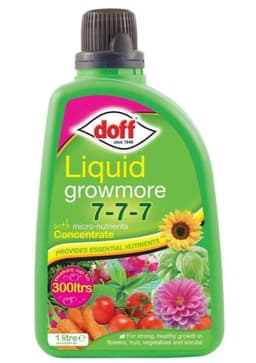
A liquid works quickly, and it stops when you stop measuring. The Miracle-Gro label for model 121175 is 7-3-5 at half a cap per litre, so a 10-litre can takes five caps, with a quarter cap for small or young plants. The listing prints no NPK. Doff's listing shows 7:7:7 and 1:466, while Doff's page says 1 litre makes up to 300 litres, so follow the bottle you receive. If the July can is only plain water, a coated granule is what still feeds the basket.
Doff Doff Liquid Growmore 1 L

Testsieger

Doff Doff Liquid Growmore 1 L
7.6/10about £6.55

Choose coated granules when you will not

The RHS defines a controlled-release fertiliser as coated inorganic granules and names Miracle-Gro All Purpose Continuous Release beside Osmocote. This listing is two 900 g tubs at £11.94, rated 4.6 from 2,641 reviews, mixed in at the start of spring. It claims one application feeds the season, which suits a basket you will forget. Goulding at £9.39 and Westland Boost at £11.64 both claim about six months, with no NPK and no sign of Miracle-Gro's coating. Beds need a different granule again.

Ordinary granules are the bed tool

Westland's own Growmore is hoed in about every four to six weeks from February to the end of October, while Vitax publishes about eight to ten weeks. Westland's vegetable rate is 135 g per square metre before planting and 70 g per square metre as a top dressing. Keep that interval and those grams on Westland's own Growmore. Westland Boost, the slow-release pack above, is a different product. Topline Growmore is 8 kg at £23.99, rated 4.5 from 136 reviews. A UK reviewer says the tub reads 7-7-7, against an Amazon field of 20:20:20, so the analysis is unsettled. It earns its place on a dug bed or in a planting hole. Tomatoes, dose and the label are on the all-purpose fertiliser for vegetables, how to use all-purpose fertiliser and all-purpose fertiliser buying guide pages.

Common questions

Which form suits a basket you will forget to feed?
A coated granule, mixed in at planting, suits a basket you will water and then forget. In this set that is Miracle-Gro Continuous Release, whose listing claims one spring application for the season. Which? still treats the category as typically about four months, so flowers into autumn may need a liquid from mid to late August.
Which form if you already water every week?
Use a liquid in the can you are already filling. The Miracle-Gro label for model 121175 is half a cap per litre at standard strength. Doff Liquid Growmore is the best value on shelf price at £6.55 if you follow the bottle rather than a review. Plain water is not a feed, so the liquid loses to a coated granule as soon as you stop measuring.
Are Goulding granules the same as Miracle-Gro continuous release?
No. The RHS describes Miracle-Gro All Purpose Continuous Release as a coated inorganic granule, beside Osmocote. Goulding and Westland Boost each claim about six months and print no NPK. Read the tub before you treat slow release as one shared recipe.
Do the plastic coatings disappear from the soil?
We cannot say that they do. One buyer of the Miracle-Gro continuous-release pack says the pellets look like resin or plastic and do not break down, and returned the tub. That is a single review, and it is not a laboratory result. A liquid avoids a coating, though you then have to remember the can.
Is a liquid always more expensive per pot?
Shelf price says no. Doff is £6.55 for 1 litre and the coated Miracle-Gro twin pack is £11.94. Which? found its own top liquid at about £3.20 per pot, against about 42p for its top controlled-release feed. Those sums are Which? products, so they are not a cost per pot for the packs here.
When do ordinary Growmore granules beat liquid and coated feed?
They suit a dug bed or a planting hole that you will hoe on a calendar. Topline's listing says every four to six weeks from February to the end of October, and it prints no grams per square metre. They are a poor fit for a hanging basket you cannot cultivate. Leave Westland's 135 g per square metre on Westland's own Growmore.
Can you add a liquid if the coating runs out?
Yes, as a measured top-up, and not as another dose of granules. Which? suggests a liquid every two weeks from mid to late August if you want flowers into autumn, after a controlled-release feed mixed in at planting. That is category advice. The Miracle-Gro listing still claims one spring application, so read the pack before you add anything.

Related pages

Sources

Public UK and manufacturer sources used for this comparison; last accessed 15 October 2026.

  1. RHS: Fertilisers (retrieved 15 October 2026)
  2. RHS: Nutrition and feeding plants (retrieved 15 October 2026)
  3. RHS: Fertiliser labels explained (retrieved 15 October 2026)
  4. GOV.UK: Manufacturing and marketing fertilisers (retrieved 15 October 2026)
  5. The Fertilisers Regulations 1991 (retrieved 15 October 2026)
  6. Miracle-Gro All Purpose Concentrate label 121175 (retrieved 15 October 2026)
  7. Which?: Controlled-release fertilisers (retrieved 15 October 2026)
  8. NHS: Poisoning (retrieved 15 October 2026)