How to use a cordless drill
You have the drill out for a hinge or a shelf, the collar is a ring of numbers, and the charger is easy to leave on overnight. This is how to use a cordless drill: set the mode before the trigger, and charge the pack where you can see it. The steps are the same whether the motor is brushless. The [Brushless cordless drill comparison](/hub/drilling-and-accessories/brushless-cordless-drill) is for choosing a different tool. This page does not rank the ten listings. Listings from 19 October 2026 were used, plus Electrical Safety First, the National Fire Chiefs Council and the London Fire Brigade. A qualifying purchase can earn a commission at no extra cost to you.
You have the drill out for a hinge or a shelf, the collar is a ring of numbers, and the charger is easy to leave on overnight.
You have the drill out for a hinge or a shelf, the collar is a ring of numbers, and the charger is easy to leave on overnight. This is how to use a cordless drill: set the mode before the trigger, and charge the pack where you can see it. The steps are the same whether the motor is brushless. The Brushless cordless drill comparison is for choosing a different tool. This page does not rank the ten listings. Listings from 19 October 2026 were used, plus Electrical Safety First, the National Fire Chiefs Council and the London Fire Brigade. A qualifying purchase can earn a commission at no extra cost to you.
Our top picks
| Badge | Product | Clutch | Speeds | Hammer | Note | Price | Offer |
|---|---|---|---|---|---|---|---|
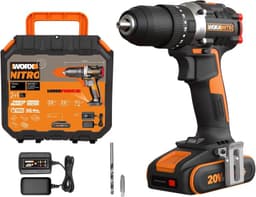
| Best overall |  WORX WORX WX355.1 20V brushless combi, 55 Nm | 20+1+1 | 0–500 and 0–2,100 rpm | Impact drill stated | 9.1 | about £89.00 | View offer |
| Best value |  LEEIKOO LEEIKOO 21V brushless hammer drill, two 2.0 Ah batteries | 20+3 title, 20 in bullets | 0–550 and 0–1,850 rpm | Screw, drill and hammer | 9.2 | about £32.20 | View offer |
 Ginour Ginour 21V brushless combi drill, two 2.0 Ah batteries | 23+3 on the listing | 0–450 and 0–1,450 rpm | Stated for masonry | 9.6 | about £55.99 | View offer |


On this page
Clutch, gears and the trigger
Bits and the workpiece
Charging the battery
When you stop
Common questions
What do the numbers behind the chuck do?
When do you use gear 1, and when gear 2?
Can you change gear while the chuck is spinning?
Which bit is for wood, metal and brick?
How do you charge the pack without leaving it overnight?
What do you do if the pack is swollen, hot or smelling?
When should you stop and call a professional?
Related pages
Sources
Public UK sources from the research digest, last checked on 19 October 2026. Shelf prices and star lines are the amazon.co.uk figures in the display file.
- Which?: how to buy the best cordless drill (retrieved 19 October 2026)
- BSI: BS EN 62841-2-1 hand-held drills and impact drills (retrieved 19 October 2026)
- GOV.UK: Electrical Equipment (Safety) Regulations 2016 (retrieved 19 October 2026)
- HSE: hand-arm vibration responsibilities (retrieved 19 October 2026)
- Control of Vibration at Work Regulations 2005 (retrieved 19 October 2026)
- HSE: PUWER overview (retrieved 19 October 2026)
- NFCC: lithium-ion batteries (retrieved 19 October 2026)
- London Fire Brigade: batteries and chargers (retrieved 19 October 2026)