





First-time tiler
You want a complete clip-and-wedge kit with pliers, not a steel pin to unscrew the same afternoon. Rezolite includes 500 bases, 100 wedges, and pliers, for tiles stated at 3–16 mm on a 2 mm joint.
The best tile levelling systems, compared.
Top pick: Bihui TSL50 tile levelling system Best value: Fleetise 100-piece tile levelling system – Highest value block at about £12.95, 4.4 from 507 reviews, tiles stated up to 14 mm, spacers not included. Updated October 2026.


A tile levelling system holds neighbouring tiles in one plane while the adhesive cures, so the finished edge has less lippage. On amazon.co.uk the ten kits here are clip-and-wedge, spin or twist-cap, or reusable steel-needle tools, bought mainly for a bathroom, a kitchen, or a porcelain patio. You judge a kit by joint width, the stated tile thickness, and whether the wedges, caps, or needles and the pliers are actually in the box. Wedges, spin caps, and steel needles are sold as reusable, but steel has to come out before the adhesive locks it. A bag of clips with wedges and pliers not included is a refill, not a system. Stars and counts are the UK listing lines. Joint, thickness, and a rough quantity are in the [tile levelling system buying guide](/hub/cutting-tools/tile-levelling-system/sub/tile-levelling-system-buying-guide). Clip-and-wedge uses a disposable base, a reusable wedge, and usually pliers.
A tile levelling system holds neighbouring tiles in one plane while the adhesive cures, so the finished edge has less lippage.

36 products checked · 58 hrs invested · +21,400 readers
Swipe for more
1-2 of 10


Personal buying guide
Question 1 of 2
What are you tiling?
The Bihui TSL50 is a reusable tile levelling system at £23.67, and the UK reviews describe pulling tiles into plane and then taking the clips back out of the thin-set. The listing is rated 4.9 from 39 reviews, the highest star line in this set, from a much smaller count than the kits above 500 reviews. The page does not state the mechanism, the joint, the tile thickness or how many pieces are in the box. In the 10 UK reviews, people praise daily reuse, a second box after the first, and pins that are cheap to renew. One reviewer says the clips came out after 24 hours, where a plastic system had left a stem under the tile, and notes that separate spacers are still required. Take them out before the adhesive goes off too far, or they are hard to extract. No review gives a thickness, a joint width or a tile size that failed.
Pros
Cons
Best for: A reusable clip when you already have spacers and you do not need a printed joint or thickness before you buy.
Less suitable: A buy that needs a stated joint, a thickness band or a piece count on the listing.
Specifications
Common questions
What size of tile is the Bihui TSL50 listing for?
The listing does not state a joint width or a tile thickness. The bullets do not name a tile type.
How many pieces are in the box?
The title and the technical block do not give a piece count. Item package quantity is 1. The model and part number are TSL50.
What mechanism does the listing name?
The title says reusable. It does not say clip-and-wedge, spin cap, or steel needle, and it does not say whether a tool is included.
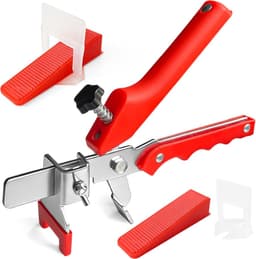
The Rezolite kit places a 2 mm base under the tile, pushes a 75 mm wedge in with the included pliers, and after about 24 hours you tap or kick the base off. The box is 500 bases, 100 wedges and one pair of pliers, for tiles stated at 3–16 mm, at £18.99. It is rated 4.5 from 27 reviews, a small sample beside the kits with several hundred reviews. UK reviewers who finished a job describe porcelain in two bathrooms with pieces left over, and one put the price under Wickes and B&Q. Those 2 mm bases were enough to keep the tiles aligned, and the pliers were called workable for a starter kit. Wedges collapse if you press them too hard, and the bases are single-use. On 20 × 20 cm floor tiles one reviewer found the tiles lifted when the plastic came out, stopped, and treated the kit as something for larger tiles only.
Pros
Cons
Best for: A bathroom or a larger-format floor on a 2 mm joint, where you can spare single-use bases.
Less suitable: 20 × 20 cm floor tiles, or a hard squeeze that crushes the wedge.
Specifications
Common questions
What is in the Rezolite 601-piece kit?
The bullet says five packs of 100 bases at 2.0 mm, one pack of 100 inserts at 75 mm, and one pair of pliers. Included components says 500 spacers, 100 reusable wedges, and pliers.
Which tile thickness does the listing state?
One bullet says tiles from 3 mm to 16 mm thick. The joint printed on the title and the item-thickness line is 2 mm.
What does the listing say about taking the clips out?
After the adhesive has dried, usually 24 hours, tap or kick off the base. The wedges and pliers are described as reusable.
The SHAFFER PRO 4 mm kit screws a reusable cap down onto a clip so neighbouring tiles sit in one plane while the adhesive sets. Across 1,509 amazon.co.uk reviews, rated 4.4, UK buyers describe outdoor porcelain, including 20 mm slabs at 600 × 900 mm and one patio of 70 slabs, plus floors and one wall. The listing states tiles from 3 to 22 mm, a 4 mm joint, 200 clips and 100 caps, and it names no pliers. A 2 mm joint is not what this box gives you. A share of clips do not snap at the break point: reviewers describe digging the stem out, a multi-tool at the tile edge, and chipped tiles when adhesive has packed around the peg. Over-tightening snaps the clip before the tile is level, and one job on 200 × 100 mm wall tiles pulled tiles off the wall when the stem was snapped. The caps are the part people keep, replacement clips are a separate buy, and several reviewers call the £35.89 price high even when they carry on using the kit.
Pros
Cons
Best for: A 4 mm joint on floor or patio porcelain, including slabs towards 20 mm, where you would rather screw a cap than squeeze a wedge.
Less suitable: A 2 mm joint, small wall tiles that can be pulled off the wall, or a job where you do not want to clear stems that stay in the joint.
Specifications
Common questions
What joint and tile thickness does the SHAFFER PRO listing state?
The title, model, and part number say 4 mm. The title also prints 5/32 inch. Two bullets and the title say tiles from 3 to 22 mm.
What is in the box?
The set name and the title say 200 clips and 100 reusable caps. Included components says clips and caps. Number of items is 300. No pliers or wrench is listed.
Does the listing say how the clips come off?
No. The bullets describe screwing the cap on. They do not give a wait time or a snap method.
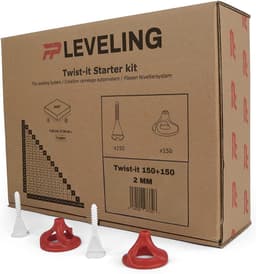
The Flat-Pro Twist-it kit sets a 2 mm joint by screwing a cap onto a clip by hand, with no pliers, on tiles the listing puts at 3–20 mm. It is rated 4.4 from 691 amazon.co.uk reviews. UK reviewers describe patio porcelain, including 20 mm tiles, 600 × 900 mm flags and 600 × 600 × 20 mm slabs, plus a first bathroom in 1,200 × 600 mm and a 750 × 750 mm ensuite. The box is 150 clips and 150 reusable caps, with a coverage claim of up to 16.5 m² of 900 × 600 mm slabs, so the clips are what you run out of once the caps are kept for the next job. On 20 mm work the threaded stem is described as short, about half the clips failed to snap in one porcelain job, and a 60 m² patio review says the clips did not break at the intended point. The listing excludes polished tiles and hand-cut natural stone; an 18 mm hand-cut slab did not work, and stems also snapped while being tightened on 15 mm limestone and on a paver one reviewer put at 22 kg. Adhesive left beside the clip makes the plastic break low in the thread, clearing a stuck stem can chip the tile, and the listing says you tap along the grout line after 12–24 hours, with extra clips at the corners of 20 mm outdoor slabs.
Pros
Cons
Best for: Large bathroom tiles or outdoor porcelain short of the 20 mm trouble zone, on a 2 mm joint, screwed on by hand.
Less suitable: 20 mm pavers, polished tiles, hand-cut stone, or a second large patio from the same 150 clips.
Specifications
Common questions
What joint and thickness does the Flat-Pro listing state?
The title and the size line say 2 mm. A bullet says tiles between 3 and 20 mm thick, with a 2 mm grout joint. Another bullet says to use extra clips on 20 mm outdoor slabs, especially at the corners.
Which tiles does the listing tell you to avoid?
Polished tiles, because they can be scratched, and hand-cut natural stone, which the bullet says usually needs joints of 10 mm or more.
How does the listing say to remove the clips?
Screw the caps on by hand. After 12–24 hours, tap along the grout line with a rubber mallet or a safety shoe. The caps are described as reusable.
The Fleetise kit pulls tiles into plane with a manganese-steel T-needle and a threaded cap, turned with one of two wrenches, rather than a snap-off wedge. The listing is rated 4.4 from 507 reviews, states tiles up to 14 mm, and puts 100 levellers, 10 spare needles and two wrenches in the box at £12.95. Spacers are not included, so the stated 2–6 mm joint only applies if you supply the spacer. UK reviewers describe taking the pins out the same day, washing them and reusing them, including a kitchen of about 10 m² and a job of nearly 20 m² with two broken pieces. They also report lippage control on slightly bent long tiles, a small lift on 600 × 600 mm floors, 600 × 300 mm bathroom porcelain, and wall tiles used with separate 3 mm spacers. Leave the needle overnight, or use quick-set adhesive, and it will not twist out. Some reviewers say the nut never got tight enough compared with a wedge clip, one called bevelled tiles unsuitable, and 20 mm porcelain was too thick until someone shortened the pin, which sits outside the stated 14 mm limit.
Pros
Cons
Best for: Floors up to 14 mm when you already own spacers and can take the needles out the same day.
Less suitable: Quick-set adhesive, porcelain around 20 mm, or a first kit that also needs the spacers supplied.
Specifications
Common questions
What thickness and joint does the Fleetise listing state?
Tile thickness up to 14 mm. The joint can be 2 mm to 6 mm if you change the tile spacer. The bullets do not include spacers in the 100-piece count.
What is in the box?
100 tile levellers, 2 wrenches, and 10 changeable T-needles. The needles are described as manganese steel.
Does the listing say when to remove the needles?
No. There is no snap-off step and no hour count. The needles are the reusable metal part. UK reviews describe taking them out the same day.
The LOLYSIC kit levels with a 1.4 mm steel T-needle and a screw-on cover, and the box includes the 2 mm spacers that many needle kits leave out. At £20.99 the bullet lists 200 levellers, four wrenches, 500 of 2 mm spacers and 100 replaceable needles, for tiles stated at 3–16 mm, and the listing is rated 4.3 from 70 reviews. UK reviewers describe a first bathroom as straightforward, use on 1,200 × 600 mm tiles, and walls on an uneven background, with several clips along a heavy tile. Spare needles earn their place: a few pins bent on the way out, and one kit would not lock because the metal anchors kept spinning. The plastic heads snap when the wrench is tightened hard. If a rod stays in after the adhesive has set it is stuck, one review reports rust marks in the grout, and the bottom part has to come out as soon as the adhesive has gone off.
Pros
Cons
Best for: A bathroom or 1,200 × 600 mm tiles inside the stated 3–16 mm band, when you want the spacers and the needles in the same box.
Less suitable: A job left overnight before the needles are removed, or a heavy hand on the wrench.
Specifications
Common questions
What joint and thickness does the LOLYSIC listing state?
The title includes 500 spacers at 2 mm (1/12 inch). A bullet says the 1.4 mm steel needle is for 1.5 mm to 2.5 mm spacers, and that the levellers suit tiles 3 mm to 16 mm thick.
Do the needles stay in the tile?
The listing does not say. The needles are steel, with 100 replacements in the bullet, so they are not described as a snap-off clip. The listing gives no wait time.
Why do the component lines disagree?
The bullet lists levellers, wrenches, 2 mm spacers, and T-needles. The included-components line names only tile leveller spacers and special wrenches.
The Fusion Bliss kit locks a stainless-steel T-needle under two tiles, you tighten the cap with a wrench, and the listing says to undo it after 4–6 hours. For £11.99 the box holds 100 levellers, 500 of 2 mm cross spacers and two wrenches, with joints stated from 2 mm to 8 mm, and tile thickness is not on the listing. It is rated 4.3 from 36 reviews, and several UK reviews describe the unopened box or a job still in progress rather than a cured floor. Where a floor was finished, 600 × 600 mm tiles were held while the adhesive set: one person used three clips on some edges and tightened fully only after four tiles were down. Removal is the weak point in the one detailed DIY account, with metal left pointing out of the joint, snapped pieces and chipped tiles. No second finished-job report in the UK sample confirms a clean pull-out.
Pros
Cons
Best for: A ceramic floor or a backsplash on the included 2 mm spacers, if you can take the needles out the same afternoon.
Less suitable: A job that needs a stated thickness limit, or a floor where a stuck needle would chip the edge.
Specifications
Common questions
What joint does the Fusion Bliss listing state?
The box includes 500 cross spacers at 2 mm. A bullet says the leveller accommodates joints from 2 mm to 8 mm. No tile thickness is printed.
What are the needles made of, according to the listing?
A bullet says the T-shaped needles are stainless steel, and that the caps are removable. The technical block does not repeat the material.
When does the listing say to take them out?
After 4–6 hours, once the adhesive has partially cured, turn the cap counterclockwise. The bullet presents that as reuse, not as a snap-off the next day.
The Flintronic kit turns a T-needle 90 degrees under the tile and winds a lid clockwise with a wrench, and the listing says to reverse that after 4–6 hours, before the adhesive sets. The title says 80 pieces at £9.99 for tiles of 5–17 mm, but it does not say how those 80 pieces are split, and the joint line is printed as 1.5 mm–6 m, which is not a grout width you can lay to. The listing is rated 4.2 from 507 reviews, of which 25 in the 50-review sample are from the United Kingdom. Those UK reviews praise the price and describe small tiles pulled together, a kitchen that needed more than one pack, and an extension floor. Turning the nut is the recurring fault: two reviews say the rotating force pushes tiles apart. One user on 600 × 600 mm tiles found the reach awkward and would not use the kit again on large tiles, another found the thread too short for the tile, and T-pins snapped before a floor tile could be raised.
Pros
Cons
Best for: Smaller floor tiles on a tight budget, with the needles taken out within 4–6 hours.
Less suitable: 600 × 600 mm tiles, or any joint you need to read in millimetres from the listing.
Specifications
Common questions
What joint width does the Flintronic listing print?
One bullet says brick joint widths 1.5 mm–6 m. The second figure is metres, as printed. The same bullet says panel thicknesses 5 mm to 17 mm.
How many pieces does the listing promise?
The title says 80 pieces. The bullets do not repeat that number, and they do not say how many needles, caps, or wrenches are inside. A wrench is mentioned.
Who is the manufacturer on the technical block?
The title brand is Flintronic. Manufacturer, part number, and manufacturer reference are XJYEU and D1-3983673.
The EONHANCE listing offers a 3 mm clip-and-wedge kit whose title promises 600 spacers, 200 reusable wedges and one floor-tile plier, at £33.00. The included-components line says spacers only, tile thickness is not stated, and the dimensions print 5.08 × 2.54 × 2.54 cm on the same line as 1.86 kg. It is rated 2.6 from seven reviews, only two of them from the United Kingdom, and one of those restates the title without describing a finished floor. The UK review that opened the box called the pieces comfortable to use and did not name a room or a tile size. That count was short of the title: 550 spacers and 150 wedges, plus the pliers, and the packaging had arrived already opened. There is no second UK use report to show whether the wedges take lippage out.
Pros
Cons
Best for: A buyer who will count the spacers and wedges on arrival and does not need a stated tile thickness.
Less suitable: Anyone expecting the printed count of 600 spacers and 200 wedges, or a UK review of a finished floor.
Specifications
Common questions
What joint does the EONHANCE title state?
The title prints 1/8 inch and, in brackets, 3 mm with 200 + 600 + plier. The model number begins 3 mm. No tile thickness is stated.
Do the component lines match the title?
The title and the bullets say 600 spacers, 200 reusable wedges, and one plier. Included components says spacers only.
What size is printed next to the weight?
Product dimensions are 5.08 × 2.54 × 2.54 cm and the item weight on that line is 1.86 kg. The listing does not explain the pair of figures.
The XMAO kit is a 2 mm clip-and-wedge set: the bullet says you seat a clip, lay tiles on both sides, press a wedge with the pliers, and after 24 hours kick the clip off or tap it away with a hammer. The listing puts tiles at 3–15 mm and names ceramic, porcelain, vitrified, polished, seamless and microcrystalline stone, at £19.99. The bullet counts 400 clips, 100 reusable wedges and one pair of pliers, the title says 501 pieces, and the included-components line says clips ×300, so the box count is not one figure. There is no customer-review line and no UK review on the listing, so nothing here shows that the clips come off cleanly or hold a large tile flat. The date first available is 23 July 2026, which leaves a buy decided on the printed spec alone. Until there are reviews, the 400-versus-300 clip mismatch is the concrete reason to treat the contents as unchecked.
Pros
Cons
Best for: A 2 mm wedge kit for tiles stated at 3–15 mm, if you are buying on the printed spec with no reviews to check.
Less suitable: A confirmed clip count, or any floor where you want UK reviews of the 24-hour kick-off.
Specifications
Common questions
What joint and thickness does the XMAO listing state?
The title and the first bullet say 2 mm clips. A bullet says tiles 3–15 mm thick, including porcelain among the named types.
How many clips are listed?
The first bullet says 400 clips, 100 wedges, and one pair of pliers, which adds to the title’s 501 pieces. Included components says clips ×300.
Is there a review score on the listing?
The listing has a Best Sellers Rank and a first-available date of 23 July 2026. It has no customer-reviews line and no review text.
We compared 10 tile levelling systems on amazon.co.uk. Prices are the shelf prices captured on 15 October 2026. Scores use the UK listing fields and the UK review themes already collected for this set. There was no lab install, and no star rating borrowed from another shop. The editorial score runs from 0 to 100. It is not the star rating times 20. The four weights below sum to 100.
Review evidence
40%Star points are the amazon.co.uk rating divided by 5, multiplied by 22, and rounded. Sample points follow the listing count, from 18 at 1,000 reviews or more down to 0 when there is no rating line.
Printed specification
25%Points only for fields the listing prints: a joint in millimetres, a thickness band, contents that agree across the title and the bullets, a tool named or an explicit statement that none is required, and a removal wait.
Review sentiment
25%An editorial reading of the UK review themes: finished floors or patios in a large sample score higher than mixed, unfinished, or empty samples. Stuck stems, chipped edges, and tile shift sit inside this block.
Price against that evidence
10%Value is specification plus sentiment, divided by the price in GBP, then capped. A joint that is not printed in millimetres, a short count, or a thin review sample caps this block further.
A kit only earns its place if the joint, the thickness band, and the box contents match the tiles in front of you. The notes below follow the order used for these ten listings: mechanism, thickness, joint, a complete kit, then removal. Prices are amazon.co.uk shelf prices from 15 October 2026.
A tile levelling system holds neighbouring tiles in one plane while the adhesive cures, so the finished edge has less lippage. It does not flatten the floor. On amazon.co.uk the kits in this set are clip-and-wedge, spin or twist-cap, or reusable steel-needle tools, bought mainly for a bathroom, a kitchen, or a porcelain patio. Clip-and-wedge uses a disposable base, a reusable wedge, and usually pliers.

A bag labelled wedges and pliers not included is a refill, not a system. Wedges from one brand often do not fit another brand’s clips. Count the title against the included-components line before you rely on the piece count.
The Tile Association says floor joints should not be less than 3 mm, citing BS 5385-3. A narrower clip can still level the tiles if separate spacers set a wider grout joint. Vitrex says LASH clips do not replace corner spacers.
Steel-needle reviewers say remove the pins the same day. Leave a Fleetise needle overnight, or use quick-set adhesive, and it will not twist out. One LOLYSIC review reports rust in the grout when metal was left in. Adhesive packed around a plastic stem is why a clip snaps above the tile and chips the edge.
Clip-and-wedge is a disposable base, a reusable wedge, and usually pliers. You knock the base off after the adhesive has set. Rezolite states about 24 hours, then a tap or a kick. XMAO’s bullet says 24 hours. Spin caps are screwed by hand. SHAFFER PRO and Flat-Pro name no pliers. Flat-Pro says tap along the grout line after 12–24 hours. SHAFFER PRO does not state a wait.
Read the thickness the listing prints. Fleetise states up to 14 mm, and 20 mm porcelain sat outside that limit in a UK review. SHAFFER PRO states 3–22 mm. Flat-Pro states 3–20 mm, with extra clips advised on 20 mm outdoor slabs; UK reviews still describe failed snaps on 20 mm. Rezolite and LOLYSIC state 3–16 mm. Flintronic states 5–17 mm. XMAO states 3–15 mm. Fusion Bliss, EONHANCE, and Bihui TSL50 do not state a thickness. A 20 mm slab needs a listing that includes 20 mm.
Three typical situations, each with a recommendation from this comparison.
You want a complete clip-and-wedge kit with pliers, not a steel pin to unscrew the same afternoon. Rezolite includes 500 bases, 100 wedges, and pliers, for tiles stated at 3–16 mm on a 2 mm joint.
A 600 mm-plus or 20 mm porcelain job needs a stated thickness. SHAFFER PRO states 3–22 mm. UK reviews include 20 mm patio slabs. Stems that do not snap are the limit, and the joint is 4 mm.
You already own spacers and can take needles out the same day. Fleetise is about £12.95, rated 4.4 from 507 reviews, for tiles stated up to 14 mm. Spacers are not in the box.
The top pick is the SHAFFER PRO 4 mm spin kit: tiles stated 3–22 mm, about £35.89, 4.4 from 1,509 reviews, with 200 clips and 100 caps and no pliers on the listing. The limit is a stem that does not snap, a 4 mm joint when you wanted 2 mm, and a price reviewers already call high. The best value is Fleetise at about £12.95, 4.4 from 507 reviews, with the highest value block in this set. It is not the cheapest kit. Flintronic at about £9.99 is cheaper, and its joint line prints 1.5 mm–6 m. Fleetise does not include spacers, and the listing stops at 14 mm.

Fleetise 100-piece tile levelling system
Highest value block at about £12.95, 4.4 from 507 reviews, tiles stated up to 14 mm, spacers not included.
Editorial

Products Compared publishes British-English buying guides based on amazon.co.uk listings and public UK sources. We do not run a lab and we do not invent test scores.
Guides on what to look for, how to use a product, and common mistakes.
Public UK sources used for this comparison. Listing prices are from amazon.co.uk on 15 October 2026.
Expert source (DIY & tools): Charlie White (Charlie DIYte) (external profile) – public expert commentary used as a research source, not as a contributor to our pages.
This page contains affiliate links to amazon.co.uk. If you buy through them, we may earn a commission at no extra cost to you. Prices, stars, and review counts are the UK listing lines. We did not run a lab test.