


Patio cut near a socket
You are cutting a patio, bricks or blocks within a stated 90 mm, beside a 230 V socket, and you can keep people out of the dust. The R230DCT is the corded saw this set can support for that job.
The best stone cutting machines, compared.
Top pick: TOPWAY 235 mm concrete saw Best value: Evolution R300DCT 300 mm – Best value only when you need more than a stated 90 mm: a stated 115 mm at 230 V, not the cheaper saw. Updated October 2026.


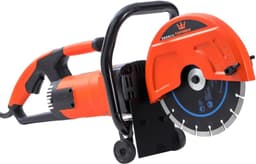
A stone-cutting machine here is a powered saw for stone, masonry or small craft stones, not a loose blade, an angle grinder or a ceramic wet tile cutter. Most UK shoppers on amazon.co.uk are choosing a corded handheld disc cutter for paving, bricks and blocks, or a bench saw for craft stones. Judge a stone cutting machine by the stated depth, a stated 230 V supply, a guard that covers the blade, and a diamond blade that is actually in the box. For slabs and block paving, the [paving guide](/hub/cutting-tools/stone-cutting-machine/sub/stone-cutting-machine-for-paving) sets out whether a stated 90 mm is enough. Handheld corded disc cutters, both Evolution models and the TOPWAY, push a guarded diamond blade along a line.
A stone-cutting machine here is a powered saw for stone, masonry or small craft stones, not a loose blade, an angle grinder or a ceramic wet tile cutter.
14 products checked · 62 hrs invested · +21,400 readers
Swipe for more
1-2 of 4


Personal buying guide
Question 1 of 2
What are you cutting?
The TOPWAY 101001 is listed as a 1,800 W handheld saw with a 235 mm blade, a stated 90 mm depth and a diamond blade in the box, at £119.99 and 10.4 kg. That shelf price sits beside the Evolution R230DCT, and the evidence does not: the amazon.co.uk line is 5.0 from one rating, and there is no review text. The listing does not state voltage, current, plug, no-load speed or a brake, and it asks what water system the saw uses without answering. A large fixed guard is described as helping with debris and dust, without a port size or a vacuum class. With one rating and a blank voltage line, the 90 mm figure is only what the listing prints. It is not a substitute for the R230DCT on the same price band, and it is not a saw whose plug you can assume is BS 1363.
Pros
Cons
Best for: Only a paper comparison of a stated 90 mm, 235 mm saw, if you are waiting for a review from someone who has used it on a known voltage
Less suitable: Anyone who needs a stated 230 V supply, a brake, or a review file before they buy a disc cutter
Specifications
Common questions
How deep does the TOPWAY saw cut?
The listing states a 90 mm maximum cutting depth with a 235 mm blade.
Is a diamond blade in the box?
Yes. Included components and the bullets both say a diamond blade is included.
What voltage is it, and does it use water?
The listing does not state the voltage or describe a water system. It asks both questions and does not answer them.
The Evolution R230DCT is a 230 V, 2,000 W disc cutter that the listing rates for a 90 mm cut on a 230 mm diamond blade, and it weighs 7.1 kg at £119.95. Across a 4.7 from 609 amazon.co.uk reviews, buyers describe breeze blocks, house bricks, paving slabs, sandstone and travertine coming apart with less effort than a hammer and chisel or a small angle grinder, often with a straighter line from the wheeled skid. Several of those reviews say the included diamond blade lasted a patio or a block-paving job, and a few bought the saw because the shelf price was close to a few days of hire. The same file keeps two limits: the dust port clogs, even with a hose taped on, and the blade guard does not move freely, which restricts cuts low on a wall. One reviewer found 90 mm shallow and cited a job of about 3.5 inches, and at least one Amazon delivery described as old stock or a return arrived without guide wheels and the blade-change tool, which Evolution support did not send. A garden hose forced into the dust port is a warranty risk one reviewer already flagged, because this is a corded saw with a listed brake, not a water-feed machine. For a socket-side cut within a stated 90 mm, this is the top pick this set can support.
Pros
Cons
Best for: A corded patio, brick or block cut within a stated 90 mm, near a 230 V socket, where you can keep people out of the dust
Less suitable: Pieces thicker than 90 mm, low cuts on a wall, wet suppression, or a site with no socket
Specifications
Common questions
How deep does the Evolution R230DCT cut?
The amazon.co.uk listing states a 90 mm depth of cut with the 230 mm blade.
Does it need petrol or a battery?
No. The listing describes a 230 V corded electric motor, with no petrol and no pull cord.
Is a diamond blade included?
The listing says a 230 mm general diamond masonry blade is included, aimed at stone, reinforced concrete and bricks.
The Evolution R300DCT states a 115 mm cut on a 300 mm blade, with a 2,400 W motor at 230 V, an electronic brake and a weight of 9.7 kg, at £255.04. UK reviews behind a 4.4 from 145 describe dense blocks, slabs, slate, brickwork, concrete fence posts and, in one account, gritstone about 4 inches thick, and one owner who has both Evolution sizes says the extra depth is worth paying for. Reviewers also call it quieter and lighter than their own petrol saw, with no fuel to mix and no pull start, and one mentions a soft start that the listing itself does not print as a bullet. Weight still comes up as very heavy, and this model has no water connection: buyers who wanted a hose were describing the R300DCT+, which is a different model. Several UK orders arrived without the diamond blade the listing includes, the centre bore is described as awkward at about 22.3 mm as well as 20 mm, and burn-out reports run from smoke within about 10 minutes to failure after about an hour or within five months of weekly use, with at least one warranty repair refused. It is the corded option when the piece is thicker than a stated 90 mm. On price it is the dearer saw, so it is a best-value choice only when that extra 25 mm is the reason you are buying.
Pros
Cons
Best for: A corded cut between a stated 90 mm and 115 mm, near a 230 V socket, if you can budget for a blade in case the box is empty
Less suitable: A one-patio job that fits inside 90 mm, anyone who needs water suppression, or a site with no power
Specifications
Common questions
How deep does the Evolution R300DCT cut?
The amazon.co.uk listing states a 115 mm depth of cut with the 300 mm blade.
Can you connect a water hose?
Not on this model. UK reviews say water suppression belongs to the R300DCT+, and this saw has a dust port instead.
Does the box include a diamond blade?
The listing says a general diamond blade is included. Several UK reviews say the blade was not in the box.
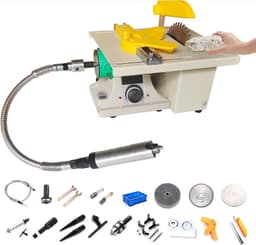
The Hocomay FHF0149 is a 750 W bench lapidary saw at £69.99, with a stated maximum thickness of 40 mm and a speed the listing sets from 0 to 10,000 RPM. It is a desktop machine with a removable flexible shaft, sold for jade, wood and other craft materials as well as stone, and the listing does not state the voltage. Of a 3.3 from eight amazon.co.uk reviews, the written texts are few: one buyer calls the machine sturdy, one says everything is OK, and one calls it a great kit while asking whether sparks are normal when cutting tumbler rocks and pebbles with no water fitting. A UK review says the plastic blade protector will not align, so the blade stays uncovered in use, and that the box had no usable instructions or contact details. The same sample says the wing-nut housing blocks the angle fence, so small jewellery stones cannot be cut, and that the blade is almost impossible to install without instructions. The size lines also disagree, with 250 x 230 x 290 mm in one place and 28 x 38 x 22 cm in another. If the cover will not line up over the blade, this is not a saw to switch on.
Pros
Cons
Best for: Small craft stones under a stated 40 mm, on a bench, only if you can confirm the guard covers the blade before you start
Less suitable: Paving, bricks, blocks, or any cut where the blade cover will not line up
Specifications
Common questions
How thick a piece can it cut?
The listing says the maximum cutting thickness is 4 cm.
Does it have a water feed for stone?
A UK review says there is no water fitting. The listing does not describe a water system.
Is this a site disc cutter?
No. It is a desktop mini table saw with a flexible shaft, sold for jade, wood and other craft materials as well as stone.
For this comparison we scored four amazon.co.uk listings captured on 15 October 2026. The score runs from 0 to 100. It uses the printed specification, the star line and review count, an editorial reading of the UK review themes, and price against that evidence. It is not the star rating times 20. There is no lab cut, and no star rating borrowed from another shop.
Review evidence
35%Star points are the amazon.co.uk rating divided by 5, multiplied by 20, and rounded. Sample points follow the listing count, from 15 points at 300 reviews or more down to 0 when there are none.
Printed specification
25%Points only for fields the listing prints: a stated 230 V supply, a stated cut depth, wattage, a brake, a dust port or guard, and a diamond blade listed as included.
Review sentiment
25%An editorial reading of the UK review themes on each listing: repeated masonry cuts with a named limit score higher than a thin file, a missing blade, or a guard that will not cover the blade.
Price against that evidence
15%Value is specification plus sentiment, set against the shelf price in GBP, then capped. Fewer than five reviews, and a guard that will not cover the blade, cap this block.
Choose the machine from the job, then from the stated depth and whether the listing actually says 230 V. A larger blade is not automatically a deeper cut. None of these four saws is a water-feed machine, and a dust port does not make a dry masonry cut safe for other people in the room.
A stone-cutting machine on this page is a powered saw for stone, masonry or small craft stones. It is not a loose blade, an angle grinder, or a ceramic wet tile cutter. UK shoppers on amazon.co.uk are mostly choosing a corded handheld disc cutter for paving, bricks and blocks, or a bench saw for craft stones. Handheld corded disc cutters, both Evolution models and the TOPWAY, push a guarded diamond blade along a line. A petrol cutter is the no-cable site tool and is not an ASIN in this set.

The Hocomay states a maximum thickness of 40 mm. It is a desktop craft saw with a flexible shaft, not a slab or block cutter. A paving flag is outside that figure.
The TOPWAY line is 5.0 from one rating, with no review text, at a shelf price close to the R230DCT. The same stated 90 mm does not make the evidence the same, and the voltage is not printed.
Water suppression on an Evolution belongs to the R300DCT+, which is not in this set. Do not hose a dust port. Several R300DCT reviews say the listed diamond blade was not in the box.
Patio, bricks or blocks need a handheld disc cutter. The Hocomay 750 W bench saw (stated thickness 40 mm, £69.99) is a craft tool with a flexible shaft, not a slab saw. Stated depths in this set are 90 mm on the R230DCT (230 mm blade), 90 mm on the TOPWAY (235 mm blade) and 115 mm on the R300DCT (300 mm blade). A larger blade is not automatically deeper. A common UK brick is about 65 mm thick, so 90 mm covers the bed in one pass and not the 102.5 mm width. That width is a rule of thumb.
Both Evolution listings state 230 V: the R230DCT at 2,000 W, 9 A and 6,000 RPM, the R300DCT at 2,400 W, 10.43 A and 4,600 RPM. The TOPWAY states 1,800 W and does not state voltage or plug. The Hocomay does not state voltage. Do not assume a BS 1363 plug. The Evolution saws have a dust port, not a water feed. Reviews say the R230DCT port clogs, and that a hose belongs on the R300DCT+, which is a different model. Do not hose the dust port. HSE says sandstone is more than 70 per cent silica.
Three typical situations, each with a recommendation from this comparison.
You are cutting a patio, bricks or blocks within a stated 90 mm, beside a 230 V socket, and you can keep people out of the dust. The R230DCT is the corded saw this set can support for that job.
You need a stated depth between 90 mm and 115 mm, you can accept 9.7 kg and £255.04, and the cut is still beside a cable. Budget for a blade in case the box is empty. This model has no water feed.
You are cutting craft stones under a stated 40 mm, not paving. Treat the Hocomay’s missing water fitting and the review that the guard will not cover the blade as open risks, and confirm the cover before you start.
The Evolution R230DCT is the top pick for a corded cut within a stated 90 mm, at £119.95, with 4.7 from 609 reviews, a stated 230 V supply and a listed brake. Its limits are a dust port that clogs, a guard that restricts low wall cuts, and anything thicker than 90 mm. The Evolution R300DCT is the best value only when the piece needs more than a stated 90 mm: £255.04 buys a stated 115 mm at 230 V, against missing-blade reviews and no water feed on this model. The TOPWAY and the Hocomay have no award. One rating does not outrank 609 reviews, and a £69.99 bench saw whose guard may not cover the blade is not a value tip for paving.

Evolution R300DCT 300 mm
Best value only when you need more than a stated 90 mm: a stated 115 mm at 230 V, not the cheaper saw.
Editorial

Products Compared publishes British-English buying guides based on amazon.co.uk listings and public UK sources. We do not run a lab and we do not invent test scores.
Guides on what to look for, how to use a product, and common mistakes.
Public UK sources from the research digest. amazon.co.uk listings checked on 15 October 2026.
Expert source (DIY & tools): Charlie White (Charlie DIYte) (external profile) – public expert commentary used as a research source, not as a contributor to our pages.
This article contains affiliate links to amazon.co.uk. If you buy through them, we may earn a small commission at no extra cost to you. Scores use listing fields and published UK review themes. We do not run a lab and we do not invent test scores.