Independent comparisons. We may earn from shop links. More info

How to use a stone cutting machine before the cut

Updated: October 2026

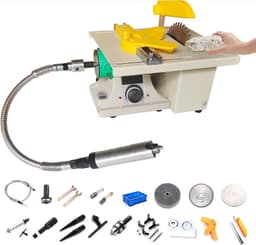
You are about to run a diamond blade along a chalk line, and the mistakes that hurt happen before the blade meets the stone. How to use a stone cutting machine, in this set, means a corded handheld disc cutter: set the depth, the guard, the lead and the dust plan, then cut once. The Hocomay bench saw is a different setup. The [stone cutting machine comparison](/hub/cutting-tools/stone-cutting-machine) is the table of four listings. This page is the sequence and the stop points. Products Compared did not film a cut. Specs are the amazon.co.uk listings of 15 October 2026.

You are about to run a diamond blade along a chalk line, and the mistakes that hurt happen before the blade meets the stone.

Our top picks

On this page

Check the saw before it is switched on

Confirm you are holding a handheld disc cutter, not the bench saw. The R230DCT states 90 mm, with a brake. The R300DCT states 115 mm, with an electronic brake. The TOPWAY states 90 mm and does not state voltage, so do not assume the plug. Several UK reviews of the R300DCT say the listed diamond blade was missing. The guard has to cover the rim. If the rim is bare, do not switch on. Fit the blade unplugged. A UK review of the Hocomay says the cover would not align. The buying guide is where you choose the saw. The R230DCT is the top pick when the piece fits a stated 90 mm. The R300DCT is best value only for the extra stated depth.

Support the piece and place the lead

Support the stone so the offcut cannot drop and pinch the blade. Keep the offcut free to fall away, and keep both hands on the saw. Put the lead behind you, fully unwound. The R230DCT states 9 A and the R300DCT states 10.43 A. A coiled extension on a shared 13 A socket asks the motor to work hot. People and pets leave the dust line first.

Cut only as deep as the listing states

The stated depth is a ceiling. The R230DCT and the TOPWAY state 90 mm. The R300DCT states 115 mm. The Hocomay states 40 mm, which is not a slab. Start with a groove on the line, then deepen it. Forcing a stall is how a dry blade glazes. One R300DCT review describes smoke within about 10 minutes. Unplug. Do not twist the blade in the kerf to correct a wander. Back out, let it stop, and start again. When the pass ends, wait for the brake, or for the blade to stop if you cannot confirm one. The TOPWAY does not state a brake. If the piece is thicker than the stated depth, change saw or stop.

Dust, and why a hose does not belong in the port

Cutting brick, concrete and mortar makes respirable crystalline silica. The Health and Safety Executive says sandstone is more than 70 per cent silica, and that the dust is too fine to see. These Evolution saws have a dust port, not a water feed. R230DCT reviews say the port clogs. Do not put a garden hose in it. HSE’s CIS54 sheet says wet suppression should not be used on an electrically operated cut-off saw. The water-feed Evolution is the R300DCT+, which is not in this set. At work, COSHH applies. Keep people out of the drift. No listing prints a vibration magnitude, so this page will not invent a trigger time. The work rules use 2.5 m/s² A(8) as an action value and 5.0 m/s² A(8) as a limit. They do not cover non-work use.

When to stop

Stop if the guard will not cover the blade, if you suspect asbestos cement, or if the cut is structural, at height, or through reinforced structural concrete. Stop if the motor smokes, the plug trips, or the lead is warm. Unplug. Do not reset and carry on with a coiled reel. Stop a long dry cut when other people will breathe the dust, especially sandstone. A contractor is the right call then, and also when the piece is thicker than 115 mm or there is no safe 230 V lead. The Hocomay does not inherit this sequence.

Common questions

How do I set up a straight cut?
Mark the line, support the piece so the offcut can fall away, and stand the lead behind you. Start with a shallow groove on the wheeled skid, then deepen it up to the stated depth. Keep both hands on the saw. If the blade wanders, back out and let it stop before you correct the line.
How deep will these saws actually go?
Only as far as the listing states. That is 90 mm for the R230DCT and the TOPWAY, 115 mm for the R300DCT, and 40 mm for the Hocomay bench saw. A review of gritstone about 4 inches thick is one account on the R300DCT, not a new depth for the 90 mm saws.
Do I need water, and can I use the dust port as a hose?
These four listings are dry. The Evolution port is for dust, and reviews say it clogs. Do not put a garden hose in it. HSE guidance says wet suppression should not be used on an electrically operated cut-off saw. The water-feed Evolution is the R300DCT+, a different model.
What protection should I wear, and who must leave?
Wear eye protection and hearing protection, and keep skin out of the dust line. Other people and pets leave the area before you start, because silica dust is too fine to see once it is airborne. At work, COSHH and suitable respiratory protection apply. A dust port is not that protection on its own.
What if the guard will not move or will not cover the blade?
Unplug and stop. On the R230DCT, a stiff guard limits low wall cuts, and a bare rim is not a workaround. On the Hocomay, a UK review says the cover will not align. Do not run either saw until the blade is covered in the way the guard was meant to work.
Why might the motor smoke or the plug trip?
A stalled dry cut, a coiled lead, or a shared socket can overheat a motor. One R300DCT review reports smoke within about 10 minutes. Unplug. The R300DCT states 10.43 A, which is close to a 13 A fuse if other loads are on. Do not reset and continue until the lead is unwound and the cut is not pinching.

Related pages

Sources

Public UK sources from the research digest. amazon.co.uk listings checked on 15 October 2026.

  1. HSE, Cancer and construction: Silica (7 February 2025) (retrieved 15 October 2026)
  2. HSE, Construction dust (22 June 2026) (retrieved 15 October 2026)
  3. HSE, Hand-arm vibration regulations (retrieved 15 October 2026)
  4. Control of Vibration at Work Regulations 2005 (retrieved 15 October 2026)
  5. HSE, Provision and Use of Work Equipment Regulations 1998 (PUWER) (retrieved 15 October 2026)
  6. HSE, Workplace exposure limits (COSHH) (retrieved 15 October 2026)
  7. GOV.UK, Accepting returns and giving refunds (retrieved 15 October 2026)
  8. amazon.co.uk listings for the four saws, captured 15 October 2026 (retrieved 15 October 2026)