Independent comparisons. We may earn from shop links. More info

Stone cutting machine buying guide: match the class

Updated: October 2026

You have slabs, house bricks or a bag of small stones, and every amazon.co.uk title seems to say stone. A stone cutting machine buying guide has to split those titles before you pay. Checked on 15 October 2026, two listings are corded Evolution disc cutters, one is a TOPWAY handheld saw with no voltage printed, and one is a Hocomay bench saw that stops at a stated 40 mm. The [stone cutting machine comparison](/hub/cutting-tools/stone-cutting-machine) puts those rows in one table. This page is the if-then: which class matches the piece, and which blanks should stop the order.

You have slabs, house bricks or a bag of small stones, and every amazon.co.uk title seems to say stone. A stone cutting machine buying guide has to split those titles before you pay.

Our top picks

On this page

Which machine type matches the job

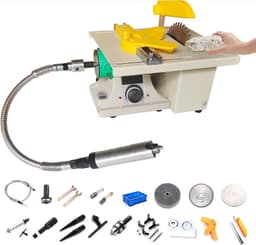
A handheld disc cutter and a bench lapidary saw are not substitutes, even when both listings mention stone. The Evolution R230DCT, the Evolution R300DCT and the TOPWAY 101001 are guarded handheld saws for bricks, concrete or paving. The Hocomay FHF0149, at £69.99, is a 750 W desktop saw with a flexible shaft. Its stated ceiling is 40 mm, so it will not take a patio flag. A UK review says the plastic cover will not line up over the blade. Petrol is a third class, and it is not an ASIN here. A small craft stone, with the guard covering the rim, is the only Hocomay case.

Depth of cut and blade diameter

Blade diameter is the size class. Depth is the number that decides the pass. The R230DCT (B08MFQ61KQ, £119.95) states 90 mm on a 230 mm blade. The TOPWAY (B0GFG7HSYV, £119.99) also states 90 mm, on a 235 mm blade. The R300DCT (B08MFSLVGK, £255.04) states 115 mm on a 300 mm blade, 25 mm more than the smaller Evolution. A common UK house brick is about 65 mm thick. That is a rule of thumb, so measure yours. On that rule, a stated 90 mm covers the bed in one pass and does not cover the 102.5 mm width. A 100 mm block needs the R300DCT’s stated 115 mm, and only after you have measured. Slabs sit on the paving page.

Voltage, weight and what is missing

Both Evolution listings state 230 V. The R230DCT is 2,000 W and 9 A, at 7.1 kg, with a brake listed. The R300DCT is 2,400 W and 10.43 A, at 9.7 kg, with an electronic brake. A long extension is a poor stand-in for a site saw at 10.43 A on a shared 13 A circuit. The TOPWAY states 1,800 W and 10.4 kg, and it does not state voltage, plug or a brake. Do not read a BS 1363 plug into that blank. The Hocomay does not state voltage either. If the listing does not state 230 V, it does not join the shortlist beside a house socket.

Dust, water and the blade in the box

None of these four listings is a water-feed saw. The Evolution models have a dust port. UK reviews of the R230DCT say that port clogs. Do not push a garden hose into it. Water belongs to the R300DCT+, which is not this ASIN. The Health and Safety Executive says cutting bricks, concrete and mortar produces respirable crystalline silica, and that sandstone is more than 70 per cent silica. The handheld listings say a diamond blade is included. Several UK reviews of the R300DCT say it was not in the box. GOV.UK sets out a refund when goods are not as described, plus the 14-day cancellation window for online orders.

Which listing to shortlist

For a craft stone under a stated 40 mm, only the Hocomay is the right type, and only if the guard covers the blade. For bricks, blocks or slabs at or under a stated 90 mm, beside a 230 V socket, the R230DCT is the shortlist this evidence supports. The comparison marks that saw as the top pick for that job. The best stone cutting machine page is where that commitment is argued. The TOPWAY, with 5.0 from one rating and no review text, does not share the shortlist. For a piece thicker than 90 mm, still near a socket, the R300DCT is the corded step. Call it best value only when you need that extra stated 25 mm. No safe cable, a structural cut, or a long dry run beside other people means you leave this set.

Common questions

Is a bench stone saw the same buy as a disc cutter?
No. The Hocomay is a 750 W bench saw with a stated thickness of 40 mm and a flexible shaft. The other three listings are handheld disc cutters with a stated depth of 90 mm or 115 mm. A patio slab or a house brick is a handheld job. The bench saw is for small craft pieces, and a UK review says its cover may not line up over the blade.
Does a 235 mm blade cut deeper than a 230 mm blade?
Not on these listings. The TOPWAY states 90 mm on a 235 mm blade. The R230DCT states 90 mm on a 230 mm blade. The deeper stated cut here is the R300DCT, at 115 mm on a 300 mm blade. Read the depth line, not the diameter in the title.
Is 90 mm enough for a UK brick and a 100 mm block?
A common UK brick is about 65 mm thick, a rule of thumb that sits inside a stated 90 mm on the bed. The brick’s 102.5 mm width does not. A 100 mm block is over a stated 90 mm and inside a stated 115 mm. Measure the piece before you treat a listing depth as enough.
Which listings actually state 230 V?
The Evolution R230DCT and the R300DCT both state 230 V. The TOPWAY states 1,800 W and does not state voltage or plug. The Hocomay does not state voltage either. A blank voltage line is not a BS 1363 plug you can assume.
Can I add a hose to the R300DCT?
Not on this model. UK reviews say water suppression is the R300DCT+, a different saw. This listing has a dust port. Do not push a garden hose into that port. The same warning applies to the R230DCT, whose reviews already describe a clogged port.

Related pages

Sources

Public UK sources from the research digest. amazon.co.uk listings checked on 15 October 2026.

  1. HSE, Cancer and construction: Silica (7 February 2025) (retrieved 15 October 2026)
  2. HSE, Construction dust (22 June 2026) (retrieved 15 October 2026)
  3. HSE, Hand-arm vibration regulations (retrieved 15 October 2026)
  4. Control of Vibration at Work Regulations 2005 (retrieved 15 October 2026)
  5. HSE, Provision and Use of Work Equipment Regulations 1998 (PUWER) (retrieved 15 October 2026)
  6. HSE, Workplace exposure limits (COSHH) (retrieved 15 October 2026)
  7. GOV.UK, Accepting returns and giving refunds (retrieved 15 October 2026)
  8. amazon.co.uk listings for the four saws, captured 15 October 2026 (retrieved 15 October 2026)