


Ceramic wall tiles
Your tiles fit inside 430 mm and 12 mm, and you can spare a practice offcut. The 430 mm TILER states that size, with dual rails, at about £40.99 and 33 reviews. The BLOSTM states the same size for less, from only four reviews.
The best hand tile cutters, compared.
Top pick: BLOSTM 430 mm manual tile cutter Best value: TILER 430 mm manual tile cutter – Best value among straight-cut rails: dual rails, 430 mm by 12 mm, 33 reviews, about £40.99. Updated October 2026.


A hand tile cutter on amazon.co.uk is not one shape of tool. The category mixes a rail that scores and snaps, a handheld cutter, pliers, a nipper and a scribe. You use one for ceramic wall tiles and some porcelain. Hire a wet saw when the tile is long, thick, textured or curved. What matters is whether the stated length and thickness cover your tile, and whether the wheel marks the glaze in one pass. Eight listings remain here after a hole saw, a glass cutter, a cone bit and diamond discs were set aside. How to match the tool to the tile is in the [hand tile cutter buying guide](/hub/cutting-tools/hand-tile-cutter/sub/hand-tile-cutter-buying-guide). A hand tile cutter is a manual tool that marks a tile and breaks it. No British Standard for choosing a manual cutter turned up in the sources used here.
A hand tile cutter on amazon.co.uk is not one shape of tool. The category mixes a rail that scores and snaps, a handheld cutter, pliers, a nipper and a scribe. You use one for ceramic wall tiles and some porcelain.
28 products checked · 58 hrs invested · +21,400 readers
Swipe for more
1-2 of 8


Personal buying guide
Question 1 of 2
What cut do you need?
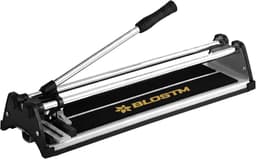
The BLOSTM is a 430 mm score-and-snap rail listed to 12 mm and about 3.45 kg, at about £25.99. All four amazon.co.uk reviews give it 5.0, and they describe ceramic and porcelain in a small bathroom, a square guide that clamps with one bolt, and less noise than an electric cutter. The listing claims straight or diagonal cuts but does not give a diagonal length in millimetres, and the wheel bullet excludes granite and marble. Four reviews are not a large sample: a 5.0 here can move on the next return. The listing was first available on 22 September 2026, so those bathroom jobs are early reports. Treat the price as the reason to look, and the review count as the reason to practise on a spare tile before you commit the room.
Pros
Cons
Best for: A small bathroom of ceramic or glazed tile inside 430 mm and 12 mm, if you can spare an offcut and accept a four-review sample.
Less suitable: Granite, marble, or a floor where a shattered tile is expensive to replace.
Specifications
Common questions
Can it cut on a diagonal?
The listing claims straight or diagonal cuts. It does not give a diagonal capacity in millimetres.
What thickness does the listing allow?
Up to 12 mm. The wheel bullet says it is not suitable for granite and marble.
How heavy is it?
The technical table lists 3.45 kg. The bullets say about 3 to 3.5 kg.
Across 780 amazon.co.uk reviews, the Amtech S4435 is the nipper in this set: carbide edges, spring handles, 360 g, and a stated limit of 6 mm ceramic and mosaic, at about £8.20 and 4.4. Reviewers nibble rough edges after a score, resize tiles around a sink, and find 6 mm wall tiles straightforward. They credit the spring for the lower effort. One review says the jaws do not meet, which made very thin tiles awkward, while 6 mm wall tiles were fine and one buyer got 8 mm microline to work. It is not a rail, so a long straight cut is the wrong job for it. The manufacturer field says DK Tools while the title brand is Amtech, and no safety lock is stated. The 4.4 is the strongest review record here, and it still only covers shaping, not a full floor.
Pros
Cons
Best for: Shaping ceramic and mosaic around a pipe, a sink or a rough edge, within about 6 mm.
Less suitable: A straight cut across a floor tile, or anything thicker than the listing if you have no spare.
Specifications
Common questions
What thickness does the listing allow?
Ceramic and mosaic tiles up to 6 mm.
Does it have a safety lock?
The listing does not say.
Is this a straight-cut rail?
No. It is a nipper for shaping edges and around fixtures.
The Vitrex 10 1500 is a handheld cutter about 287 mm long and 349 g, at about £13.79, not a 430 mm rail. Across 113 amazon.co.uk reviews it sits at 4.1, and some buyers did cut small ceramic pieces. Others smashed tiles, failed to score large ceramic, or found it poor on porcelain. The breaker head broke for at least one buyer, including a report of failure on the first cut, and another found a spring missing. The listing states no cutting length and no thickness, so those review failures have no millimetre limit to check against. The technical table says AC. No lead is described, so that field is not a mains tool. At this size it is a small ceramic cutter with a real chance of a broken head, not a measured bed.
Pros
Cons
Best for: A few small ceramic offcuts, when you already know the tile is thin and you can spare a practice piece.
Less suitable: Porcelain, large tiles, or any cut that needs a measured rail.
Specifications
Common questions
What cutting length does the listing give?
None. The product dimensions are 11.51 x 1.8 x 28.7 cm, so it is not a 430 mm rail.
Is it mains powered?
The technical table says AC. The title is a hand cutter and no lead is described. Treat AC as the printed field, not as a confirmed mains tool.
What do reviews say about porcelain and large tiles?
Reviews include successful ceramic cuts and failures on large ceramic and on porcelain, including a broken breaker head.
The Vitrex 10 3175 is a 20 g tile scorer, about 214 mm long, at about £2.74. Across 684 amazon.co.uk reviews it is 4.0 and rank 2 in Hand Tile Cutters, which reflects the price and the volume more than any stated capacity. The listing gives no thickness and no cutting length. Reviewers who only need a basic score like the visible tip, and one used it with nibblers for an awkward cut. The repeated failure is the tip falling out, including before first use, or barely scratching the glaze. Ceramic often needs heavy pressure and sometimes a second pass. The table says AC and that batteries are not required, but no lead is described, so this is still a hand scorer and not a full tiling kit on its own.
Pros
Cons
Best for: Marking a ceramic offcut you can afford to waste, then snapping or nipping with another tool.
Less suitable: Porcelain, thick floor tile, or a job with no spare tiles.
Specifications
Common questions
What tile thickness can it score?
The listing does not state a thickness or a cutting length.
Does it need batteries?
No. Batteries required and batteries included are both No.
Is it mains powered?
The technical table says AC. No lead is described. Treat that field as printed, not as a confirmed mains tool.
The Draper 49417 is a 200 mm pair of tile pliers with a 13 mm tungsten carbide wheel and a swivelling snap plate, at about £11.25. Across 301 amazon.co.uk reviews the score is 4.0, and the job reviewers actually praise is snapping a line that another tool has already scored. They use it for mosaic and angled subway edges, and one says the rubber face does not mark the glaze. The wheel is the repeated complaint: it does not scribe a snap line on its own, and the pliers feel flimsy to some buyers. The listing claims glass, ceramic or stone up to 16 mm. Porcelain is not answered. The printed weight of 20 g is not a plausible mass for 200 mm pliers, so ignore that figure when you compare tools.
Pros
Cons
Best for: You already score with a scribe and want pliers to snap mosaic or a short edge.
Less suitable: A long straight cut, or porcelain you have not tried on an offcut.
Specifications
Common questions
What does the listing say it can cut?
Glass, ceramic or stone tiles up to 16 mm thick. Porcelain is not answered in the bullets.
Does it come with a case?
The listing does not say. Included components are the pliers only.
How do reviews describe the wheel?
Many say the wheel is a weak scorer and the plate is more useful after a separate scribe.
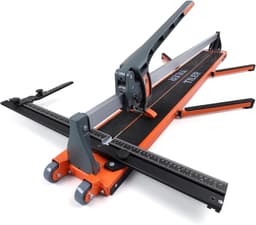
This 430 mm TILER is a dual-rail score-and-snap cutter listed to 12 mm, at about £40.99 and 3.33 kg. Across 33 amazon.co.uk reviews the rating is 3.9, but several of those texts describe a 630 mm TILER and a carry bag, so they are not evidence for this listing. Short comments that match the 430 mm title say it does the job for the money, and one buyer reports a firm single score on porcelain. The listing itself says it is not for large-format tiles. One reviewer wanted positive stops and a bed that does not mark the glaze. No repeated broken part shows up in the reviews that actually match this 430 mm model. Thirty-three reviews is a modest sample, and the mixed model comments make the 3.9 harder to read than a cleaner set.
Pros
Cons
Best for: Wall or floor tiles that fit inside 430 mm and 12 mm, including porcelain the listing claims, after a practice offcut.
Less suitable: Tiles longer than the bed, or anyone treating the 630 mm comments as this model's specification.
Specifications
Common questions
What size of tile does the listing allow?
The listing states a maximum length of 430 mm (17 in) and a maximum thickness of 12 mm, and says it is not for large-format tiles.
Does it need electricity?
No. The technical table says hand powered.
Are the 630 mm comments part of this model?
No. Those reviews describe a different cutter. The specification used here is the 430 mm listing.
The Faithfull FAITLCDIY is a TCT scribe at about £4.31 and 45.4 g. You score the face along a steel rule, then snap the tile over a thin wire, and thick tiles may need the edges scored as well. Across 417 amazon.co.uk reviews it sits at 3.7. Some buyers get through a single quick ceramic tile. Others need many strokes, get an unclean snap, or find the tip leaves the soft handle after a few scores or on the first tile. One review reports no mark at all on porcelain bathroom tiles. The listing does not confirm porcelain, a thickness, or a safety cover. At this price it is a spare marker for a ceramic offcut, not a system for a floor.
Pros
Cons
Best for: Scoring one ceramic tile you will snap over a wire, when a failed tip costs about £4.31.
Less suitable: Porcelain, or a run of floor tiles.
Specifications
Common questions
How does the listing say you snap the tile?
Score along a steel rule, then place a thin wire under the score and press both sides.
Does it come with a safety cover?
The listing does not say.
Will it mark porcelain?
The bullets do not confirm porcelain. One review says it left no mark on porcelain bathroom tiles.
Across nine amazon.co.uk reviews, the TILER 1200 mm rail is the only cutter here with a stated 1,220 mm bed, a 16 mm thickness, a 0–60° guide and a 22 mm wheel, listed at about £225.00 and 18 kg. Reviewers use that length on large-format tiles and describe solid rails, a smooth slide and side supports that hold a wider tile steady. One review found a porcelain offcut neater than a grinder cut, though very hard porcelain still needs one careful score rather than extra pressure. The same small set of reviews calls the machine heavy to carry and more than you need for a few small wall tiles. Buyers mention having paid about £215 and £188.60, so the £225.00 shelf price has already moved. A clean break still depends on a single consistent score, and one reviewer wanted a second thumb screw for the stored ruler. Nine reviews at 3.7 is a thin record for a tool at this price.
Pros
Cons
Best for: You are cutting ceramic or porcelain that will not fit a 430 mm bed, and you can store an 18 kg rail.
Less suitable: A handful of small wall tiles, or stone you have not checked against the listing and a spare offcut.
Specifications
Common questions
How long and how thick a tile does the listing allow?
The listing states a maximum cutting length of 1220 mm (48 in) and a maximum thickness of 16 mm.
Does this cutter need mains power?
The technical table says hand powered, and the bullets say no electricity is needed.
Does the listing include an angle guide?
Yes. It states an adjustable ruler for cuts from 0 to 60 degrees. A separate diagonal capacity in millimetres is not given.
Eight amazon.co.uk listings were scored from shelf prices, star lines, stated limits and review notes. This is not a laboratory cut. Stars are shrunk for a small sample: a prior of 40 reviews at 3.7, then that average divided by 5 and multiplied by 50. Fewer than 10 reviews deducts 6 points, which is why a 5.0 from four reviews does not lead. Reviews that describe a different model deduct 3 points on the 430 mm TILER, and those 630 mm comments are not used as its specification. Weights sum to 100. In sentences this page says top pick and best value.
Stars, shrunk for small samples
50%About half the score. The amazon.co.uk star average is pulled toward 3.7 with a prior of 40 reviews, then scaled to 50 points. A 5.0 from four reviews does not outrank 4.4 from 780.
Stated limits
20%Up to 20 points. A listing with both a cutting length and a thickness scores 20. Thickness only, or a clear nipper limit, scores in the mid teens. No millimetre capacity scores 4 to 6.
Review sentiment
20%Up to 20 points. Repeated praise for the job the tool actually does scores high. A repeated defect, such as a tip leaving the handle or a breaker head breaking, scores low.
Price fit
10%Up to 10 points. A low price only helps when the reviews support the job. A cheap tool with a falling tip does not collect the full 10.
Choose the cut before the star count. A rail, a nipper and a scribe do different jobs, and the amazon.co.uk hand tile cutter node mixes them with spare wheels and powered saws. This guide uses the eight listings kept in the table. Match the stated length and thickness to the tile before you treat four reviews as a large sample. Prices are the amazon.co.uk shelf figures for this set.
A hand tile cutter is a manual tool that marks a tile and breaks it. In this set that is a rail that scores and snaps, a small handheld cutter, pliers, a nipper, or a scribe. UK shoppers use one for ceramic wall tiles and some porcelain. A wet saw is the usual hire when the tile is long, thick, textured or curved. None of these eight listings is a 230 V appliance. No British Standard for choosing a manual cutter turned up in the sources used here. The cut shape comes first.

The bed has to be longer than the cut, and a diagonal is longer than the side. A 430 mm rail will not take a 600 mm tile. Screwfix makes that length point, and the Faithfull rail chart pairs 600 mm straight with a 425 mm diagonal.
Topps Tiles and BuildWiz both say a second pass on the same score is how tiles break badly. Score once, then snap. On a scribe, score along a rule and snap over a thin wire.
The BLOSTM is 5.0 from four reviews. The Amtech nipper is 4.4 from 780. A cheap scribe is not a floor system, and comments about a 630 mm TILER are not the specification of the 430 mm listing.
Start with the shape of the cut, then the bed, then the thickness. A rail is for a straight snap. A curve, a pipe or a mosaic edge is a scribe plus nippers or pliers, which is how B&Q and Wickes describe the job. The bed has to be longer than the cut you need, and a diagonal is longer than the side, which is the Screwfix point. The Faithfull rail chart pairs 600 mm straight with 425 mm diagonal. That chart is not the about £4.31 scribe in this table.
The scoring tip on a rail is usually tungsten carbide. Screwfix prefers two guide rails to one, and the 430 mm TILER listing claims dual chrome-plated rails. The 1,200 mm TILER states a 22 mm replaceable wheel and a 0–60° guide. Reviews describe a single solid rail, and the table does not print a rail count. Score the glaze once. Topps Tiles and BuildWiz both say a second pass on the same line is how tiles break badly. Weight and the review sample sit next to the hardware.
Three typical situations, each with a recommendation from this comparison.
Your tiles fit inside 430 mm and 12 mm, and you can spare a practice offcut. The 430 mm TILER states that size, with dual rails, at about £40.99 and 33 reviews. The BLOSTM states the same size for less, from only four reviews.
You need small bites around a pipe, a sink or a rough edge, not an 18 kg rail. The Amtech nipper states ceramic and mosaic up to 6 mm, at about £8.20, with 4.4 from 780 reviews.
The cut will not fit a 430 mm bed, and you can store an 18 kg rail. The 1,200 mm TILER states 1,220 mm and 16 mm, at about £225.00, from nine reviews. Material the listing excludes still needs a wet saw or a cutter bought for that tile.
In this set the top pick is the Amtech S4435 tile nipper. It is about £8.20, 4.4 from 780 reviews, and the listing states ceramic and mosaic up to 6 mm. It leads because that review record is the strongest here, not because it snaps a floor tile in one pass. The best value straight-cut rail is the 430 mm TILER at about £40.99: dual rails, a stated 430 mm by 12 mm, and 33 reviews. The BLOSTM is cheaper at about £25.99 with the same stated size, and the four-review deduction keeps it just below. The other six have no award. None of these scores is a laboratory cut.

TILER 430 mm manual tile cutter
Best value among straight-cut rails: dual rails, 430 mm by 12 mm, 33 reviews, about £40.99.
Editorial

Peter F. is the editor for DIY & tools at productscompared.co.uk. Comparisons in this category are checked against amazon.co.uk listings, review evidence and public UK sources.
Guides on what to look for, how to use a product, and common mistakes.
Public UK sources used for this comparison. Listing prices, stars and review counts are the amazon.co.uk figures saved for this set on 20 October 2026.
Expert source (DIY & tools): Charlie White (Charlie DIYte) (external profile) – public expert commentary used as a research source, not as a contributor to our pages.
This page contains affiliate links to amazon.co.uk. If you buy through them, we may earn a commission at no extra cost to you. Prices, stars and review counts are the UK listing lines. We did not run a lab test.