Independent comparisons. We may earn from shop links. More info

Manual tile cutter vs wet saw

Updated: October 2026

Ten wall tiles are stacked in the hall, and a hire page is offering a wet saw you would have to fetch, feed and plug in. A manual tile cutter vs wet saw choice is the cut you actually have: a straight score inside a stated length, or a diamond blade when the tile, the curve or the dust says otherwise. No wet saw was kept in this comparison. The hand tools are on the [hand tile cutter comparison](/hub/cutting-tools/hand-tile-cutter). Hire-day prices were not captured, so none are quoted. Products Compared has not run a lab test. A purchase through our links can earn a commission at no extra cost to you.

Ten wall tiles are stacked in the hall, and a hire page is offering a wet saw you would have to fetch, feed and plug in.

Our top picks

On this page

What each tool actually does

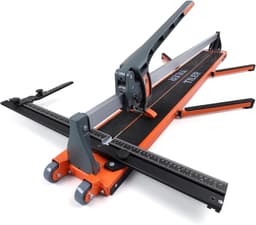
A manual cutter scores the glaze and snaps the body. In this set that is a rail, a scribe, pliers or a nipper, all hand powered. The Vitrex tables say AC. No lead is described, so that field is not a 230 V saw. The long TILER is 18 kg and still hand powered. A wet saw uses a diamond blade and a water feed. National Tool Hire keeps score-and-snap for straight ceramic, and the saw for porcelain, stone, angled cuts and large format. Speedy Hire says manual cutters should not be used on porcelain. That is that firm’s line. Other UK retailers still allow a hand cutter on some thinner porcelain. If you have neither a safe socket nor a tile the rail can mark, call a tiler rather than use a dry disc.

Dust and UK work rules

Score-and-snap still throws chips. Wear safety glasses. Dust-free on the 1,200 mm TILER is seller wording, not a measurement of your bathroom. HSE prefers hand tools where the tile can be cut that way. Where the method is a cut-off saw, the roofing-tile guidance wants water suppression and respiratory protection at APF 20. HSE’s ST3 sheet is about respirable crystalline silica from powered rotary tools. A dry grinder indoors is that problem. A rail score is not. A mask on the snap does not control a dry blade. PUWER 1998 applies when a tool is provided for use at work, not to a householder’s own bathroom. Consumer Rights Act 2015, section 9, still expects the tool to match its description.
Amtech Amtech S4435 tile nipper

Testsieger

Amtech Amtech S4435 tile nipper
8.7/10about £8.20

When to stay with the hand tool

Stay with the hand cutter when the cuts are straight, the tile fits the stated length and thickness, and a spare has already snapped. Glazed ceramic inside 430 mm and 12 mm does not need a socket. Length and tool type are the manual tile cutter buying guide. A nipper at about £8.20 covers mosaic bites up to 6 mm. A 430 mm rail is about £25.99 or £40.99. The 1,220 mm rail is about £225.00 if the tile is long and still a hand-tool material. None of those prices is a hire quote. A clean snap on a spare is the decision. Two shattered spares are the other decision.

When to hire

Hire when the tile is long, thick, textured or excluded by the listing, or when you cannot nibble the cut. National Tool Hire names porcelain, stone, angled cuts and large format. Both 430 mm rails stop at 12 mm. Textured porcelain around 10 mm, or porcelain over 15 mm, is hire or a tiler. The material question is manual tile cutter for porcelain. Hire when the alternative is a dry grinder in a lived-in room. Do not hire for ten wall tiles that already fit a 430 mm bed. If spare porcelain keeps failing, stop and get a tiler.

Common questions

When is the hand cutter the whole job?
When every cut is straight, the tile is inside the printed length and thickness, and a spare snaps along one score. A glazed splashback inside 430 mm and 12 mm is the usual case. You do not need a water feed for that. If the spare shatters, the hand cutter has stopped being the whole job.
When should I hire a wet saw instead?
When the rail will not mark the porcelain or stone, when the format is longer than the bed, or when nippers will not finish the curve. National Tool Hire points the wet saw at porcelain, stone, angled cuts and large format. No hire price is quoted, because none was captured.
Does score-and-snap create the same dust as a grinder?
No. A grinder on silica-bearing tile makes respirable dust. HSE’s ST3 sheet is about that powered cutting. A manual score throws chips. Glasses matter. A seller’s dust-free line is not a lab result. A dry blade changes the dust rules with the tool.
Do I need a dust mask for a manual cutter?
Glasses are the kit for the snap, because of chips. A dust mask is not the control HSE describes for a powered cut. If the method becomes a cut-off saw at work, that guidance wants water and respiratory protection at APF 20. A mask plus a dry blade in a closed bathroom is not that control.
Does a wet saw need a 230 V supply and water?
Yes. The wet saw is a diamond blade cooled by water, so you need a socket and a way to deal with slurry. The hand cutters here are not that machine. AC on a Vitrex scorer is not a lead. Plan the cable and the wet floor before you hire.
Is PUWER my problem at home?
Not for your own bathroom. PUWER 1998 applies when equipment is provided for use at work. If you are an employee and the saw was provided for the job, suitability is your employer’s question. The Consumer Rights Act still applies to a tool you bought.
What does dust-free on a listing actually mean?
On the 1,200 mm TILER it is seller wording for a score-and-snap, set against a powered blade. It means no spinning disc. It does not mean zero chips, and it does not replace glasses or, later, water and respiratory protection on a grinder.

Related pages

Sources

Public UK sources used for this comparison. Listing prices, stars and review counts are the amazon.co.uk figures saved for this set on 20 October 2026.

  1. Topps Tiles — how to cut tiles (retrieved 20 October 2026)
  2. Walls and Floors — which tile cutter (retrieved 20 October 2026)
  3. B&Q — how to cut wall tiles (retrieved 20 October 2026)
  4. Screwfix — tiling tool buying guide (retrieved 20 October 2026)
  5. Wickes — how to cut tiles (retrieved 20 October 2026)
  6. HSE — cutting roofing tiles (retrieved 20 October 2026)
  7. HSE ST3 — respirable crystalline silica (retrieved 20 October 2026)
  8. Consumer Rights Act 2015, section 9 (retrieved 20 October 2026)