Independent comparisons. We may earn from shop links. More info

Petrol pressure washer for a patio

Updated: 21.10.2026

The flags have gone dark, the joints are growing a green line, and the lance is on a petrol washer that can sit around 180 bar. A petrol pressure washer for a patio is a surface problem. The jet that shifts algae will also etch stone, empty kiln-dried joints, and scar tarmac. Products Compared used Marshalls' aftercare notes, London Stone's jet-wash guidance, and the nozzle kits in our [petrol pressure washer comparison](/hub/compressors/petrol-pressure-washer), on 19 October 2026. We did not wash a patio. Use the widest fan that still moves the dirt, keep the lance moving, and leave the red 0° tip in the holder.

The flags have gone dark, the joints are growing a green line, and the lance is on a petrol washer that can sit around 180 bar. A petrol pressure washer for a patio is a surface problem.

Our top picks

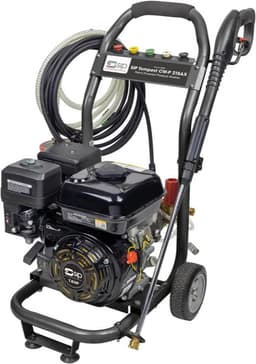
SIP SIP Tempest CW-P 215AX

Best overall

SIP SIP Tempest CW-P 215AX
7.4/10about £432.26
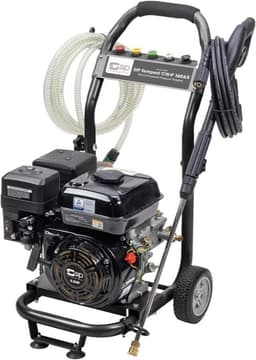
SIP SIP Tempest CW-P 160AX

Best value

SIP SIP Tempest CW-P 160AX
7.6/10about £330.89
On this page

What a petrol jet does to stone

A petrol pump in this set is often stronger than a small corded washer. The SIP 215AX is rated at 180 bar, Ark Mat states 185 bar, and Pro Splash's table says 200 bar. On stone the damage is etching, and tiger stripes where the lance paused. Marshalls says to use medium or low pressure, hold the lance at an angle, and keep at least 200 mm off the face of Marshalls paving. London Stone is stricter for natural stone: about 50 cm away and about 45°, worked diagonally. Sweep grit off first. A 40° tip held on one spot still marks the slab. Bar and flow, as a buying choice, stay on the petrol pressure washer buying guide.

Flags, sandstone, and York stone

Concrete flags tolerate a wider fan and Marshalls' 200 mm stand-off better than soft sandstone. Fit the 25° or 40° tip. Ark Mat's set includes a 25° fan. Pro Splash's title says four quick-connect nozzles, and one review says the green tip was missing, so check the holder. Indian sandstone is where London Stone's 50 cm and 45° matter. If the test patch roughens under your fingertip, stop. Historic York stone is the surface to leave. A petrol lance at these pressures is the wrong tool for a worn face you cannot replace. The same refusal applies to a roof.
SIP SIP Tempest CW-P 215AX

Testsieger

SIP SIP Tempest CW-P 215AX
7.4/10about £432.26

Block paving and the sand in the joints

Block paving fails when you chase the joint. The kiln-dried sand locks the blocks. A 0° nozzle, or a narrow fan aimed down the line, empties that sand and lets the blocks rock. Marshalls' block-paving article says to work at about 30° and on a diagonal, then re-sand once the surface has dried. If sand is fanning out of the joint, step back and change to the wider tip. The red tip stays in the holder. Several £169 cartons include a 0° nozzle as standard. That is not a prompt to use it on blocks.

Tarmac, cars, and a surface cleaner

Tarmac marks when the jet cuts the binder. Hold a wide fan well off the surface, keep moving, and stop if the texture changes. A petrol machine rated around 135 to 180 bar, the SIP pair, can do that in one paused second. Cars and painted furniture sit with tarmac. Use a 40° fan and a detergent tip if the listing has one. Pro Splash includes a detergent tank. The SIP listings describe an injector and do not state an integrated tank. None of these cartons lists a surface cleaner. Buy one separately for a large patio. Oil, the first pull, and dumping hose pressure are on the how to use a petrol pressure washer page.

When the tap is not allowed

Thames Water's temporary use ban, updated on 12 October 2026, restricts a mains-fed pressure washer on patios, drives, paths, walls, and vehicles for households. Stored rainwater is still allowed on that page. The ban is regional and dated, and a petrol engine does not opt you out. The SIP 160AX and 215AX state 2 m of suction with a strainer. A £169 page that never mentions suction cannot be assumed to pull from a butt. A pond or a drain is a contamination risk.

Common questions

Will 200 bar ruin patio slabs?
It can, if you hold a narrow jet close and still. Pro Splash's table says 200 bar, and the SIP 215AX is rated at 180 bar. Marshalls tells you to keep at least 200 mm off the face at an angle, on Marshalls paving. London Stone's gentler start for natural stone is about 50 cm and 45°. A wide fan and a moving lance are how you use these machines on flags. A paused pencil jet is how you etch them.
Which nozzle do I use on concrete flags?
Use the 25° or 40° fan, usually the green or white tip, after a sweep and a test patch. Keep Marshalls' 200 mm gap as the minimum and widen it if the surface roughens. Ark Mat includes a 25° tip in a four-piece set. Leave the red 0° nozzle in the holder.
What about Indian sandstone or York stone?
Soft sandstone needs the longer stand-off. Start near London Stone's 50 cm and 45°, and stop if the test patch feels rough. Historic York stone is a surface to leave alone at these pressures. A petrol lance is a poor match for a face you cannot replace, and a roof is out of scope entirely.
Will I blow the sand out of block paving?
You will if you follow the joint with a narrow jet. Work on a diagonal at about 30°, as Marshalls describes for block paving, and step back as soon as sand leaves the joint. When the surface is dry, brush kiln-dried sand back in. The bright look is a failure if the blocks are loose the next week.
Can I jet wash tarmac?
Only with a wide fan, more distance, and a lance that never pauses. Tarmac scars when the binder is cut, and a petrol washer in the 135 to 180 bar rated band can do that quickly. Stop at the first change in texture. Marshalls does not print a bar figure that makes a close pass safe.

Related pages

Sources

Public UK sources from the research digest. Last checked on 19 October 2026. Prices and star lines are the amazon.co.uk figures in the display file.

  1. HSE: petrol storage at home and in clubs (retrieved 19 October 2026)
  2. Petroleum (Consolidation) Regulations 2014, Schedule 2 (retrieved 19 October 2026)
  3. GOV.UK: E10 petrol explained (retrieved 19 October 2026)
  4. Water Supply (Water Fittings) Regulations 1999, backflow (retrieved 19 October 2026)
  5. Control of Noise at Work Regulations 2005 (retrieved 19 October 2026)
  6. SIP Tempest CW-P user manual, April 2024 (retrieved 19 October 2026)
  7. ManoMano: petrol or diesel pressure washer buying guide (retrieved 19 October 2026)
  8. amazon.co.uk listings for the eleven ASINs in this set (retrieved 19 October 2026)