Independent comparisons. We may earn from shop links. More info

How to use a petrol pressure washer

Updated: 21.10.2026

The carton is on the drive, the lance is still in the wrap, and the sump may be empty. How to use a petrol pressure washer starts with oil and water, then the cord. Products Compared wrote this from the machines in our [petrol pressure washer comparison](/hub/compressors/petrol-pressure-washer), the April 2024 SIP Tempest manual, and the pattern in Sealey's PWM1300.V2 instructions, on 19 October 2026. We did not film a start. One Ark Mat review says the washer arrived with no oil. A Pro Splash review says the oil was so low the engine would not spark. Those comments are why the first pull waits.

The carton is on the drive, the lance is still in the wrap, and the sump may be empty. How to use a petrol pressure washer starts with oil and water, then the cord.

Our top picks

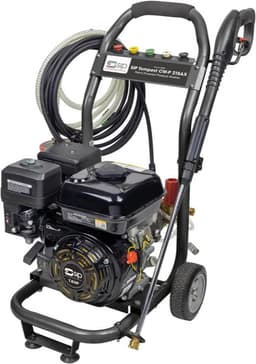
SIP SIP Tempest CW-P 215AX

Best overall

SIP SIP Tempest CW-P 215AX
7.4/10about £432.26
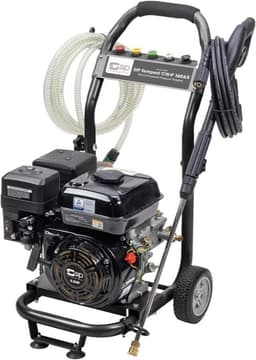
SIP SIP Tempest CW-P 160AX

Best value

SIP SIP Tempest CW-P 160AX
7.6/10about £330.89
On this page

Before the first pull

Stand the machine level and look for a dipstick or a filler. Many small four-stroke engines in this kind of carton are shipped dry. Sealey's instructions for a different model say not to start until the sump is filled. Use that warning. Do not copy a litre figure the listing never states. The April 2024 SIP manual specifies SAE 10W-30 and 0.5 litre for the Tempest 160AX and 215AX only. If your page has no oil capacity, the dipstick marks are the fill. Jerool's large pump-oil figure sits next to the 3.6 litre tank field, so treat it as muddled catalogue text. Fresh petrol goes in a suitable can, then into the tank, with the cap seated. HSE allows up to 30 litres at home without notifying the Petroleum Enforcement Authority, and not in a living room. GOV.UK says standard petrol is E10 and that garden equipment may not be compatible.

Water, then the engine

The pump needs water before it sees a load. Connect the inlet, open the tap, and squeeze the trigger with the engine still off so air leaves the hose. Fit a fan nozzle for that first bleed, not the red 0° tip. If the hose collapses or the jet sputters, the pump is running ahead of the tap. Suction is a different feed, and only where the listing allows it. The SIP 160AX and 215AX bullets say 2 m, with a strainer, from a butt, barrel, tank, or container. A hose in a pond, a drain, or slurry is a contamination risk under the Water Supply (Water Fittings) Regulations 1999. Jerool does not claim self-priming. Surface choice, once water is moving, sits on the petrol pressure washer for a patio page.
SIP SIP Tempest CW-P 215AX

Testsieger

SIP SIP Tempest CW-P 215AX
7.4/10about £432.26

While it is running

Pull with a straight back and keep the lance pointing at the ground. Eye protection and hearing protection go on before the first noisy minute. The SIP listings state 104 dB(A) and 112 dB(A) sound power. Those numbers are not the level at a neighbour's window. Stay off a ladder. Electrical Safety First says not to use a pressure washer from a ladder. Keep the spray off the engine and any socket nearby. Thames Water's temporary use ban, as updated on 12 October 2026, still restricts a mains-fed pressure washer on patios, drives, paths, walls, and vehicles for households in that area. Stored rainwater is treated differently. The ban is regional and dated, so check your own supplier.

Shut down and the faults that end the session

Stop the engine, then dump the pressure. Squeeze the trigger until the hose goes soft, with the nozzle pointed at the ground. Do not leave E10 sitting until spring. Two faults end the session. If the engine dies when you release the trigger, DGJMuu reviews here describe a cut-out when jetting stops. A UK owners' thread calls that an unloader that is not going into bypass. That is a return, not a strip of the valve. An Ark Mat review describes a pull cord that stuck, a bang, and the head coming off. Stop. Amazon's returns process is the route, under the Consumer Rights Act 2015. If an outdoor socket would have done this job, the petrol vs electric pressure washer page is the buying decision for next time.

Common questions

Do I add oil before the first pull?
Yes, unless your manual shows a filled sump and the dipstick agrees. Ark Mat and Pro Splash reviews in this set describe machines that arrived empty or too low to spark. Check the level on level ground before any cord is pulled. A dry start is how these engines get damaged in the first minute.
What oil, if the listing does not say?
Use the oil grade in that model's manual. For the SIP 160AX and 215AX, the April 2024 manual says SAE 10W-30 and 0.5 litre. Other machines in this set often omit a capacity. Do not borrow 0.5 litre, or Sealey's 0.55 litre, for a page that never states one. The dipstick or the maker's sheet is the fill.
Why does it start and then die when I let go of the trigger?
A petrol engine that dies as soon as you release the trigger is often the unloader failing to bypass. That pattern appears in a UK owners' thread and in DGJMuu reviews here. Check that water is actually reaching the pump. If oil is present and the cut-out repeats, stop and return the machine. This page does not include a strip-down.
How do I get water through the pump before I start?
Open the supply, leave the engine off, and hold the trigger until a steady stream replaces the spit of air. A fan nozzle is enough for that. Fit the lance properly once the air is gone. Starting against a dry pump is the failure the oil warning has a twin for.
Can I use a water butt?
You can when the listing says so, and only to the lift it states. The SIP models in this set say 2 m, with a strainer under the water and off the silt. Jerool does not claim suction. A butt is also the supply some water companies still allow during a mains-use ban. A pond or a drain is not that supply.

Related pages

Sources

Public UK sources from the research digest. Last checked on 19 October 2026. Prices and star lines are the amazon.co.uk figures in the display file.

  1. HSE: petrol storage at home and in clubs (retrieved 19 October 2026)
  2. Petroleum (Consolidation) Regulations 2014, Schedule 2 (retrieved 19 October 2026)
  3. GOV.UK: E10 petrol explained (retrieved 19 October 2026)
  4. Water Supply (Water Fittings) Regulations 1999, backflow (retrieved 19 October 2026)
  5. Control of Noise at Work Regulations 2005 (retrieved 19 October 2026)
  6. SIP Tempest CW-P user manual, April 2024 (retrieved 19 October 2026)
  7. ManoMano: petrol or diesel pressure washer buying guide (retrieved 19 October 2026)
  8. amazon.co.uk listings for the eleven ASINs in this set (retrieved 19 October 2026)