Independent comparisons. We may earn from shop links. More info

How to install a wireless doorbell without a battery

Updated: 16 October 2026

The kit is chosen, and you have a live socket in a room you use. How to install a wireless doorbell without a battery still goes wrong if the press is a soft tap, the pad is half peeled, or the chime sits in an empty room. Plug the chime in where you will hear it, then walk the house. The three kits are on the [wireless doorbell without a battery comparison](/hub/burglar-protection/wireless-doorbell-without-battery). Which box to buy stays on the [buying guide](/hub/burglar-protection/wireless-doorbell-without-battery/sub/wireless-doorbell-without-battery-buying-guide). Listings were checked on 15 October 2026, not in a lab. A qualifying purchase can earn a commission at no extra cost to you.

The kit is chosen, and you have a live socket in a room you use.

Our top picks

On this page

What you are fitting

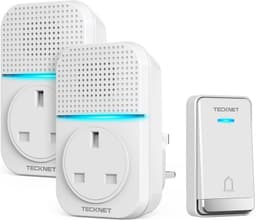
You are fitting one outdoor press and either one or two indoor chimes. The press has no battery to insert. The chime plugs into a UK socket on 230 V mains, and the plug has to suit BS 1363 under the Electrical Equipment (Safety) Regulations 2016, including regulation 35. The pages do not print BS 1363, so check the plug in your hand. TECKNET reviews often say the chime is paired when you plug it in. If the socket does not exist yet, stop before you stick anything to the door.

Put the chime where you will hear it

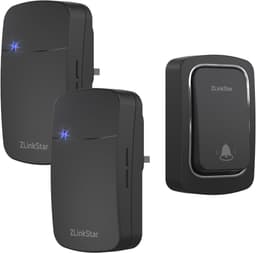
Plug the chime into a socket in a room you occupy. With two chimes, put one toward the front and one in a back room, or one upstairs and one down. The second unit puts the same sound in a second place. Both TECKNET listings claim a pass-through, and the bullets do not print a watt limit. One review says the packed sheet allows up to 2,000 W and forbids a kettle or a heater. The ZLinkStar listing does not mention a pass-through.

Fix the press so the click can make power

The press has to move firmly. Reviews call it a rocker or a positive click, because that movement makes the pulse. A soft tap is the wrong test. Clean the frame. A dirty or metal frame is a poor bed for the pad. Peel both sides of the adhesive. One twin-TECKNET reviewer found the button on the pavement until the second liner came off. One older review of the single TECKNET could not see screw holes and used the pad only. One UK review says the transmitter is not completely weatherproof, so use a sheltered frame. On the ZLinkStar kit, one reviewer paired the press beside the receiver, then moved the button to the door. A tune for someone who misses short sounds sits on the doorbell with a flashing light for hearing page.

Walk-test through the rooms you care about

Press from the door, then walk to the kitchen, upstairs, and any outbuilding you hoped to cover. All three listings claim up to 400 m / 1,300 ft, and none says that distance is through walls. Range through a terrace is why a walk beats the number on the box. One ZLinkStar reviewer could not reach an outbuilding past about 30 feet. If the kitchen misses the chime, move that receiver before you call the button faulty.

When you should not carry on yourself

Call an electrician if you need a new socket, if old doorbell cable has to be made safe, or if the socket is cracked or loose. Ask the landlord before you drill a rented or communal door. Do not connect the kit to an alarm panel yourself. If the kit is faulty, the Consumer Rights Act 2015 gives a 30-day short-term right to reject when goods are not as described. A failed walk to the kitchen is a placement problem first.

Common questions

Do you need a battery in the button on the day you fit it?
No. On these three kits the press makes its own pulse, and the listings say a battery is not required in the button. You plug the chime into a live UK socket. The single TECKNET has one chime. The twin TECKNET and the ZLinkStar kit have two. Fitting day is a socket, a firm press, and a pad or screws. It is not a trip to buy a coin cell.
Pad or screws, and what if the frame is dirty or metal?
Clean the frame and peel both sides of the pad. One twin-TECKNET review found the button on the pavement when a liner was left on. Screws are described for the twin kits. One older single-TECKNET review could not find screw holes and used adhesive only. A dirty or metal frame is a poor surface. In a rented or communal door, ask the landlord before you drill.
How hard do you press?
Press until you feel a firm click. Reviews describe a rocker, because that movement generates the pulse. A fingertip tap is the wrong test and makes a working bell seem dead. The listings do not print a force in newtons. If a firm press at the door does nothing, move the chime closer and try again before you return the kit.
What must you not plug into a TECKNET pass-through?
The online bullets claim a pass-through and do not print a watt limit. One review of the twin TECKNET says the packed sheet allows up to 2,000 W and forbids a kettle, a heater, a small oven and an extension lead. Follow that sheet if it is in your box. The ZLinkStar listing does not mention a pass-through, so do not hang another appliance off that chime.
When do you stop and call an electrician or the landlord?
Call an electrician for a new socket, for old doorbell wiring that must be made safe, or for a damaged socket. Ask the landlord before you drill a rented or communal door. Do not connect these kits to an alarm panel yourself. A faulty new kit is a shop question under the Consumer Rights Act 2015, including the 30-day short-term right to reject, not a reason to open the wall.

Related pages

Sources

Public UK sources and the amazon.co.uk listings for B001IAADH6, B00HYZ966I and B0GFN8JM46. Listings checked 15 October 2026.

  1. Ofcom: short-range devices (retrieved 15 October 2026)
  2. Wireless Telegraphy (Exemption) Regulations 2021 (retrieved 15 October 2026)
  3. Radio Equipment Regulations 2017, regulation 6 (retrieved 15 October 2026)
  4. GOV.UK: Electrical Equipment (Safety) Regulations 2016 (retrieved 15 October 2026)
  5. Electrical Equipment (Safety) Regulations 2016, regulation 35 (retrieved 15 October 2026)
  6. Which?: Consumer Rights Act 2015 and faulty goods (retrieved 15 October 2026)
  7. Quinetic: plug-in doorbell (retrieved 15 October 2026)
  8. Ener-J: wireless kinetic doorbell, UK plug (retrieved 15 October 2026)