Independent comparisons. We may earn from shop links. More info

Wireless doorbell without a battery: the buying guide

Updated: 16 October 2026

You are comparing wireless bells, and the titles still do not say where the power sits. A wireless doorbell without a battery, in the kits that belong here, is a press that makes a pulse of electricity when you push it, plus a chime that plugs into the mains. The button is battery-free. The sounder is not. This page orders the checks before a winner is named. Shelf prices on the [wireless doorbell without a battery comparison](/hub/burglar-protection/wireless-doorbell-without-battery) were £20.99, £29.99 and £19.99 on amazon.co.uk on 15 October 2026. Those listings were read, not lab-tested. A qualifying purchase can earn a commission at no extra cost to you.

You are comparing wireless bells, and the titles still do not say where the power sits.

Our top picks

On this page

What “without a battery” means on the button

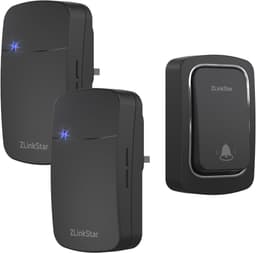
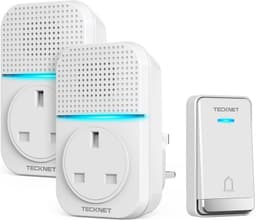
The outdoor press is the part that has to be battery-free. On the three kept kits the listing says the push generates electricity. A line that says a 4.5 year battery, or names a CR2032, is a different product. Nine of the twelve listings in this search were that other type, which is why the title alone is a weak filter. The chime still needs a socket. The single TECKNET, the twin TECKNET and the ZLinkStar twin all say the button needs no battery. A camera doorbell stays outside this set. Once the press is self-powered, the next question is which room has a live socket, because that is where the sound will be.

Where the chime gets its power

You need a live UK socket in a room you use. Mains are 230 V, and a plug-in chime has to suit a BS 1363 socket under the Electrical Equipment (Safety) Regulations 2016, including regulation 35. The listing pages do not print BS 1363, so check the plug you unpack. A pass-through is claimed on both TECKNET listings, and the bullets do not print a watt limit. One UK review of the twin says the packed sheet rules out a kettle, a heater and an extension lead. The ZLinkStar page does not mention a pass-through.

One receiver or two, and what 400 m means

One receiver is enough for a small flat when the socket is in the room where people sit. Two is what UK reviewers use for another floor or a back kitchen. The single TECKNET has one chime. The twin TECKNET and the ZLinkStar kit each have two. All three listings claim up to 400 m / 1,300 ft and do not say that distance is through brick. Quinetic publishes about 30 m indoors and Ener-J about 40 m with walls, which is not a test of these ASINs. One ZLinkStar reviewer stopped at about 30 feet to an outbuilding. Range through a terrace is the walk that matters.

Weather, volume, and the mistakes that waste the kit

All three listings say IP65: dust-tight and protected against water jets, not immersion. One UK review of the single TECKNET says the transmitter is not completely weatherproof. Volume is printed without a measurement distance, so 85 dB and 115 dB are not a league table. A dirty or metal frame is a poor place for the pad. Fitting, once the box is chosen, is on the how to install page.

What you can settle before you pick a kit

Three checks are enough. The press has to be self-powered. A live socket has to sit in a room you use. One room points at the single TECKNET and its long review record. A second floor or a back kitchen points at a twin, and the gap between 5,026 reviews and 96 reviews matters more than the £10 between the two twin prices. A coin-cell listing is a different product, set out on the kinetic doorbell vs battery doorbell page. A new or damaged socket is an electrician’s job.

Common questions

Does “without a battery” mean the chime is battery-free as well?
No. On the three amazon.co.uk kits checked on 15 October 2026, the outdoor press makes its own pulse and the indoor chime plugs into a mains socket. TECKNET HDB01806, TECKNET HWD01816 and the ZLinkStar twin all work that way. A wireless doorbell without a battery still needs a live UK socket for the sounder. The button is the only part with no cell.
Do you need a live socket in the room where people sit?
Yes, if you want to hear the door. The chime only sounds where it is plugged in. A spare room you do not use will miss the knock. UK mains are 230 V, and the plug has to suit a BS 1363 socket. With no spare socket in a lived-in room, this type of kit is the wrong product until an electrician adds one.
Is one receiver enough in a flat?
One receiver is enough when that socket is in the room you occupy. The TECKNET HDB01806, at £20.99 with 4.7 from 10,434 reviews, is the single-chime kit here. It is the wrong count if the sound also has to reach upstairs or a back kitchen. Two receivers cover that second place. They do not extend the open-field range on the box.
Is IP65 the same as waterproof in a storm?
IP65 means dust-tight and protected against water jets. It is not a claim that the button can be immersed, and these listings do not describe a hose test of the unit. One UK review of the single TECKNET says the transmitter is not completely weatherproof. A sheltered frame is a practical place to start. Standing water is outside what this page can promise from the listing.
Is a “4.5 year battery” doorbell this product?
No. A stated cell life, a CR2032, or an AA pack is a battery doorbell. It can appear in the same search and it is a different product. If the bullet names a cell, it is not a wireless doorbell without a battery, however long that cell is said to last. The versus page sets out that fork, including when a missing socket changes the choice.

Related pages

Sources

Public UK sources and the amazon.co.uk listings for B001IAADH6, B00HYZ966I and B0GFN8JM46. Listings checked 15 October 2026.

  1. Ofcom: short-range devices (retrieved 15 October 2026)
  2. Wireless Telegraphy (Exemption) Regulations 2021 (retrieved 15 October 2026)
  3. Radio Equipment Regulations 2017, regulation 6 (retrieved 15 October 2026)
  4. GOV.UK: Electrical Equipment (Safety) Regulations 2016 (retrieved 15 October 2026)
  5. Electrical Equipment (Safety) Regulations 2016, regulation 35 (retrieved 15 October 2026)
  6. Which?: Consumer Rights Act 2015 and faulty goods (retrieved 15 October 2026)
  7. Quinetic: plug-in doorbell (retrieved 15 October 2026)
  8. Ener-J: wireless kinetic doorbell, UK plug (retrieved 15 October 2026)