Kinetic doorbell vs battery doorbell
You have two wireless doorbells in the same search, and the titles sound alike. One press makes a short pulse when you push it. The other hides a CR2032, an AA pack, or a line that says a 4.5 year battery. A kinetic doorbell vs a battery doorbell is that split, not a small difference in cell life. This page says when the kinetic kits on the [wireless doorbell without a battery comparison](/hub/burglar-protection/wireless-doorbell-without-battery) are the ones to buy, and when a battery bell is a different job this comparison will not rank. The checks before a model name sit on the [buying guide](/hub/burglar-protection/wireless-doorbell-without-battery/sub/wireless-doorbell-without-battery-buying-guide). Listings were read on 15 October 2026, not in a lab. A qualifying purchase can earn a commission at no extra cost to you.
You have two wireless doorbells in the same search, and the titles sound alike. One press makes a short pulse when you push it. The other hides a CR2032, an AA pack, or a line that says a 4.5 year battery.
You have two wireless doorbells in the same search, and the titles sound alike. One press makes a short pulse when you push it. The other hides a CR2032, an AA pack, or a line that says a 4.5 year battery. A kinetic doorbell vs a battery doorbell is that split, not a small difference in cell life. This page says when the kinetic kits on the wireless doorbell without a battery comparison are the ones to buy, and when a battery bell is a different job this comparison will not rank. The checks before a model name sit on the buying guide. Listings were read on 15 October 2026, not in a lab. A qualifying purchase can earn a commission at no extra cost to you.
Our top picks
| Badge | Product | Button power | Chime power | Plug-in chimes | Note | Price | Offer |
|---|---|---|---|---|---|---|---|
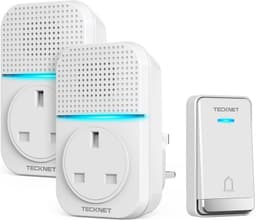
| Best overall |  TECKNET TECKNET HDB01806 self-powered doorbell | Kinetic press, no cell | Plug-in mains | 1 | 9.6 | about £20.99 | View offer |
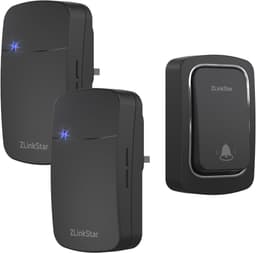
| Preis-Tipp |  ZLinkStar ZLinkStar self-powered doorbell, two chimes | Kinetic press, no cell | Plug-in mains | 2 | 9.6 | about £19.99 | View offer |
| Alternative |  TECKNET TECKNET HWD01816 twin self-powered doorbell | Kinetic press, no cell | Plug-in mains | 2 | 9.4 | about £29.99 | View offer |

On this page
Two wireless doorbells, two power stories
The chime is the part people forget
When the kinetic kit is the one to buy
When a battery doorbell is a different job
The recommendation, with one condition
Common questions
What does the kinetic press do that a coin cell does not?
Why can a 4.5 year battery still be the wrong buy from this search?
If you have no spare socket, is a battery receiver the point of the other product?
Does a plug-in chime still need mains even when the button does not?
Is a video doorbell with a big battery in this comparison?
Related pages
Sources
Public UK sources and the amazon.co.uk listings for B001IAADH6, B00HYZ966I and B0GFN8JM46. Listings checked 15 October 2026.
- Ofcom: short-range devices (retrieved 15 October 2026)
- Wireless Telegraphy (Exemption) Regulations 2021 (retrieved 15 October 2026)
- Radio Equipment Regulations 2017, regulation 6 (retrieved 15 October 2026)
- GOV.UK: Electrical Equipment (Safety) Regulations 2016 (retrieved 15 October 2026)
- Electrical Equipment (Safety) Regulations 2016, regulation 35 (retrieved 15 October 2026)
- Which?: Consumer Rights Act 2015 and faulty goods (retrieved 15 October 2026)
- Quinetic: plug-in doorbell (retrieved 15 October 2026)
- Ener-J: wireless kinetic doorbell, UK plug (retrieved 15 October 2026)