Independent comparisons. We may earn from shop links. More info

Doorbell with a flashing light for hearing

Updated: 16 October 2026

Someone knocks, and the person who needed to hear it is upstairs with the television on. A doorbell with a flashing light for hearing, in this set, is a plug-in chime with a tune and an LED in the room you use. The light is not a deaf-alerting system, and the decibel line is not a lab result. The three kits are on the [wireless doorbell without a battery comparison](/hub/burglar-protection/wireless-doorbell-without-battery). Listings were checked on 15 October 2026. No clinical test was run. A qualifying purchase can earn a commission at no extra cost to you.

Someone knocks, and the person who needed to hear it is upstairs with the television on. A doorbell with a flashing light for hearing, in this set, is a plug-in chime with a tune and an LED in the room you use.

Our top picks

On this page

A missed knock is a room problem as well as a volume problem

You miss the door when the only chime is in a room you have left. A louder listing figure does not move that chime. If the single TECKNET sits in the hall and you are in a back bedroom, the knock is gone whether the step says 25 dB or 85 dB. Two plug-in chimes put sound and a light where the person is. That is placement, not a higher decibel claim. Start with the socket in the room the person uses. How the press is fixed is on the install guide.

What the three listings say about sound and light

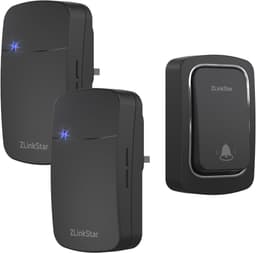
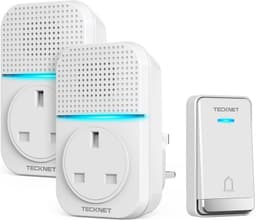
Both TECKNET kits state 25–85 dB in five steps, 60 melodies, and a flashing light. The pages do not say at what distance 85 dB was taken, and mute is not in the bullets. ZLinkStar states 0–115 dB in five steps, 38 melodies, and a flashing light, including a stated 0 dB step. None of the three states a flash-only mode. Do not rank 115 dB above 85 dB. Without a distance and a tune, the higher figure is not a measured win. The listing’s phrase about hearing loss is the maker’s line, not a claim that the kit suits a particular level of hearing.

Pick a tune you can actually hear

Sixty melodies help only if one of them is long and plain enough to notice. Twin-TECKNET reviews say some chimes are too soft for someone who is hard of hearing, and that a longer chime helped one household. ZLinkStar reviews split the other way: some buyers call it very loud, and some call tunes tinny. Pick the tune with the door shut and the television on. A second chime does not raise the decibel claim. It repeats the tune and the light in another room.

One light or two chimes

Use the single TECKNET HDB01806 when the person is usually in one room and that room has the socket. One light in the right place beats two lights in empty rooms. Skip it when they move between floors. Use two chimes when the day is split across rooms. The twin TECKNET is the longer UK record, 4.6 from 5,026 reviews. The ZLinkStar twin is the cheaper pair, 4.7 from 96 reviews. Neither states flash without sound. Who each kit is for sits on the best wireless doorbell without a battery page.

What this flash is not

This flash is a light on a plug-in chime. It is not a deaf-alerting system. The listings mention people with hearing loss and do not cite a sensory-impairment standard, a measurement distance, or a mode that keeps the light and drops the sound. If you need a dedicated alerting setup, this kit is the wrong product. No charity or NHS device is named, because none was in the sources for this comparison. A stated 0 dB step on ZLinkStar is still not a documented flash-only mode. The TECKNET volume floor is 25 dB, so those chimes cannot be silenced from the printed steps.

Common questions

Will a higher decibel number on the listing be louder in your kitchen?
Not necessarily. TECKNET states 25–85 dB and ZLinkStar states 0–115 dB, both in five steps, and neither page gives a measurement distance. A shut door, a television, and a short tune can make the higher figure the quieter one in the room you use. Treat the numbers as listing text. Judge the chime from the socket where the person actually sits.
Can you silence the chime and keep the light?
None of the three listings states a flash-only mode. TECKNET’s lowest printed step is 25 dB, so mute is not in the bullets. ZLinkStar’s range includes a stated 0 dB step, which is still not a description of light without sound. One ZLinkStar buyer wanted flash only and did not get it. If silence plus a light is the requirement, this kit does not state that behaviour.
Are 60 melodies a help or a problem if you miss short sounds?
They help if one long, plain tune is easy to notice, and they get in the way if you have to hunt through thin or brief sounds. Twin-TECKNET reviews say some tunes are too soft for someone who is hard of hearing, and a longer chime helped one household. ZLinkStar buyers have called some tunes tinny. Choose the tune in the occupied room, with the usual background noise, and keep that one.
Is one chime enough if you are often upstairs?
Only if the single socket is upstairs with you. The TECKNET HDB01806 has one receiver. A chime in the hall will not follow you to a bedroom. Two plug-in chimes, on the twin TECKNET or the ZLinkStar kit, let you put a sounder and a light on each floor. The second unit does not increase the decibel figure. It repeats the same claim in a second room.
Does the person at the door hear the indoor chime?
Often they do not. One twin-TECKNET review says the visitor cannot hear the indoor sounder. The light and the tune are in the house, not on the step. Someone waiting outside can think the bell has failed while the kitchen chime is flashing. Agree a simple tune indoors, and do not treat silence on the doorstep as proof the kit is dead.

Related pages

Sources

Public UK sources and the amazon.co.uk listings for B001IAADH6, B00HYZ966I and B0GFN8JM46. Listings checked 15 October 2026.

  1. Ofcom: short-range devices (retrieved 15 October 2026)
  2. Wireless Telegraphy (Exemption) Regulations 2021 (retrieved 15 October 2026)
  3. Radio Equipment Regulations 2017, regulation 6 (retrieved 15 October 2026)
  4. GOV.UK: Electrical Equipment (Safety) Regulations 2016 (retrieved 15 October 2026)
  5. Electrical Equipment (Safety) Regulations 2016, regulation 35 (retrieved 15 October 2026)
  6. Which?: Consumer Rights Act 2015 and faulty goods (retrieved 15 October 2026)
  7. Quinetic: plug-in doorbell (retrieved 15 October 2026)
  8. Ener-J: wireless kinetic doorbell, UK plug (retrieved 15 October 2026)