Wireless doorbell range through walls: test the hall

A 50 or 80 metre wireless doorbell claim is open air. Terrace walls and a metal door shrink the link. Test the hallway before you screw the outdoor unit.
On this page
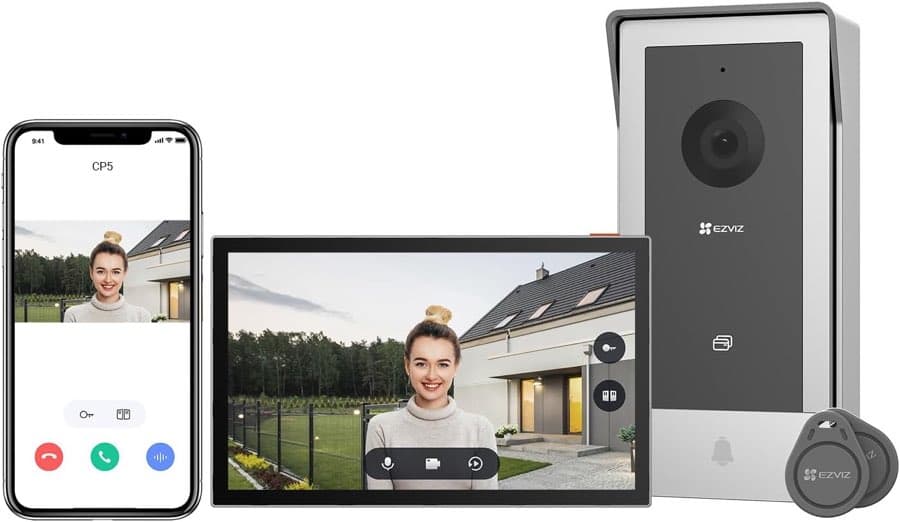
You unboxed the kit on the kitchen table, and the picture was fine. You carried the indoor screen to the front hall of the terrace, and it went blank. Wireless doorbell range through walls is that walk, not the metre printed on the listing. Fifty metres, or eighty, described open air. Your hall is a few steps and a brick skin away from the door.
The Products Compared editorial team read the amazon.co.uk listings in our video door intercom comparison, ManoMano's UK doorbell and intercom guide, and Ofcom's page on short-range devices, as checked on 15 October 2026. We did not survey a terrace and we did not run a lab test. A qualifying purchase through an Amazon link can earn us a commission at no extra cost to you.
In short
The figure on the box is an open-air claim. On TKMARS the radio bullet is 50 metres in the open and 5 to 10 metres indoors, while 80 metres is the night-vision line and must stay separate.
ACEBELL and XPJ warn against a metal door, and ACEBELL limits itself to about two walls that are not load-bearing. Prove the call in the hall before adhesive or screws. A wired monitor does not use that radio path for the picture.
The metre on the box is open air
ManoMano's UK buying guide states the point the listings blur. Open-air range is not the distance through a house. A clear line across a garden is the condition behind one large number. A British terrace puts brick, a staircase, and often a steel door between the outdoor unit and the room where you answer.
On the TKMARS 016-1 the radio bullet says 50 metres in the open and 5 to 10 metres indoors. Treat 5 to 10 metres as the listing's ceiling once walls are in the way. A front room on the same floor can sit inside it. A kitchen at the back of a long terrace often will not. We have not measured your house, so this page will not say your terrace fails at six metres or holds at nine.
The Winnes 0K18S bullets give 30 to 80 metres in open areas, not an indoor figure. Neither end of that span is a promise through a party wall. If a listing gives a span, use the lower figure as a warning, not as a floor plan.
A kinetic press and a plug-in chime, on our wireless doorbell without a battery comparison, are a sound in a room, not a picture of the caller. The hallway test still applies if you only need a chime.
Ofcom's short-range rules, and regulation 4 of the Wireless Telegraphy (Exemption) Regulations 2021, can leave home Wi-Fi and some 2.4 GHz use licence-exempt when the kit does not cause undue interference. That is a licence point, not a minimum range through masonry. A weak link can be lawful and still useless where you answer.
Walls, and a metal door
Brick is the ordinary obstacle. A metal door is the one the listings forbid. ACEBELL and XPJ both warn against mounting the outdoor unit on a metal door. A steel leaf detunes the outdoor radio, so a pair that worked on a wooden table can show nothing once it is stuck to that leaf. Move the unit to the timber frame or the masonry beside the door and test again before you call the kit faulty.
ACEBELL's limit is about two walls, excluding load-bearing walls. A stud partition is not the party wall between two terraces, and a load-bearing wall does not count as one of the two. A steel front door is a separate ban. The kitchen test hides that difference: you pair beside the router, then carry the screen to the hall. Ten minutes with the outdoor unit held, not screwed, against the frame beats a return.
A camera on the frame sees a different slice of the step. You may gain the signal and lose the face. If the only working spot films the pavement more than the caller, the range is fixed and the filming question is not.
Night-vision metres are not radio metres
On TKMARS the night-vision specification says 80 metres. The radio bullet says 50 metres in the open and 5 to 10 metres indoors. Eighty metres of infrared is how far the sensor claims to light a scene in clear night air.
It does not say the picture arrives in the hall. The Winnes 0K18S span of 30 to 80 metres in open areas is the same trap if you treat the top number as both vision and radio. If the send figure does not say indoors, you do not have an indoor figure.
A dark picture and a dropped call are different faults. If the screen stays connected and the image is black, look at aim, infrared, and the porch light. If the call dies as you walk away, a brighter porch will not restore it. Walk the test in daylight. If the call fails at noon, night vision is the wrong setting.
Test the hallway, then screw
TKMARS tells you to test before you fix the outdoor unit. Adhesive and screws are both too early if the only good call was on the kitchen table. Complete a call in one room first, picture and speech if the kit has speech.
Then hold the outdoor unit on the real door, or on the frame if the door is metal, with nothing stuck down. Put the screen on the socket where you will answer. If you answer from upstairs, test upstairs. A pass in the hall and a fail on the landing is a fail. A flash that drops is not a pass.
If it holds, mark the holes or fit the pad. If it fails, move the screen one room closer before you blame the outdoor unit. Drilling, then learning the back kitchen sits outside the 5 to 10 metre indoor band, costs the afternoon and, in a rental, the wall.
A 2.4 GHz private link does not grow because the router is on 5 GHz. That setting is the path to a phone. It does not lengthen the private link or cancel a metal door. Dropouts in the doorway are a fail. The next step is a closer screen, a non-metal mount, or a cable.
When a cable is the honest fix
A wired TMEZON, or the EZVIZ CP5, does not send the picture to the monitor on the open-air radio those metre claims describe. The wall stops being the path. Use a cable when the radio test has failed, or when intact cable is already in the wall. A short flat with a timber door and a screen by the entrance can still live inside the TKMARS indoor band. You trade a brick problem for a core-count problem.
The CP5 is the top pick in our video door intercom comparison when two wires are in the wall and you want a phone as well as a 7 inch screen. It is listed at £161.49, with 4.4 from 1,330 amazon.co.uk reviews, from that comparison on 15 October 2026.
Two cores are not four. Count them on the wired or wireless video door phone page before a 50 metre title sends you into the loft.
TKMARS at £58.99, with 3.9 from 748 reviews, writes the indoor figure down: 50 metres open, and 5 to 10 indoors. ACEBELL at £189.99 and XPJ at £207.99 forbid a metal door, and ACEBELL stops at about two walls that are not load-bearing. The Winnes 0K18S at £59.99 prints 30 to 80 metres in open areas and skips that indoor split.
The no-app radio kits sit on the video door phone no Wi-Fi page if you will stay near the screen. If the radio did not survive the hall, the cable you can already see is the predictable path.
Common questions
Why is the picture fine in the kitchen and dead in the hall?
Can I put the camera on a metal door?
Is 80 metres of night vision the same as 80 metres of radio range?
Will a 5 GHz router help a 2.4 GHz private link?
How many walls is about two?
Should I fix the doorbell with adhesive before I know the signal?
Does a wired kit avoid a weak wireless doorbell range?
Is a licence-exempt radio allowed to be this weak indoors?

Products Compared publishes British-English buying guides based on amazon.co.uk listings and public UK sources. We do not run a lab and we do not invent test scores.
Related articles
Video doorbell for elderly no app: use the room screen
A video doorbell for elderly no app is the indoor screen, not a phone they will never open.

Video doorbell false alarms: cats, cars and the path
False alarms for a cat or a car are often the PIR and a wide lens working as listed.
Replace old video door phone: count the cores first
Two wires suit the EZVIZ CP5. Four suit a TMEZON bus. A battery doorbell does not use that pair.