PAT testing home workshop: what the law asks you to do

PAT testing a home workshop is not a named annual test in UK law. See when the Electricity at Work Regulations apply, and what your user check should cover.
On this page

The sticker on the drill ran out in March, and the quote for the shed prices every item with a plug, including the bench supply you use at the weekend. PAT testing a home workshop is the label on that quote. Where a maintenance duty exists, the Electricity at Work Regulations 1989 require equipment to be kept so as to prevent danger. They do not name an annual test.
The Products Compared editorial team used HSE's PAT FAQ, INDG236, HSG107, Electrical Safety First's plugs guidance and Best Practice Guide 8. The Jesverty price is an amazon.co.uk figure from our laboratory power supply comparison on 16 October 2026. We did not run a PAT instrument. A qualifying purchase can earn us a commission at no extra cost to you.
In short
PAT testing a home workshop is not a legal requirement under that name, and the Electricity at Work Regulations 1989 set no annual date. With no employees, private hobby use sits outside the employer duty, but you should still check the plug, fuse, lead and case. Where people work, match the checks to the risk. A pass sticker does not clear the bench-supply output or the shed wiring.
What the regulations actually require
The duty, where it applies, is maintenance. Regulation 4 of the Electricity at Work Regulations 1989 requires systems to be maintained so as to prevent danger, so far as is reasonably practicable. Portable equipment you plug in is part of that system. HSE's portable appliance testing FAQ states the limit in the same place: the law does not require a PAT test, an annual visit, or a sticker.
A duty holder who uses portable appliance testing is choosing a formal visual inspection and instrument tests, such as earth continuity on Class I equipment and an insulation check. The tester must be competent. HSE does not require a qualified electrician, and the regulations do not name a certificate. INDG236, for low-risk offices, calls for user checks and accepts that many items never need a formal test. HSG107 is the fuller book. A user check does not need that competence. HSG107's example intervals are a starting point for some workplaces, not a month count for a private shed.
Class I equipment depends on a protective earth through the flex and the BS 1363 earth pin. Class II equipment is marked with a square inside a square and does not use that conductor for safety. If the label is gone, do not guess the class from the colour of the case. Northern Ireland uses the Electricity at Work Regulations (Northern Ireland) 1991, with HSENI as the regulator, and the maintenance split is the same.
When a private shed sits outside the duty
If you employ nobody and the shed is your hobby, you are outside the employer duty in those regulations. You may still pay for a yearly visit and a folder of certificates. The HSE FAQ does not describe that visit as the legal minimum for this private use.
Inspect the plug, the fuse, the lead and the case even so. A lead nicked by a chisel, a plug that runs warm, or a missing screw that lets you see the board is a shock and fire risk with an empty payroll. Electrical Safety First's plugs guidance is written for homes, and it still tells you to look. If a household policy adds its own condition, that condition is in the policy.
Paying a helper, or having a customer at the bench while you work, can bring a duty back. A neighbour borrowing a drill is not, by that alone, your employee. If you cannot tell which arrangement you have, get advice and keep doing the user check. A flex damaged the day after a test is still damaged.
When the workshop is a place of work
Employ anyone who uses the tools, even one day a week, and you need a maintenance regime for that electrical equipment. HSE leaves the gap between checks to the risk. Flexes on the floor, swarf and winter damp are not a quiet office.
The user still looks at every session. Formal testing is how you find a broken protective earth on Class I equipment that looks intact. Include a plug-in work light with tripod, a mains wood lathe and the extension lead when people use them for work.
Leave a vice or a trolley off the list, because they are not electrical appliances. HSE does not require stickers. A note of what you removed from use is what shows the regime was real. HSG107 is the reference if you are the duty holder. If you are self-employed and customers visit the bench, take advice before you rely on the hobby line.
A user check on a bench supply
Unplug the supply. A sound BS 1363 plug has no cracks, scorch marks or tape. The cord grip clamps the outer sheath, so a pull does not land on the cores. Fit the BS 1362 fuse the manufacturer states. Foil is not a fuse, and a 13 A fuse is the wrong part when the maker called for a smaller rating to protect the lead.
In our laboratory power supply comparison, a UK review of the Wanptek 30 V 5 A unit describes a magnetic plug and fuse. Do not use a fitting like that. The sheath should be whole to the case, including both ends of a detachable IEC lead. Tape is not a repair. Stop for vents full of swarf, cracks onto live parts, or browning at the inlet, and leave the case shut. Without the Class II mark, a metal case needs the earth pin on its own flex.
For a general 30 V bench, the top pick in that comparison is the Jesverty SPS-3010V, ASIN B0DDPVDWPZ, at £50.99 with 4.6 stars from 915 amazon.co.uk reviews. It is titled 0–30 V and 0–10 A, weighs about 1.53 kg, and has an output button. A UK reviewer found three front posts and one output: the centre terminal is mains earth, not a second rail. The bullets say 115/230 V selectable and the table says 115 V, so the rear panel decides.
The buying guide covers range and plugs. Set the current with the output off, then enable it, following the how to use page. Skip this model for a second rail or a stated linear noise figure.
What a pass sticker does not decide
A competent formal test can show earth continuity and insulation on the mains side of Class I equipment. It should not invent an earth test for Class II. HSE does not require a sticker. A date on the case describes the past, and it ceases to be a fair description once the lead is crushed, cut or overheated.
The mains result cannot clear the output. BS EN 61010-1 covers shock, burn and fire from laboratory equipment, including terminals that are live when the output is enabled. A current limit holding its set value is constant-current operation, not a lithium charge profile. Use a charger built for the cell if that is the job. Where employees use the supply and you cannot test competently, hire someone who can, and still train users to look.
A CE or UKCA line is a placing-on-the-market claim under the Electrical Equipment (Safety) Regulations 2016, not a test of your unit. UK mains are nominally 230 V, and the Electricity Safety, Quality and Continuity Regulations 2002 allow about 216 V to 253 V.
Fixed wiring is a different inspection
The cable from the house, the consumer unit, the sockets and the earthing are fixed wiring, inspected against BS 7671 by someone competent to test installations. Stickers on the tools do not clear the shed board. This article does not teach that inspection.
Best Practice Guide 8 says a plug-in socket tester does not prove an installation. It may show a missing earth or reversed polarity at one socket, and it misses loose joints elsewhere and the trip time of an RCD.
A 30 mA RCD, where fitted, is checked with its own test button, not by a PAT of the drill. Older sheds may have no RCD. Ask an electrician about a hot board, unexplained tripping, or a new heavy load. Ask a competent person before any case is opened, and before a high-voltage supply, including a 400 V unit, is used.
Common questions
Is annual PAT testing the law in a UK home workshop?
Do I have to PAT test my own tools if I have no staff?
What if I employ someone in the workshop?
What is a user check?
Does a bench power supply need a PAT test?
Can I PAT test equipment myself?
Does a pass sticker make the output of a bench supply safe?
Who tests the building wiring in a shed?

Products Compared publishes British-English buying guides based on amazon.co.uk listings and public UK sources. We do not run a lab and we do not invent test scores.
Related articles

Check the UK plug before the first switch-on
A marketplace lead can arrive with a plug that is not a sound BS 1363 fitting.
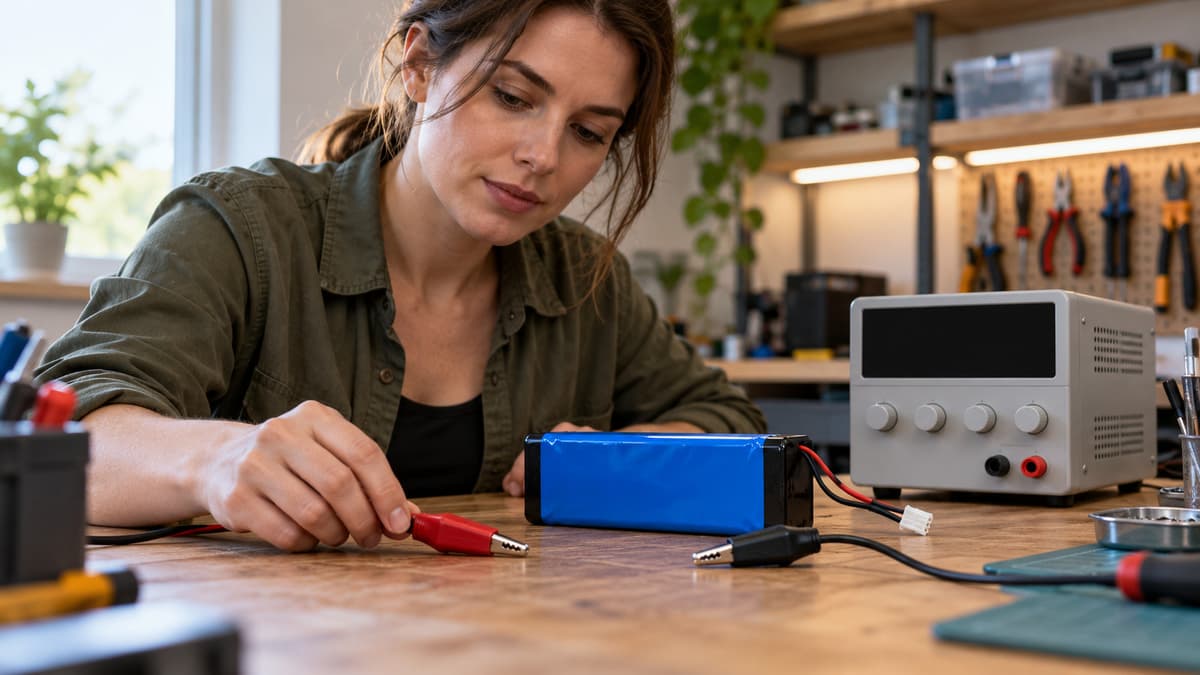
A bench supply is not a battery charger
A current limit holds a number. It does not end a charge the way a charger does.

What a bench power supply costs in the UK
The £40 unit and the £300 unit are not the same tool on a UK bench.