Bench power supply UK plug: check the BS 1363 lead

Check the bench power supply UK plug before you switch on. It should be BS 1363 with a BS 1362 fuse, and the rear panel must cover UK mains up to 253 V.
On this page

The part that decides whether you switch on is the plug in your hand. A bench power supply UK plug for a domestic 13 A socket should be a BS 1363 three-pin plug, with a BS 1362 fuse of the rating the maker specifies. Several units in this amazon.co.uk set print a British lead in one line and 115 V or 220 V in another. Only the rear panel and the plug you unpack can break the tie.
This page is from the Products Compared editorial team. Prices, star scores and the conflicts below come from the amazon.co.uk listings stored for the laboratory power supply comparison, as of 16 October 2026. Electrical Safety First, the Electricity Safety, Quality and Continuity Regulations 2002, and the Electrical Equipment (Safety) Regulations 2016 are the public frame. We did not lab-test the supplies. A qualifying purchase through our links can earn a commission at no extra cost to you.
In short
Look at the plug, the fuse and the rear voltage marking before the output button. A BS 1363 plug with a BS 1362 fuse is the household pattern Electrical Safety First describes for a UK socket. A 115 V attribute beside a British lead, a 220 V rating that stops at 242 V, and one review of a magnetic plug are reasons to pause. A CE or UKCA cell records a seller's claim.
What a sound bench power supply UK plug looks like
The plug body should carry a BS 1363 marking, the fuse should be a BS 1362 fuse, and the flex should be clamped so a firm tug does not pull the conductors out of the pins. A 13 A socket in England, Scotland, Wales or Northern Ireland is built to accept those three pins.
The fuse rating belongs to the maker. Electrical Safety First notes that household plugs commonly use 3 A or 13 A, which is a poor reason to fit 13 A because the socket says 13 A. If the plate or the manual names the fuse, follow that figure. If neither names it, leave the fuse that arrived. An empty carrier, or a fuse with no BS 1362 mark, means you stop.
A travel adaptor is the wrong repair. Equipment for a UK socket should arrive with a BS 1363 plug or a proper conversion. An adaptor adds a loose joint and often omits a BS 1362 fuse. A two-pin or flat-pin plug in the box means the British-lead line failed at delivery. Return it, or have a competent person fit a lead the manufacturer documents.
A 115 V table beside a British lead
The Nankadf WPS3010H, ASIN B09C8LWV9W, is listed at £59.99 with 4.4 stars from 1,517 reviews. The attribute table says 115 V AC and the bullets include a British standard lead. Read the rear panel with the unit unplugged. If it says 115 V only, UK mains are the wrong primary. If a 115/230 selector is present, set it to 230 V before the fan starts.
The Jesverty SPS-3010V, ASIN B0DDPVDWPZ, is the top pick for a general 30 V bench that may want 10 A, at £50.99 with 4.6 stars from 915 reviews. The bullets say AC 115 V / 230 V selectable. The attribute table says 115 V, and also 32 V and 320 W against a title of 0–30 V and 0–10 A. The best bench power supply page keeps the pick and the skip together: one 0–30 V rail after the selector is confirmed, and the wrong box for a second output or a stated millivolt noise figure.
The Nankadf WPS305H, ASIN B09C8MT4KM, at £49.99 with 4.5 stars from 1,045 reviews, has 230 V on the table and a British lead in the bullets. That is why it is the value case when 5 A is enough. Skip it above 5 A. Range, enable and plug sit together on the bench power supply buying guide.
A selector left on 115 V puts a UK socket, which may reach 253 V, onto a winding marked for half that. If the panel and the listing still disagree, leave the unit unplugged.
What one magnetic-plug review can tell you
One UK review of the Wanptek 30 V 5 A, ASIN B0CN6WRZFS, listed at £49.98 with 4.4 stars from 105 ratings, says the IEC lead, the UK plug and the fuse were magnetic. The reviewer read that as a non-copper conductor and a fuse outside BS 1362.
If the plug, the fuse or the IEC connector grips a magnet when a known BS 1363 plug in the same room does not, stop. This comparison withholds a recommendation for the 5 A Wanptek until that plug has been looked at. The WPS305H, a penny higher at £49.99, is the row whose table already says 230 V. The how to use page checks the BS 1363 plug before the first enable.
220 V plus or minus 10 per cent on UK mains
UK mains are nominally 230 V. The Electricity Safety, Quality and Continuity Regulations 2002 keep the low-voltage supply within +10 per cent and −6 per cent of 230 V, which is 216.2 V to 253 V. A rating of 220 V plus or minus 10 per cent runs from 198 V to 242 V. GPS LTD, writing about its own linear benches and not these amazon.co.uk boxes, notes that such a rating can stop at 242 V while a UK supply may reach 253 V.
The RUZIZAO R-SPS4001S, ASIN B0GX5PVZM9, at £319.96 with 4.0 stars from two reviews, prints that input at 50 Hz and an output of 0–400 V at up to 1 A. Leave that supply unless you already work at that voltage.
The Wanptek 30 V 10 A, ASIN B0CN6Y3T5K, at £50.92 with 4.5 stars from 379 reviews, prints 220 V and no tolerance. Borrowing GPS LTD's sentence does not stretch that cell to 253 V. If the rear panel includes 253 V, the panel outranks the table. If it only repeats 220 V, the gap stays open.
The RUZIZAO SPS-E3010 at £39.99 has bullets that say 100–240 V. If the panel matches, a UK socket sits inside the claim without a 115/230 switch. The same listing is 150 W, so 10 A reaches only 15 V. The other rows are on the laboratory power supply comparison.
What a CE or UKCA cell actually records
A cell that says CE, UKCA, UL or FCC is the seller's claim. We did not inspect a technical file for these ASINs. The Electrical Equipment (Safety) Regulations 2016 are the Great Britain framework for equipment designed for 50 to 1,000 V AC. Northern Ireland's market rules can differ from Great Britain's. A 13 A socket in either part of the UK still expects a BS 1363 plug. UL and FCC do not put a BS 1362 fuse in the plug.
Seeing BS EN 61010-1:2010+A1:2019 in a listing is different from holding a certificate for that ASIN. Match the rear panel to a window that includes 253 V, or to a selector on 230 V, then match the plug and the fuse. After that, set the current limit before the board, as the electronics repair page describes.
When to leave the lead unplugged
Leave the lead out for heat marks, a browned socket, a loose cord grip, exposed copper, a fuse with no BS 1362 mark, or a body that is not a BS 1363 plug. Pull the plug out by the body and leave the case shut.
Stop when you cannot resolve the disagreement with the unit unplugged: a 115 V-only panel, a selector you cannot see, a 220 V line with no tolerance that reaches 253 V, or a magnetic plug of the kind one Wanptek buyer described. Keep the original plug, the fuse and a copy of the listing. The Consumer Rights Act 2015 covers goods that do not match the description or are not of satisfactory quality.
Call a competent person for fixed wiring, for a lead the manufacturer says must be replaced, and for a 0–400 V rail even when the plug is perfect. If you employ people, the Electricity at Work Regulations 1989 put maintenance on you. HSE does not turn that duty into a compulsory test every twelve months. If you employ nobody, you still keep this supply away from any attempt to prove a socket.
Common questions
Should a bench supply arrive with a UK plug?
What fuse should a bench power supply plug have?
What did the magnetic-plug review on the Wanptek mean?
Is a 220 V power supply safe on UK mains?
What if the listing says 115 V but includes a UK lead?
Does CE or UKCA on the Amazon table settle the plug?
Can I use a travel adaptor on a bench supply?
When should I stop using the lead?

Products Compared publishes British-English buying guides based on amazon.co.uk listings and public UK sources. We do not run a lab and we do not invent test scores.
Related articles

Bench power supply cost UK: what £50 to £300 buys
Shelf prices here run from about £40 to about £320. The plug and the rear panel still need a look at every price.

Bench power supply stuck on CC: the limit is working
The CC lamp means the current limit is doing its job. Confirm the plug and the fuse before you treat the lamp as a fault.
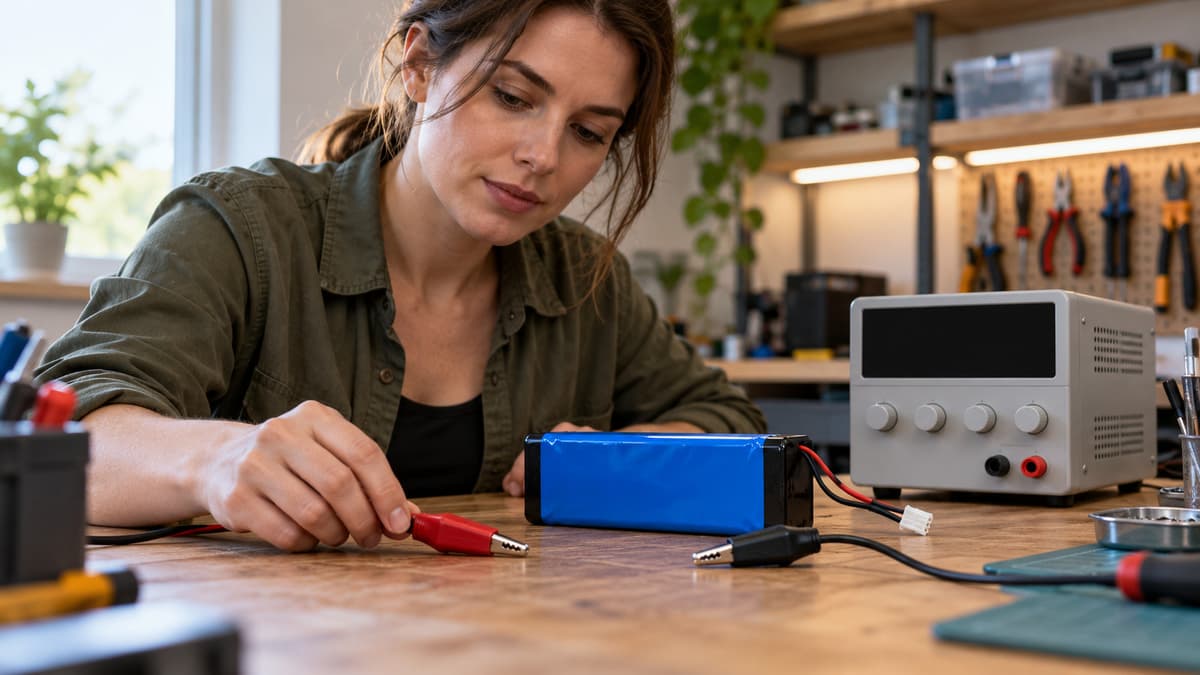
A bench supply is not a battery charger
A current limit is a ceiling you set for a circuit. It does not end a lithium charge the way a charger does.