Bench power supply stuck on CC: the limit is working

A bench power supply stuck on CC is holding the current limit, so the voltage falls. Switch the output off and check the load before you raise that limit.
On this page

You set 12 V, clipped the board on, pressed output, and the display fell to a volt or two while CC lit. A bench power supply stuck on CC is almost always holding the current limit you set, not announcing a dead instrument. Constant current drops the voltage once the load asks for more amps than you allowed.
This page is from the Products Compared editorial team. The mode explanation follows the Institution of Electronics and Electronics Info Line, plus the amazon.co.uk listings in our laboratory power supply comparison. Prices, stars and review counts are those listing figures as of 16 October 2026. We did not lab-test these supplies, and a live shelf price can move. A qualifying purchase through our links can earn a commission at no extra cost to you.
In short
A CC light on, with the voltage below the figure you set, means the current limit is active. Switch the output off before you touch the knob. Look for a limit that is too low, a short, or a reversed part. Do not keep raising the current until the lamp goes out.
What the CC lamp is doing
In constant voltage the supply holds the voltage you set, and the current follows the load up to the limit. In constant current it holds the current you set, and the voltage falls. The CV CC crossover is that handover. The lamp means it has already happened.
The Institution of Electronics states that the mode follows the voltage you set, the current you set, and the load resistance. At 12.0 V and a limit of 0.20 A, constant voltage holds only while the load draws less than 0.20 A. That boundary is 60 ohms. It is arithmetic, not a measurement we made. A limit left at 0.02 A by one encoder step crosses into constant current and pulls the voltage down.
Electronics Info Line reads that lamp, on a board you expected in constant voltage, as a short, a reversed part, or a limit set too low. A current limit is not a battery-charge profile. An alarm that shuts the rail off is a later event.
Why the voltage fell
The voltage fell because the supply would not exceed the current you allowed. A bench supply voltage dropped below the set point is the display showing what the load will support at that current.
A module that should draw about 200 mA, limited at 50 mA, sits in constant current and sags. Limited at 300 mA and still in constant current, that board is faulty. One encoder click can move 0.50 A to 0.05 A. A solder bridge and a regulator clipped the wrong way round look the same from the supply. You tell them apart with the output off.
The power ceiling is separate from the title. RUZIZAO SPS-E3010, listed at £39.99, is 150 W, so 10 A is only available down at 15 V. Abestop AT6301, listed at £99.99, cannot combine 60 V and 10 A inside 300 W. Wanptek's 30 V 10 A unit (B0CN6Y3T5K, £50.92) and Nankadf WPS3010H (B09C8LWV9W, £59.99) are 300 W, so 30 V at 10 A is the ceiling. We did not measure the fold point. Use the listing wattage.
Do not chase the lamp with more current
Switch the output off first. On the Nankadf WPS305H and WPS3010H the OUTPUT button is that enable. On the Jesverty SPS-3010V it is the same control unless OPN is on, in which case the listing says the rail follows the mains switch. Where no output switch is described, as with the Wanptek 30 V 10 A, unclip the board before you turn knobs. Terminals are live while the output is on. BS EN 61010-1 is the safety standard behind that caution.
Read the current that was set. If the module states 200 mA, a limit near that is a defended choice. About one and a half times the current you expect is a rule of thumb, not a British Standard. If you do not know the current, start far below the maximum. Enable briefly with nothing connected: the set voltage, current near zero, and constant voltage. Constant current at a justified limit means the fault is still in the load.
Do not raise the current until the CC light on goes out. Ten amps, because a title says 10 A, is more than a small track can survive.
The Jesverty, the top pick for a general 30 V bench, is listed at £50.99 with 4.6 stars from 915 reviews and a 0–10 A range. That 10 A is headroom for a motor, not a default for an unknown board. The Nankadf WPS305H, £49.99 and 4.5 from 1,045 reviews, stops at 5 A.
Clips, alarms and the wrong socket
Clips touching, or plus and minus bridged, put the supply in constant current. UK reviews of the Nankadf WPS305H complain about weak crocodile clips. A clip that falls off does the opposite: current collapses and the rail looks dead. Replace leads that will not stay on the terminal.
An over-current alarm is a different event. The WPS305H listing ties a long press to that alarm, and reviews describe a long press that silences the key beep. If current is still flowing and the CC lamp is on, you are in ordinary constant current. If the output stays shut, disconnect the load and follow that model's manual. Wanptek and Jesverty claim OCP without a shared key-hold.
With OPN enabled, the Jesverty listing says the output comes on with the mains switch, so a short can show constant current immediately. Disabled, the button holds the terminals off while you set the numbers. The centre post is mains earth. A reviewer found three posts and still only one output. The green socket is not a spare negative. USB is not the variable rail: Jesverty claims about 20 W, the Nankadf units about 18 W, and a Wanptek review says USB current is fixed.
When the supply has failed
With the leads apart you should see the set voltage, almost no current, and constant voltage. Constant current with no load means you switch off and unplug. Do not open the case. A hot case or a burning smell is the same stop. One UK review of the Wanptek 30 V 5 A, listed at £49.98 with 4.4 stars from 105 ratings, describes a magnetic plug and fuse. That is a lead fault, not a CC fault.
One Wanptek 30 V 5 A review describes a unit dead after about a month. One Nankadf WPS3010H review describes a failure after about three months, and another a snapped dial on arrival. That listing is 4.4 stars from 1,517 reviews. Use the return window.
Owner traces on cheap 10 A switchers cite roughly 80–200 mV peak-to-peak: about 100 mV at 7 A on a Wanptek 30 V 10 A, about 200 mV near 40 kHz on a Nankadf WPS3010H, and about 80 mV at 24 V and 300 mA. Those are owner figures, not our lab. They do not light the CC lamp.
Stop for fixed wiring, a calibration other people will rely on, or opening the supply. Employers are under the Electricity at Work Regulations 1989. The Health and Safety Executive does not require a yearly PAT test in every case, and a hobbyist who employs nobody is outside that duty. The RUZIZAO R-SPS4001S lists 0–400 V. A current limit does not make that a beginner rail.
Where the rest of the setup lives
This article starts from the lamp. Setting the voltage, the limit, connecting and enabling is the how to use a bench power supply page. What a small track can survive is on bench power supply for electronics repair. If the lamp is off and a scope is not quiet, the topology choice is on linear versus switching. Volts, amps and the watt ceiling are on the bench power supply buying guide.
The Jesverty SPS-3010V is the strongest general 30 V case after you confirm the mains selector: the bullets say 115/230 V selectable and the attribute table says 115 V. The Nankadf WPS305H is the value case at 30 V and 5 A, with 230 V on its attribute table and a British lead in the bullets. Constant current with the leads in the air means you unplug. Nothing here is a measurement of your supply.
Common questions
Why is the voltage lower than I set?
Is a CC light on a fault in the supply?
Should I raise the current until the CC lamp goes out?
What if an over-current alarm has shut the output off?
Can a short lead put the supply into constant current?
Does a CC lamp mean the supply is noisy?
How do I get back to constant voltage?
When has the bench supply actually failed?

Products Compared publishes British-English buying guides based on amazon.co.uk listings and public UK sources. We do not run a lab and we do not invent test scores.
Related articles
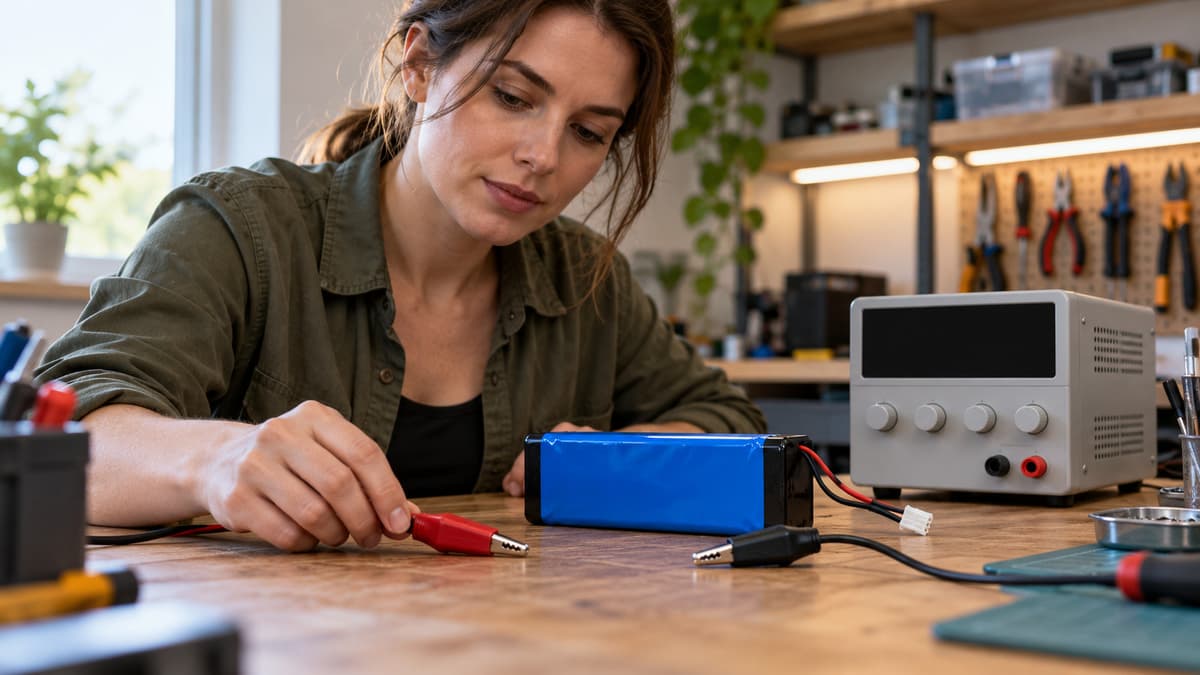
A bench supply is not a battery charger
A current limit holds amps. It does not end a charge the way a lithium charger does.

Switching noise on a hobby bench
Ripple on a cheap switcher is a different fault from a CC lamp. A digital board may not care.

Check the UK plug before the first switch-on
A marketplace lead can arrive with a plug that is not a sound BS 1363 fitting. Look first.