geotextile under driveway: when 100 gsm is only a start

A 100 gsm driveway listing states a mass for light domestic traffic. CBR, puncture and a BS 8661 profile belong on a datasheet these cuts omit.
On this page

Clay is on the spade, the MOT Type 1 is still in the bags, and the amazon.co.uk title in your other hand says geotextile under driveway at 100 gsm. That weight is a merchant starting point for light traffic. A California Bearing Ratio and a named BS 8661 profile are separate figures. The folded cuts in this set leave both unpublished.
On clay, the sheet keeps soil and stone apart so fines stay out of the sub-base you compact. Aggregate depth, compaction and a route for water remain part of the drive. The fabric is one layer. We read the drainage fleece listings on amazon.co.uk, EasyMerchant’s and BuildWiz’s weight notes, the Association of Geotechnical and Geoenvironmental Specialists’ account of BS 8661:2019, and a Green-tech page that prints a tensile figure these titles omit. This is the October 2026 snapshot. We ran no lab test. Check the live price. A qualifying purchase through our links can earn us a commission at no extra cost to you.
In short
Place a permeable separator between clay and the sub-base when you are building a light domestic drive and fines would otherwise mix into the stone. Treat 100 gsm as a merchant default for light use. A weak subgrade, heavier traffic or a BS 8661 profile asks for published strength, which these amazon.co.uk titles leave off the page.
Separation under the aggregate
The separator sits on the prepared subgrade, with the MOT Type 1 on top. Playbark’s how-to, one contractor view, puts the membrane between the subgrade and the sub-base. Stone is placed and compacted after that. A sheet dropped halfway through the Type 1 leaves the lower stone already mixed with the clay.
Joins spend area. EasyMerchant’s FAQ suggests about 200 mm of overlap. BuildWiz’s guidance uses 300 mm. Follow the lap on the datasheet you are working to. On an 8 m cut, a 300 mm lap leaves the piece short of an 8 m run once you turn back along a garage. Measure after the laps, then buy area.
The garden cuts on the drainage fleece comparison run from a 1.1 m trench strip to sheets 2.25 m wide, and from 6.75 m² to 22.5 m². A drive wider than the sheet needs a second run, and that run spends width on the lap. Shake a folded parcel out before the first barrow. A hole at the formation is the path clay will use. A damp-proof membrane stops water. In the separator’s place it can hold water in the stone.
What 100 gsm is being asked to mean
Grams per square metre are a mass. EasyMerchant says 100 gsm non-woven should be plenty for a general domestic driveway with light traffic, and points to 200 to 300 gsm for heavier use, a weak subgrade or a horse arena. BuildWiz uses about 80 gsm on firm ground, 100 gsm as the domestic default, and about 200 gsm where puncture is the risk. Neither page tested the Spudulica cuts. Green-tech’s GT 100 gsm page states 8 kN/m for that named sheet. These amazon.co.uk titles leave a tensile figure off the page, and a shared mass does not copy 8 kN/m across.
Prices are the October 2026 snapshot. The Caisse cut (B06ZZR2QKZ) is 2.25 m by 8 m, 18 m² at a stated 100 gsm, £37.55, 4.5 stars from 87 reviews, about £2.09 per square metre. One UK review laid it under MOT Type 1, and another kept a patio sub-base out of wet clay. A vehicle rating would be a published puncture figure, which this listing omits. The 2.25 m by 4.4 m fleece (B072HHCBLH) is 10 m² at £29.99, 4.1 stars from 47 reviews. The title mentions driveways. Weight and overlap are on the drainage fleece buying guide.
Water versus strength
A drive that holds water needs a sheet that lets water through. EasyMerchant describes non-woven membrane as needle-punched, the fabric used for French drains and soakaways, and woven membrane as less porous, with a higher load capacity, often under patios or asphalt.
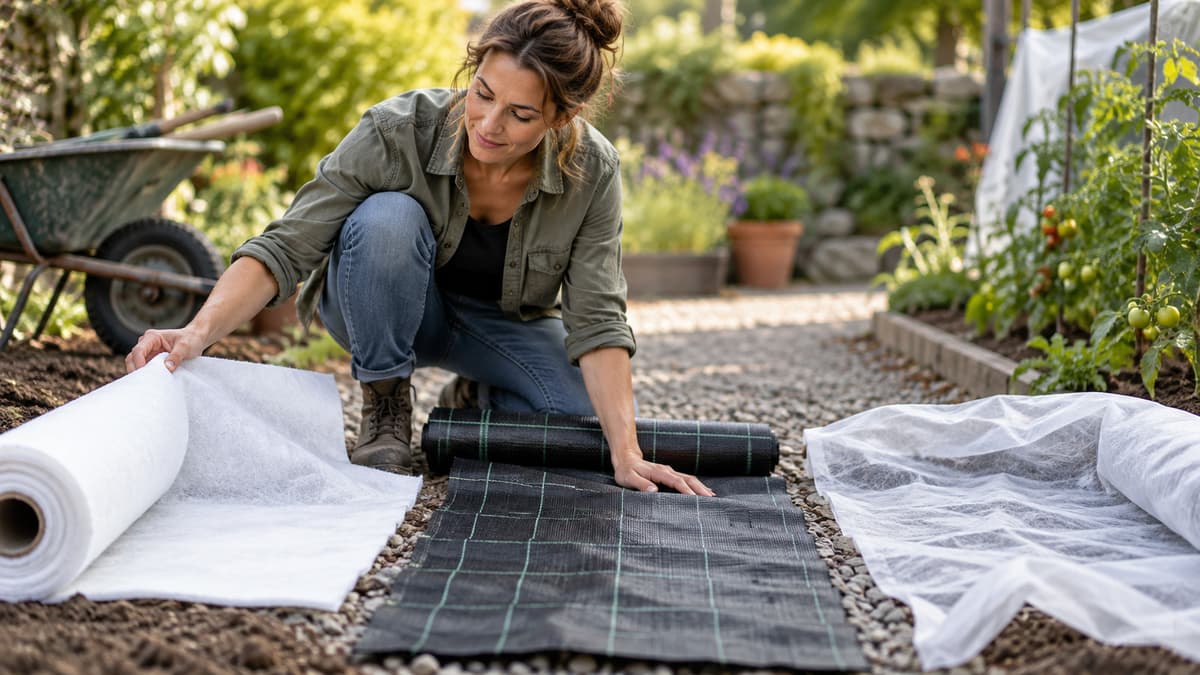
A black woven weed membrane is sold to block light under bark or gravel. Spudulica’s project note calls a woven sheet a poor drainage layer when the drive already holds water. Under Type 1 on clay that choice can leave a wet base. White non-woven fleece passes water and holds fines back, and it also lets light through. UK reviews in this set report grass rooting into fleece under decorative stone, and seed in the surface gravel can still grow. The fork is on drainage fleece vs weed membrane.
A 100 gsm non-woven title answers the light-traffic band in EasyMerchant’s note. Angular Type 1 and a plate compactor can still be too much for a sheet with no survivability figure. The AGS account of BS 8661 says opening size and permeability are measured on pristine samples. A tear during placement means that opening size no longer describes the sheet in the ground. Clay that pumps when it is wet is the filtration case.
When the listing is not enough
BS 8661:2019 is guidance for basic separation and filtration geotextiles. Ian Fraser’s AGS article, which he states as his view rather than BSI’s, covers separation under roads, paths and car parks, and says harder jobs need stricter design. The standard offers three profiles, chosen from the subsoil’s shear strength or CBR, from plant, traffic, fill size and layer thickness, and from how important filtration is. A designer can name a profile. The words “100 gsm” do not.
Those profiles use EN tests quoted for CE and UKCA marking, so they live on a datasheet. None of these amazon.co.uk cuts publish a CBR puncture figure, an opening size or a flow rate, so they make no compliance claim for BS 8661 or for BS EN 13252:2016. A driveway phrase in a title is a description. The 10 m² path review and the MOT Type 1 review on the 18 m² cut are reports about those parcels.
Ask for a datasheet when the subgrade is soft, the cars are more than light use, the fill is coarse, or someone will ask which profile you used. The best drainage fleece page sends a trafficked base to a sheet with numbers. The 18 m² cut is the wider piece here with a MOT Type 1 review, if you accept the missing puncture figure. The 10 m² title a reviewer limited to a path stays a path piece.
A folded cut on the day you lay it
These pieces arrive folded. The 1.1 m by 10 m fleece (B07CKQ1C1D) is 11 m² at a stated 100 gsm, listed at £30.91, with 4.6 stars from 319 reviews, and it comes boxed. One UK review measured a piece short of 10 m, so tape it before you cut to the formation. That width lines a trench. Crossing a drive means several lengths side by side, and each length gives up a lap.
Strip to the formation and dig out soft spots, rather than asking the fleece to bridge them. Where the drive falls, keep the upper sheet over the lower one. Pin the edges so the first pass of stone does not ruck the fabric. Soil that rides in with the Type 1 is the silt the fleece was there to stop, and compaction then works that silt under the wheels.
Cover the sheet with the sub-base before anyone parks. Polypropylene left in the sun is an installation exposure. Cut edges and pegs are sharp, so keep gloves with the knife. A drive that needs a digger, a scan for services, or a soakaway that building control will assess has left a folded garden cut behind. Trench order, stone and pipe sit on how to lay drainage fleece.
Common questions
Does every domestic drive need geotextile?
Is 100 gsm the driveway grade?
Should the sheet under a wet drive be woven or non-woven?
Does the geotextile sit under the MOT Type 1 or inside it?
What is a BS 8661 profile?
Can I use a folded amazon.co.uk cut under a drive?
What did reviewers say about thin fabric?
When do I need a datasheet instead of a 100 gsm title?

Peter F. is the editor for DIY & tools at productscompared.co.uk. Comparisons in this category are checked against amazon.co.uk listings, review evidence and public UK sources.
Related articles
Choosing ground fabric
Fleece, weed membrane and frost fleece can share one search. Match the sheet to water, light or a plant cover before you buy.

Covering geotextile after you lay it
Polypropylene is specified to be covered. Sunlight is an installation exposure, so white fleece is a layer you bury the same day.

The base under artificial grass
The permeable sheet is one layer in a base. It leaves the stone, the fall and any declared strength still to be chosen.