Woven or non woven geotextile: which fabric for the job
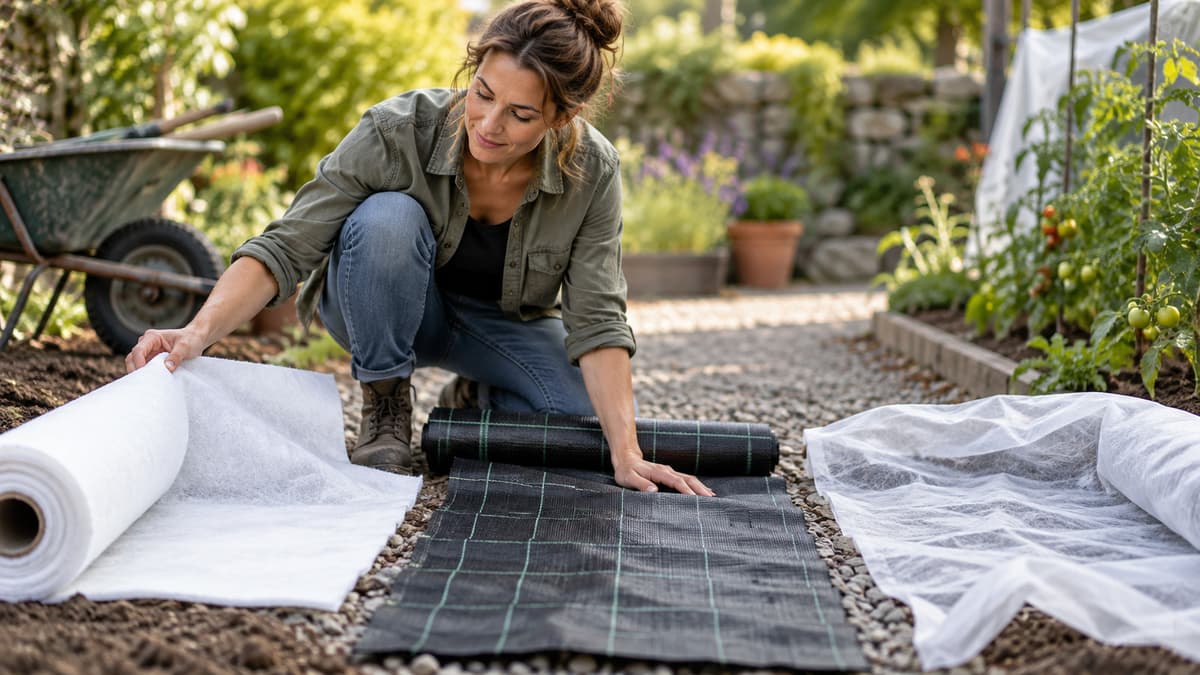
Woven or non-woven geotextile, weed membrane, and frost fleece do different jobs. Match the sheet to drainage, weeds, or plants before you buy a roll.
On this page

You have three parcels on the path, or three amazon.co.uk tabs, and every title says fleece or membrane. One piece is a white felt. One is a black grid of plastic tape. One is the thin cloth you used on the tomatoes. Woven or non woven geotextile is the split that tells you whether water is supposed to pass. The other two products in that search are a weed sheet and a plant cover. They can share a word on the packet and still fail the hole you have just dug.
This page is the map for that mix-up. It was updated on 16 October 2026 from the drainage-fleece and weed-membrane listings on amazon.co.uk, and from public notes by Geoworks, Cotterill Civils, Travis Perkins, and Principal. We did not classify a sample in a lab, and we did not install a drain. A qualifying purchase through our links can earn a commission at no extra cost to you.
In short
Use non-woven geotextile where water has to pass and soil fines have to stay out of clean stone, a pipe, or a soakaway crate. Use a covered black woven weed membrane where the base already drains and the complaint is seedlings under bark or gravel. Use horticultural frost fleece only as a plant cover. Grams per square metre do not choose the construction, Terram is a brand, and a damp-proof membrane is an impermeable sheet.
The words on the packet
Woven geotextile is yarns or tapes crossed into a cloth. On a garden weed roll you can often see the grid. Cotterill Civils puts that construction where you need tensile separation, and Travis Perkins' geotextile category copy puts woven fabric on stabilisation. The sheet keeps two layers from mixing while it takes a pull.
Non-woven geotextile is fibres bonded into a felt. Water is meant to pass, and fine soil is meant to stay on the soil side. Geoworks marks soakaways and sustainable drainage for non-woven fabric. Travis Perkins puts non-woven cloth on soakaways and land drains.
Some trade copy calls woven geotextiles generally impermeable. That is too blunt for a garden weed sheet sold as letting water through while it blocks light. Colour misleads in the same aisle: white felt is the usual drainage fleece here, and black tape is the usual weed membrane, but a black felt can exist. A damp-proof membrane stops moisture, including as a geomembrane on a tank that must hold water. A drainage geotextile is specified because water has to move.
Drainage, weeds, and frost
Drainage fleece in this hub is the permeable non-woven. You line a trench or wrap a crate so clean stone stays clean. UK reviews in the drainage set report grass rooting into the textile. On one Spudulica cut, a review describes grass coming through decorative stone. Growtivation's note on white Draintex-type geotextile is that weed suppression is not the job.
Weed membrane is the sheet you peg on cleared soil and hide under bark, slate, or gravel. In UK retail it is usually black woven polypropylene, sold so light does not reach annual seedlings. Groundtex's installer note asks for at least 100 mm of overlap, about 50 mm of cover, and an edge turned into a small trench. Weeds still grow in dust that settles on the gravel. Perennial roots already in the ground come out before either fabric goes down.
Frost fleece is a plant cover. An Ambassador horticultural fleece at 17 g/m² turned up in the drainage search and was removed from that set because it will not line a trench. The Lucky Reptile HF-100, ASIN B009SB1LSC, is a further lookalike: a terrarium hydro fleece at about 100 cm by 50 cm and £8.99. It separates vivarium substrate. A French drain will not fit on that piece.
A simple job map
If the lawn holds water and you are lining a trench around a perforated pipe, non-woven fleece goes on the soil side of the clean stone. Drainage Superstore's sequence holds the fabric up the sides, adds aggregate, lays the pipe, adds more aggregate, and closes the fabric. Soil tipped in with the gravel is the silt the felt was meant to stop. Overlaps in the notes we used are 150 mm, 200 mm, or 300 mm, depending on the detail. An 8 m cut does not finish an 8 m trench once a 300 mm join takes its share.
The top pick for a short trench is the Spudulica 1.1 m by 8 m fleece, ASIN B06ZYB3XDK: 8.8 m², stated 100 gsm, £29.55 when this set was read, 4.9 stars from 45 reviews. One UK review describes a 300 mm clay trench, this fleece, about 20 mm rounded gravel, and a perforated pipe. Forty-five reviews are a small sample, and the star line is not a permeability test. The narrow width suits a trench. A wide patio wants a wider cut on the drainage fleece comparison.
An infiltration crate needs the same non-woven behaviour. Growtivation contrasts Draintex-type felt with woven Groundtex and keeps the woven sheet off the crates, because water has to enter the void. A geomembrane suits a tank that must hold water. If the crate serves a building, siting and size sit with building control. BRE Digest 365 asks for geotextile between granular fill and the soil, and it says not to wrap geotextile around concrete ring units.
Under decorative gravel, split the complaint. A path that already drains, with weeds in the joints, takes a covered weed membrane from the weed membrane comparison. Gravel that is drainage stone, or a path that holds water, takes the non-woven separator, and you will still weed the fines on top. A drive that carries vehicles, or a fitted lawn with a named membrane, wants a datasheet rather than a consumer gsm line.
What the grams do not tell you
Grams per square metre are a mass, and only when the figure is on the specification table. They do not say woven or non-woven, and they do not say how large the openings are or how fast water passes. Principal's pocket guide uses under about 35 microns when the aim is weed control, and about 100 to 150 microns when the aim is drainage. That is Principal's split. These amazon.co.uk cuts do not publish an opening size, so 100 gsm cannot be parked in either band.
Merchant guides treat about 100 gsm as a domestic starting point for French drains, crate wraps, and light sub-base separation. A printed 100 gsm does not show that the cut meets BS EN 13252:2016, the standard for geotextile characteristics in drainage systems, or BS 8661:2019, the guidance on basic separation and filtration. On B074S46496 the specification table states no gsm, and a UK review reports a piece advertised around 100 gsm that arrived stamped Lotrak 80. Read the stamp before you treat that cut as 100 gsm.
Weed-membrane listings are thinner still. Only some rolls state a gsm. Others say "heavy duty". A printed 150 g/m² still does not tell you the weave. That check sits on the woven or non-woven weed membrane page. Terram is a brand, not a fabric type. One grade can be a non-woven separator with a datasheet. An unbranded felt is a different product.
Where the comparisons take over
Width, stated weight, and spare for overlap are on the drainage fleece buying guide. Fleece, stone, and pipe order are on how to lay drainage fleece. The drainage fleece versus weed membrane page is the fork if you are still choosing between a pale filter and a black weed sheet.
Cover polypropylene when the laying is done. Lotrak treats ultraviolet light as an installation exposure, so the white felt is not a surface you leave for the summer. Groundtex's note describes about 50 mm of bark, slate, or gravel. A trafficked drive, a weak subgrade, or a soakaway that building control will assess is the point to buy a declared datasheet or to call a contractor.
Common questions
What are the three fleeces people mix up?
When is woven geotextile the right cloth?
When is non-woven geotextile the right cloth?
What is a damp-proof membrane doing in this search?
Is Terram a type of fabric?
Which comparison should I open?
Does gsm decide woven or non-woven?
Can one roll do every garden job?

Peter F. is the editor for DIY & tools at productscompared.co.uk. Comparisons in this category are checked against amazon.co.uk listings, review evidence and public UK sources.
Related articles

Weeds coming through decorative gravel
Drainage fleece and weed membrane are both sold under gravel. The right sheet depends on whether the path holds water.

Covering geotextile after you lay it
Polypropylene fleece is specified to be covered. Sunlight is an installation exposure, so the sheet is not the finished surface.

The base under artificial grass
The permeable sheet is one layer in a synthetic lawn base. It does not replace the stone or the fall.