Weed membrane under gravel: which sheet to buy

Decorative gravel goes weedy when light reaches the soil or when seed roots in the stone. Choose a weed membrane or a drainage fleece for the job you have.
On this page
The gravel looked finished in April. By July, grass is threaded through the golden stones, and the pale sheet at the edge is full of roots. A weed membrane under gravel is the light-blocking layer for that path, and it is a different product from the drainage fleece often sold on the next line of the same search. One starves seedlings in the soil of light. The other lets water through and keeps soil fines out of the stone. Buy the first for a cleared decorative path. Buy the second when the gravel is part of a drain.
This page is from Peter F., editor for DIY & tools. The laying figures come from public UK supplier notes, including Sherborne Turf, Growtivation, and the Principal Building Products geotextile pocket guide. Prices and star lines are from the amazon.co.uk listings in our weed membrane comparison, captured for that page. We did not run a laboratory test. A qualifying purchase through our links can earn a commission at no extra cost to you.
In short
Grass in new gravel is usually seed rooted in the stone, or roots in an open fleece that was never a light block. Use a covered weed membrane on a cleared bed, with an overlap of about 100 mm and at least 50 mm of stone, as in Sherborne Turf’s laying note. Use drainage fleece when the job is filtration. Neither sheet clears seed that lands on top, and neither replaces a fall if the path floods.
Two reasons gravel goes weedy
The first reason sits in the gravel itself. Decorative stone is full of gaps. Dust, leaf litter, and blown seed collect there, and a wet British spring turns that grit into a seedbed. The plant you pull has its roots in the fines between the pebbles. The sheet underneath can be intact and black, still keeping light off the soil. Sherborne Turf’s buying guide makes the same observation: later weeds often grow in the covering.
The second reason is the sheet. A white or pale non-woven fleece is a weak light block. Growtivation’s geotextile chooser treats that pale felt as a poor weed barrier because it is built to pass water, and light comes through with the water. The Principal Building Products pocket guide draws the same line in opening size: weed-control fabric under 35 microns, drainage fabric around 100–150 microns. Those figures describe product classes in a trade guide, and they describe your roll only when the listing prints an opening size. Reviews on these categories describe grass rooted into fleece under bark, and under a stone layer several inches deep.
You can tell the two apart with a trowel. Roots only in the grit, over a continuous dark sheet, mean surface seedlings. A felted white mat with roots in the fibres means a drainage geotextile used as a weed stop. A green crown, a white rhizome, or a mare’s-tail shoot from under the sheet means the bed was covered while the weed was alive.
When you want a weed membrane
Choose a weed membrane when the soil is cleared, the path is decorative, and you are buying a light block. In UK garden retail that sheet is usually black woven polypropylene, laid on prepared ground and covered with bark, slate, or gravel. Water is often claimed to pass. Treat that as a listing claim. A drainage design still needs a fall, and these packets do not print a flow rate.
Match the width to the path. A 1 m roll means a seam every metre. A 2 m width covers a typical footpath in one piece, so a 2 m × 10 m roll is a useful default for about 20 m². A drive is a different order. The weed membrane comparison holds the sizes, stated weights, and amazon.co.uk review counts. The under-gravel guide stays with stone depth and the point where a path stops being a path.
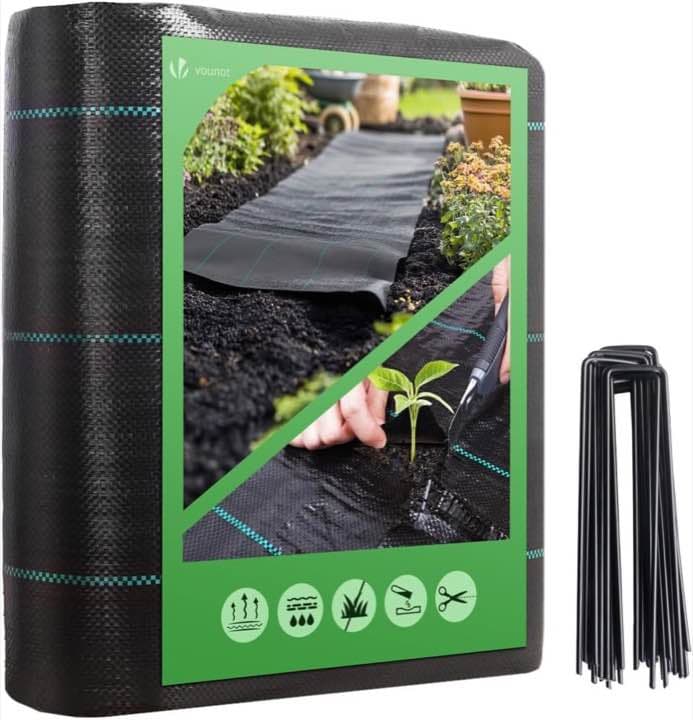
The top pick in that set is the VOUNOT 2 m × 10 m, listing B0895LY6F1. It states 100 gsm woven polypropylene, includes 30 U-shaped pegs and guide lines, and shows £11.90 with 4.6 out of 5 from 4,562 reviews. Skip this roll if you already own pegs and only want the cheapest 20 m² cut with no stated gsm.
Perennial crowns need digging out, or they come through joins. Invasive plants such as Japanese knotweed sit outside a retail membrane, and moving contaminated soil is a waste question in GOV.UK guidance.
When you want drainage fleece
Choose drainage fleece when water is the brief. It is a permeable non-woven geotextile that lets water through and keeps soil fines out of clean stone, a perforated pipe, or a soakaway crate. Geoworks points soakaway and sustainable-drainage details toward non-woven fabric. A woven weed membrane is a poor crate wrap, because that weave is there to block light. If you searched “geotextile under gravel” because the path holds puddles, you are in this column.
The pale colour is the clue. The same white fleece that fails as a weed stop is often the right separator under a wet path, because it stays open. Merchant guides, including EasyMerchant, treat about 100 gsm as a domestic starting point for crate wrap, French drains, and light separation. BS EN 13252 is the drainage-geotextile standard, and these garden listings do not show it. One UK review in our drainage set reported a lighter stamp than the title, so read the spec table.
Fleece can stop soil pumping up into the decorative stone. It does not create a fall or an outfall. Water against the house, a building-control soakaway, or a digger are outside a folded garden fleece. Our drainage fleece comparison is the filter range. The fork between the two sheets is the page to open while both packets are in the basket. If you stack a weed membrane over fleece and block the only route out, the path becomes a tray. Leave the water a way to leave.
Cover, overlap, and what reviews show
Sherborne Turf’s guide asks for a covered fabric, an overlap of about 100 mm, and at least 50 mm of cover. A sheet left bare while you wait for the stone is taking ultraviolet light the stabiliser was only meant to soften.
Supplier laps do not agree, so use the figure for the sheet you bought. Groundtex’s installer note says at least 100 mm, a 50 mm cover, and an edge turned down about 100–150 mm. Hy-Tex suggests 150 mm on Covertex. GravelMaster uses 100 mm for weed suppression and 300 mm for ground stabilisation. Lap so water runs over the join if the path has any fall. A 20 mm overlap opens under a wheelbarrow.
A repeated theme is grass rooted into fleece under bark, or under stone described as several inches deep, around 4–6 inches. That is shopper testimony, and it matches an open felt: the openings stay open under 50 mm or under 150 mm. Scrape back a trowel-sized patch before you buy a second tonne of stone. Cut edges on woven sheet fray if you leave them uncovered, so cut with scissors or a knife and gravel the cut the same day, including the triangle by the step.
Pegs, joins, and the weeds that return
Pins hold overlaps until the gravel arrives. They matter on a breezy day, when a 2 m sheet becomes a sail, and they are optional only if you will weigh the whole area before you leave. In our weed membrane set, pegs are named on a minority of rolls. The VOUNOT listing includes 30 U-shaped pegs. Several cheaper 2 m rolls do not name pins, so budget a bag in the same order.
Lay a footpath in one session. Clear live growth, including couch and bindweed crowns, and take off loose soil that would hump under the sheet. Lay the fabric at the overlap your supplier states, using about 100 mm when you are following the Sherborne Turf gravel note. Pin or weigh the joins so they stay shut while you barrow. Cover with at least 50 mm of gravel the same day, and turn the edge down so the stone has a lip. That sequence is for a cleared footpath. A domestic drive needs a sub-base and a separation fabric chosen for load. The laying guide carries the order without the price table.
Common questions
Why is grass growing in my new gravel?
Is white fleece a weed stop?
How deep should gravel be on a weed membrane?
Do weeds grow in the gravel itself?
Which sheet should I buy if the path also floods?
Will pegs fix a fabric that is the wrong type?
Is a light landscaping fabric the same as 100 gsm drainage fleece?
Which comparison should I open?

Peter F. is the editor for DIY & tools at productscompared.co.uk. Comparisons in this category are checked against amazon.co.uk listings, review evidence and public UK sources.
Related articles
Choosing ground fabric
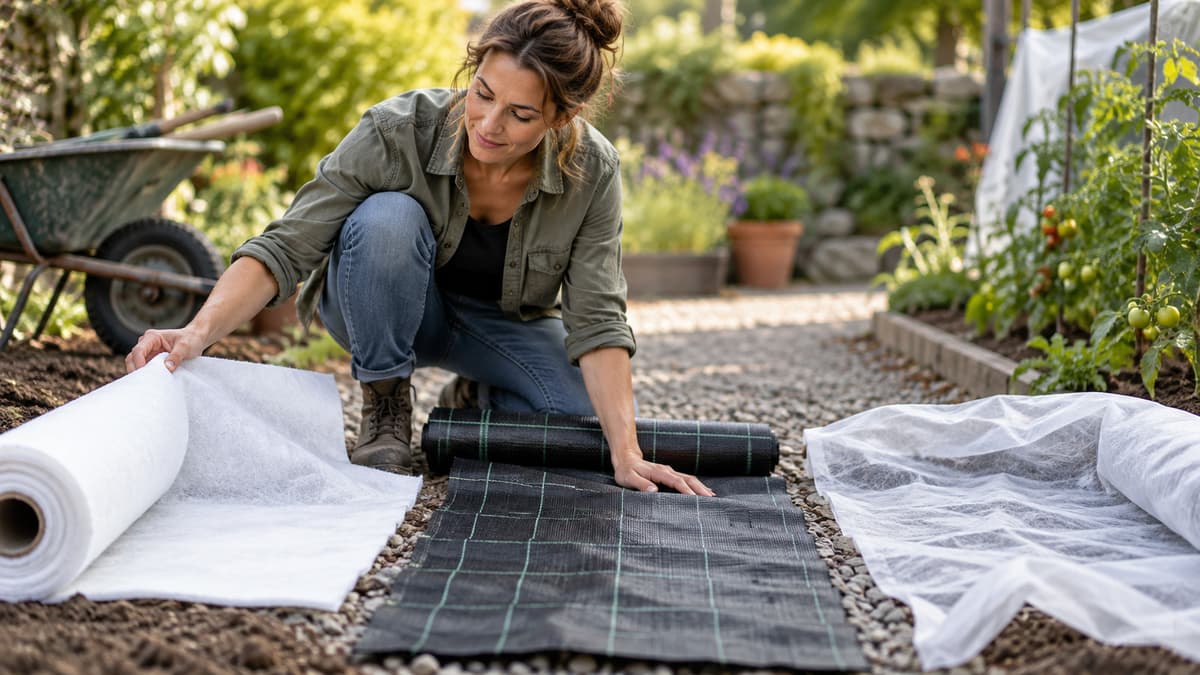
Fleece, weed membrane, and frost fleece share a word and do three different jobs.

Covering geotextile after you lay it
Polypropylene is meant to be covered. Sunlight on a bare sheet is an installation exposure.

Geotextile under a domestic drive
A 100 gsm title is a merchant starting point for separation, and a drive still needs a base.