Independent comparisons. We may earn from shop links. More info

Drainage fleece vs weed membrane

Updated: 16 October 2026

You searched both products because the path, the bark bed, or the crate all seem to want membrane, and the listing titles do not split the job. Drainage fleece vs weed membrane is that split. One sheet is there to let water through and keep silt out. The other is there to block light under a cover. The drainage cuts, prices, and review lines sit on the [drainage fleece comparison](/hub/weed-control/drainage-fleece). Woven garden sheets have their own comparison at [weed membrane](/hub/weed-control/weed-membrane). The Products Compared editorial team updated this page on 16 October 2026 from the amazon.co.uk listings in this set and from public UK geotextile notes. We did not run a lab test. If you buy through our links, a qualifying purchase can earn us a commission at no extra cost to you.

You searched both products because the path, the bark bed, or the crate all seem to want membrane, and the listing titles do not split the job. Drainage fleece vs weed membrane is that split.

Our top picks

On this page

Two jobs

Drainage fleece in this category is a non-woven geotextile. Geoworks points soakaways and land drains to that construction because water has to pass while soil fines stay back. Cotterill Civils makes the same trade in trade language: woven fabric where you need tensile separation, non-woven fabric where water must pass. Travis Perkins’ geotextile category text puts non-woven on soakaways and land drains, and woven fabric on stabilisation. A weed membrane is the garden sheet sold to sit under bark, slate, or gravel and starve annual seedlings of light. Principal’s pocket guide draws a useful line on opening size: under about 35 microns when the aim is weed control, and about 100 to 150 microns when the aim is drainage. That is Principal’s split, not a measurement of the Spudulica cuts here. Those listings do not publish an opening size, so you cannot look at 100 gsm and claim either band. Gsm is a mass. It does not tell you whether the pores are tight enough to shade soil or open enough to drain a trench. A gravel path shows both jobs at once, which is why people buy one roll for two problems. If the path already sheds water and the complaint is weeds in the joints, a covered weed membrane matches the complaint. If the path is a French drain in disguise, or the gravel is the stone around a pipe, the non-woven fleece matches the complaint. Spudulica’s project note says a woven sheet is a poor drainage layer when the drive already holds water.

Under stone or bark

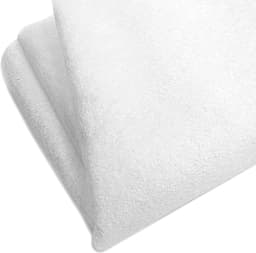
White drainage fleece disappoints people who bought it as a weed stop. It is pale, so it does not exclude light the way a black woven weed fabric does. Growtivation notes that point for white Draintex-type geotextile: weed suppression is not what the sheet is built to do. UK reviews in this drainage set report grass rooting into the textile. On the Spudulica Powerroad 20 m² fleece, a review describes grass coming through decorative stone. The fleece can still separate stone from soil. It does not become a weed membrane because the title mentions weeds. Sherborne Turf’s weed-membrane guide talks about 70 gsm non-woven landscaping fabric as a covered layer under gravel, and it says later weeds often grow in the covering itself, in the dust and fines that settle on top. That 70 gsm landscaping fabric is not the 100 gsm drainage fleece in this category. Mixing the two numbers produces a product neither page is selling. A drainage cut at a stated 100 gsm is still a filter felt. A 70 gsm landscaping sheet is still a light garden fabric. Neither figure is a promise that the bed stays bare. Under decorative gravel, choose by the failure you are trying to avoid. If water must leave the build-up, and you will accept some weeding, non-woven fleece is the separator. If the base already drains and you want a dark sheet under 50 mm or so of bark or stone, use a weed membrane and cover it. Weeds that arrive in the mulch itself will still grow, whichever sheet is underneath. Perennial roots already in the ground are a clearance job before either fabric goes down. Weight and width for the drainage cuts are on the drainage fleece buying guide.

Around a drain or crate

A soakaway crate or a French drain needs the non-woven fleece on the soil side of the stone. Wrapping those crates in black weed membrane asks a light-blocking woven sheet to act as a filter. Growtivation’s crate guidance contrasts non-woven Draintex with woven Groundtex and keeps the woven sheet off the crates. Water still has to enter the void. A tight woven fabric can slow that, and it is the wrong risk on an infiltration crate. The same limit applies to the pipe trench. Line the trench with drainage fleece, close it over clean stone, and cover it. The laying sequence is on how to lay drainage fleece. Weed membrane stays in the beds and under decorative surfaces where drainage is already sorted. Some products are neither. Horticultural frost fleece is a plant cover. The Lucky Reptile hydro fleece is a terrarium sheet. A damp-proof membrane or a geomembrane is impermeable, which is what you want on a storage tank that must hold water, and what you do not want around an infiltration crate that must let water go. If a single sheet is being asked to filter, to block light, and to waterproof, it will miss at least one of those jobs.

Buy for the failure you cannot accept

If silt in a pipe or a crate is the failure you cannot accept, buy non-woven drainage fleece and cover it. If weeds under bark or decorative stone are the failure, and the base already drains, buy a weed membrane and cover that too. Do not treat a 100 gsm line as a British Standard, and do not treat a star rating as a filtration test. Frost fleece, terrarium fleece, and a damp-proof membrane stay out of both jobs.

Common questions

Can one sheet do both jobs?
A marketplace title can claim both, and the fabric still has one main behaviour. Non-woven drainage fleece passes water and keeps fines back. Weed membrane is sold to block light. Principal’s guide separates a tight opening for weed control from a more open one for drainage, and these amazon listings do not publish that opening size. Buy the sheet for the failure you cannot accept, and cover a weed sheet so it is not the finished surface.
Why did grass come through the fleece?
Because the fleece is not a light block. UK reviews in this set report grass rooting into the textile, including under decorative stone on a 20 m² cut. White fabric lets light through, and dust in the gravel gives weed seeds a place to grow above the sheet as well. A thicker mulch hides the colour. It does not turn the fleece into a weed membrane.
Is black weed membrane all right around a crate?
Use non-woven drainage fleece around infiltration crates. Black weed membrane is the light-blocking garden sheet, and crate guidance that contrasts Draintex with Groundtex keeps the woven fabric off the crate. A storage tank that must not leak is a different detail and usually needs a geomembrane, which is not a weed membrane either. Follow the tank instructions for that case.
What should go under decorative gravel?
If the gravel is only a mulch and the base already drains, a covered weed membrane matches a weed complaint. If the gravel is drainage stone, or the path holds water, non-woven fleece is the separator and a woven sheet is a poor filter. Weeds will still grow in soil that collects in the gravel. Sherborne’s 70 gsm landscaping fabric is a third product, not these 100 gsm drainage cuts.
Does white fabric block light?
White non-woven fleece does not block light the way a black weed membrane does. Growtivation makes that point for white geotextile, and reviewers here have seen the pale sheet through thin chippings. Cover it for appearance and for ultraviolet exposure. Do not specify it as a shade cloth for a bed.
Is 70 gsm landscaping fabric the same as 100 gsm drainage fleece?
No. A 70 gsm landscaping fabric in a weed-membrane guide is a light covered garden layer. The drainage cuts in this set are mostly sold as 100 gsm non-woven filter fleece, and one listing does not even state gsm in the specification table. The numbers are not interchangeable, and neither number is an opening size or a puncture grade.
What should this comparison refuse to claim?
It should refuse to claim that any drainage cut stops weeds, that 100 gsm means a British Standard has been met, or that a star rating is a filtration test. It should also refuse to treat frost fleece, terrarium fleece, or a damp-proof membrane as a substitute. The drainage comparison assumes you already want filter fleece. This page is only the fork.

Related pages

Sources

Public UK sources from the research digest. Shelf prices and star lines are the amazon.co.uk figures in the product listings used for this page. gsm, permeability and puncture lines are listing claims or review notes, not a test run for this page.

  1. Approved Document H: drainage and waste disposal (retrieved October 2026)
  2. CNC Building Control: soakaway size FAQ (retrieved October 2026)
  3. BRE Digest 365 via UNDA (retrieved October 2026)
  4. BS EN 13252:2016 geotextiles for drainage (retrieved October 2026)
  5. AGS: BS 8661:2019 geotextile guidance (retrieved October 2026)
  6. Geoworks: where to use geotextiles (retrieved October 2026)
  7. EasyMerchant: geotextile membranes explained (retrieved October 2026)
  8. Growtivation: fabric for wrapping soakaway crates (retrieved October 2026)