Independent comparisons. We may earn from shop links. More info

Drain rods vs a pressure washer jetter at home

Updated: 17 October 2026

Choosing drain rods vs a pressure washer jetter depends on what is blocking the pipe and where you can reach it. Rods can punch through a soft, local obstruction from a chamber; a domestic jetter hose uses the washer's water flow to loosen material and wash the bore. Neither method is equivalent to a drainage firm's camera and van-mounted jetter. Make the tool decision first, then use our [drain cleaning hose comparison](/hub/tools/drain-cleaning-hose) only if a compatible washer hose suits the job. A qualifying purchase can earn a commission at no extra cost to you.

Choosing drain rods vs a pressure washer jetter depends on what is blocking the pipe and where you can reach it.

Our top picks

Nilfisk Nilfisk 15 m bayonet

Best overall

Nilfisk Nilfisk 15 m bayonet
8.8/10about £39.12
STYDDI STYDDI 15 m, 180 bar

Rank 2

STYDDI STYDDI 15 m, 180 bar
9.2/10about £28.87
OHAYORI OHAYORI 15 m

Best value

OHAYORI OHAYORI 15 m
9.0/10about £24.99
On this page

What drain rods do, and where they stop

Drain rods are rigid sections screwed together to push, twist and retrieve a tool through a drain. From a safe ground-level chamber they can open a path through a soft obstruction such as paper that is close enough to reach. They need no pressure washer and produce less spray. Opening a channel is not the same as cleaning the pipe. Rods can leave grease, silt or scale on the wall. Tight bends can stop them, and force can damage weak pipework or drive material farther along. If resistance feels hard or identical on repeated attempts, diagnosis is more useful than more leverage. Confirm responsibility before you work beyond your boundary or into a shared system.

What a washer hose does instead

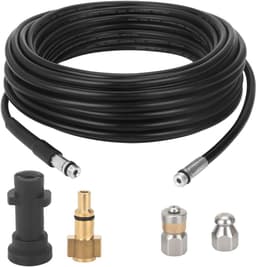
A pressure washer jetter hose carries water to a small nozzle inside the drain. Rear-facing jets help pull the hose forward and return loosened debris; a forward jet works on a local obstruction, and a rotating nozzle may wash more of the pipe wall. That suits leaves, silt and greasy residue in a reachable gully or larger waste run. The cleaning force still comes from the washer you own. A title that says 400 bar or 5800 psi is a claimed hose ceiling, not the pressure at the nozzle. The adapter must match the gun, and the nozzle must enter without being forced. Kärcher's pipe-cleaning set specifies at least 40 mm pipe, a bend radius of 70 mm or more and bends no sharper than 90 degrees. Follow the nozzle-inside-before-pressure sequence in our how to use a drain cleaning hose guide.
Nilfisk Nilfisk 15 m bayonet

Testsieger

Nilfisk Nilfisk 15 m bayonet
8.8/10about £39.12

A contractor's van jetter is a third option

Professional drain jetting is not a longer version of a £25 hose. A firm can use high-flow equipment, specialist nozzles and a camera to identify roots, displaced joints, collapse or a recurring restriction. Rods open a channel; jetting scours residue. That distinction is useful. A claim that every blockage needs a van jetter is not. A leaf-blocked gully is not the same problem as roots in a shared sewer. One HuaCommerce reviewer still hired a firm for roots. Checkatrade's October 2026 guide gives ballpark averages of about £85 for rodding, £185 for jetting and £200 for a CCTV survey. Location, access and the fault change the price. These are planning figures, not a quote. Call a professional when the blockage returns, the pipe may be damaged, or sewage is backing into the property. Do not enter a chamber to extend either tool.

Which method should you choose?

Choose rods when a soft blockage is close to a safe chamber and you can work from ground level. Stop if a joint loosens or the obstruction feels hard. Choose a domestic jetter when you already own the washer, the adapter fits, the head can enter and the task is washing a reachable gully or private run. It has an advantage when residue on the wall is part of the problem. A 10 or 15 m hose is easier to manage than surplus 30 m beside a short gully. Choose a firm when roots, collapse, a repeat blockage or unknown pipe ownership is in play. In England and Wales, a drain serving only one property is generally yours, while shared lateral drains and sewers are normally the sewerage company's. Scotland and Northern Ireland have their own arrangements. If the jetter wins, the pressure washer drain hose buying guide puts adapter, diameter, length and rating in order.

Common questions

When are drain rods enough?
Rods can be enough for a soft, local blockage that you can approach from a safe ground-level chamber through a suitable route. They are good at opening a channel but may leave grease or silt on the wall. Stop if resistance is hard, the rods may unscrew or the blockage quickly returns.
When is a pressure-washer hose the better DIY tool?
Choose the hose when you already own a compatible washer and need to wash loose material or residue from a reachable private gully or larger waste pipe. The adapter and nozzle must fit, and the route must be measured. It is not the better choice for roots, collapse or a small trap.
Is my Kärcher the same as a drainage company's jetter?
No. A domestic Kärcher can power a small drain-cleaning hose, but a contractor's unit may provide greater flow, specialist nozzles and camera support. The hose's printed 180 or 400 bar ceiling does not change the washer's output. Domestic kits are for limited reachable tasks, not structural faults.
Can rods make a blockage worse?
They can drive material farther along, become stuck or leave a detached section if used incorrectly. Rods may also open only a narrow path through grease, allowing the fault to return. Use the correct clockwise technique for screw-together rods and stop when the route or resistance does not suit them.
What might a professional call-out cost?
Checkatrade's October 2026 guide lists ballpark averages of about £85 for rodding and £185 for jetting, with reported ranges of £75–£150 and £120–£250 respectively. A CCTV survey averages about £200 in that guide. These are planning figures, not a quote for your address.
Who handles a shared drain?
Responsibility depends on location and the pipe. In England and Wales, shared lateral drains and sewers are generally the sewerage company's responsibility following the 2011 transfer, while a private drain serving only your property is usually yours. Check with the relevant provider before attempting DIY work beyond your boundary.

Related pages

Sources

Public UK sources for private drains in England and Wales, drain diameter, and water-jetting precautions. Listings are the amazon.co.uk captures for these eleven ASINs, saved on 16 October 2026, not a live reload. Prices on amazon.co.uk move. Wickes and Nilfisk shop prices cited above are not Amazon shelf prices.

  1. Kärcher GB, pipe cleaning set 15 m (retrieved 16 October 2026)
  2. Kärcher PC 7.5 / PC 15 manual (retrieved 16 October 2026)
  3. Private sewers regulations 2011 (retrieved 16 October 2026)
  4. GOV.UK, sewerage repair liability (retrieved 16 October 2026)
  5. Ofwat, public and private sewers (retrieved 16 October 2026)
  6. Citizens Advice, drains and sewers (retrieved 16 October 2026)
  7. Approved Document H (retrieved 16 October 2026)
  8. HSE INDG68, safety in pressure jetting (retrieved 16 October 2026)