Independent comparisons. We may earn from shop links. More info

How to use a drain cleaning hose from ground level

Updated: 17 October 2026

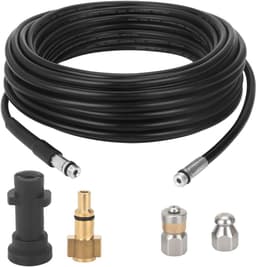
Learning how to use a drain cleaning hose starts with one rule: put the nozzle clearly inside the pipe before you pull the pressure-washer trigger, and switch the washer off before the head comes back out. That sequence reduces the risk of a whipping hose, flying debris and a high-pressure jet reaching you. This guide covers a reachable gully, downpipe or chamber from ground level. If you still need a suitable kit, compare lengths and fittings on the [drain cleaning hose comparison](/hub/tools/drain-cleaning-hose) before starting. A qualifying purchase can earn a commission at no extra cost to you.

Learning how to use a drain cleaning hose starts with one rule: put the nozzle clearly inside the pipe before you pull the pressure-washer trigger, and switch the washer off before the head comes back out.

Our top picks

Nilfisk Nilfisk 15 m bayonet

Best overall

Nilfisk Nilfisk 15 m bayonet
8.8/10about £39.12
STYDDI STYDDI 15 m, 180 bar

Rank 2

STYDDI STYDDI 15 m, 180 bar
9.2/10about £28.87
OHAYORI OHAYORI 15 m

Best value

OHAYORI OHAYORI 15 m
9.0/10about £24.99
On this page

Put the nozzle in before pressure

Kärcher's instructions for its PC 7.5 and PC 15 say not to operate the trigger until the minimum insertion mark is completely inside the pipe, and not to withdraw the hose past that mark while pressure is on. An older booklet placed its red mark 50 cm from the nozzle. That distance belongs to that set and should not be copied onto every marketplace hose. If your kit has no mark, do not invent a universal distance. Place the nozzle and its metal connection clearly inside a straight section, keep the unpressurised hose under control and make sure it cannot jump back out. If the access is too short to contain the head, choose another opening. High-pressure water can penetrate skin and turn grit into projectiles. Wear eye protection and keep hands, feet and face away from the opening. Use an RCD-protected supply, keep plugs out of standing water and follow the washer's UK instructions.

Prepare the washer, hose and access

With the washer isolated, select the adapter that is explicitly named for the gun. A Kärcher-style bayonet is not a Nilfisk bayonet, and Bosch AQT or Lavor adapters must be the correct version. Dry-fit the connection without tools or force. If it almost fits, leaks during a low-pressure check or requires cutting metal, stop and resolve the compatibility issue using our Karcher drain cleaning hose fit guide. Choose the nozzle before it enters the pipe. A button head normally uses a forward jet to work at a local obstruction and rear jets to propel the hose and wash debris back. A rotating head works around the pipe wall. If your kit gives no pattern or orifice information, do not assume that a head behaves like one from another brand.
Nilfisk Nilfisk 15 m bayonet

Testsieger

Nilfisk Nilfisk 15 m bayonet
8.8/10about £39.12

Work through a gully or downpipe in order

Remove loose leaves you can reach without putting a hand into hidden pipework. Connect the water supply, washer, gun adapter and hose while the machine is off. Feed the nozzle in by hand until the head and connector are securely inside. Lay the remaining hose out behind you and stand to one side of the opening. Start the water and washer according to its manual, then pull the trigger only after the head is inside. Advance a short distance, pause and work the hose gently back and forth. Do not ram a ferrule around a bend. To finish, release the trigger, switch the washer off and confirm the system is no longer pressurised before you withdraw the hose. Let it dry, then coil it in broad loops.

Manage bends, kinks and temperature

Kärcher specifies at least 40 mm pipe, a bend radius of at least 70 mm and bends no sharper than 90 degrees for its pipe-cleaning set. Those limits show why a 32 mm basin waste or tight trap is a poor place to improvise. A thin hose does not mean the nozzle and ferrule will turn the same corner. If progress stops, release the trigger before you change grip or withdraw the hose. One small movement is enough. Repeatedly striking the same point is a physical limit. Stop before the hose folds at the ferrule. Use cold water unless both the hose and the washer allow a stated inlet temperature. The black StoneBanks listings state up to 60 °C, but that does not apply to other brands. A RUHUHUR reviewer reports that a hot jet wash blew the end off.

Treat indoor wastes and chambers cautiously

A shower tray, basin or WC may be named in marketplace copy without a measurement showing that the head passes the trap. Do not send a metal jetter head through sanitaryware because the hose looks thin. An inspection chamber is an access point from above, not a place to climb into. If it is deep, damaged, overflowing or on a shared run, withdraw and contact the water company or a drainage professional.

Know when the hose is the wrong tool

Stop if the hose cannot advance without force, dirty water returns inside the property, the same blockage comes back, or you suspect roots, concrete, a displaced joint or collapse. Domestic rear jets can wash loose material and residue, but they are not a contractor's high-flow van jetter or a camera survey. One HuaCommerce reviewer still needed professional jetting for roots despite using a 30 m hose. In England and Wales, a private drain serving one property is generally the householder's responsibility, while shared lateral drains and sewers are normally the sewerage company's. Check the relevant arrangements in Scotland or Northern Ireland rather than assuming the same organisation applies. If you are deciding whether a different DIY method is appropriate, see drain rods versus a pressure washer jetter.

Common questions

Do I turn the washer on before inserting the hose?
No. Connect and feed the unpressurised nozzle into the pipe first. Kärcher instructs users to put the minimum insertion mark completely inside before operating the trigger. If your third-party hose has no mark, keep the complete head and connector clearly inside and under control before pressure starts.
What if my kit has no insertion mark?
Do not copy the 50 cm distance from an older Kärcher product onto an unrelated hose. Put the head and metal connection securely inside a straight section, ensure it cannot jump free and keep it inside until the washer is off. If the access cannot safely contain the head, do not use it there.
How do I prevent a kink at the ferrule?
Lay the hose out in broad loops before use, line it up with the access and avoid pulling sideways against the connector. Advance gently rather than pushing a tight coil. If it folds or repeatedly stops, release the trigger and remove pressure before repositioning it.
Can I use hot water?
Only when both the hose and pressure washer documentation allow the intended temperature. A temperature printed on one StoneBanks listing does not apply to another brand. One RUHUHUR review reports a failed end during hot-water use, so cold water is the safer default when documentation is absent.
When should I call a professional?
Call when you suspect roots or structural damage, the blockage repeatedly returns, there is no safe ground-level access, or wastewater is backing up inside. Contact the relevant water company if the run is shared or outside your responsibility. Do not enter a chamber or keep increasing force on a stuck head.

Related pages

Sources

Public UK sources for private drains in England and Wales, drain diameter, and water-jetting precautions. Listings are the amazon.co.uk captures for these eleven ASINs, saved on 16 October 2026, not a live reload. Prices on amazon.co.uk move. Wickes and Nilfisk shop prices cited above are not Amazon shelf prices.

  1. Kärcher GB, pipe cleaning set 15 m (retrieved 16 October 2026)
  2. Kärcher PC 7.5 / PC 15 manual (retrieved 16 October 2026)
  3. Private sewers regulations 2011 (retrieved 16 October 2026)
  4. GOV.UK, sewerage repair liability (retrieved 16 October 2026)
  5. Ofwat, public and private sewers (retrieved 16 October 2026)
  6. Citizens Advice, drains and sewers (retrieved 16 October 2026)
  7. Approved Document H (retrieved 16 October 2026)
  8. HSE INDG68, safety in pressure jetting (retrieved 16 October 2026)