Independent comparisons. We may earn from shop links. More info

How to fit a TRV

Updated: October 2026

You have either a dead head in your hand or a new valve set still in the box, and the search results treat both jobs as one list. They are not. How to fit a TRV starts with a dry test: if the small pin in the valve body springs back, you can change the head without draining. If you are about to open a compression nut, you are in a wet job, and a leak or the boiler is the point where you stop. This page does not rank the twelve listings. Which carton is a head and which is a set is on the [radiator thermostat comparison](/hub/thermostats/radiator-thermostat). Peter F., DIY & tools editor, wrote this in October 2026 from those listings and public UK fitting notes. There was no lab test. A qualifying purchase can earn us a commission at no extra cost to you.

You have either a dead head in your hand or a new valve set still in the box, and the search results treat both jobs as one list. They are not.

Our top picks

On this page

Tell a dead head from a dead body

Turn the heating off and let the radiator cool before you judge it. A hot pin and a hot nut are a poor moment to learn which part failed. Unscrew the head by hand. Under it you should see a small pin standing proud of the brass. Press the pin in with a thumb or a coin and let go. If the radiator has been cold and the pin springs out, the body can still open, and the head is the part that has stopped pushing. MoreTips’ UK head-swap note uses that test, then sets the new head to 5 and hand-tightens it, with no drain. If the pin stays down, or it is stuck up and will not move, a new head will not fix the flow. That is a body problem, or sludge. Have a towel and a small bowl within reach even for the dry test, because the first surprise is usually a drip from the spindle. Do not use the thermostatic head as a shut-off if you later lift the radiator off the wall. Drayton’s TRV4 installation guide says to close the valve with the manual cap and to close the lockshield. The sensor head is not an isolator. If water appears as soon as the head is off, you have gone past a head swap.

Fit a replacement head

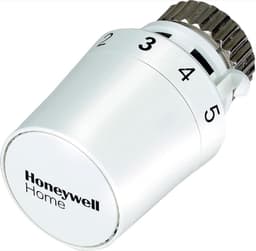
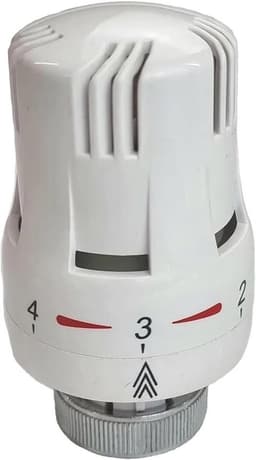
Set the new dial to the highest number before you screw it on. On the heads in this set that is often 5, or the top of a 0 to 5 scale. The sensor is then slack, and you are less likely to wind the collar down onto a closed pin. Offer the nut up by hand. The Thera-5 bullet asks for horizontal mounting. The LJAPPLIED bullet says horizontal only, not vertical. Those are limits on those listings, not a universal rule for every head in the cupboard. If your pipework forces the head to stand upright, do not assume a horizontal-only head will behave, and do not force the pipe to suit the instruction. Tighten by hand until the head is seated. MoreTips stops at hand-tight. Drayton’s guide tells installers not to overtighten the sensor ring. Manissa reviews describe the failure you get when you do: the collar holds the pin shut and the radiator stays cold. Honeywell’s Thera-5 bullet mentions a torque of about 10 Nm. That is a maker figure for that head, not a reason to put a long spanner on a £4 ABS collar. If the collar does not reach the pin, the head is the wrong length for that body. Reviews on the Manissa and on the Yi kai pair both describe that miss. Stop and return it. Turn the dial from high to low and back. You should feel the pin load and unload. There should be no water at the nut, because you have not opened a joint. If water appears, isolate what you can, catch the drip, and stop.

When the body has to come off

A new body means a compression joint on a 15 mm pipe, an olive, and a lockshield. Resideo’s UK note for changing a TRV is written for installers: boiler off, system cool, isolate both ends, towels down, PTFE where the thread needs it, then the body, then a bleed. BestHeating’s guide says a single radiator can sometimes be changed without a full-system drain, and it also says that is not a first attempt. Note how many turns the lockshield was open, and put it back to the same place, or the radiator you have just fitted will run starved or will short-circuit the circuit. You need the heating off, both valves closed, a bowl that can take more than a cupful, and towels under the joint. Some water in the radiator is normal when the tail comes out. A continuous feed from the pipe means the isolation has not held. Stop. An open-vented tank in the loft that you do not know how to isolate, a pipe size that is not 15 mm, or an insert that does not match, is the engineer’s job. One UK Radiators corner review said that set suited copper and not multilayer. The Marella listing has a separate small trap. A reviewer’s lockshield arrived in the locked position and wanted an 8 mm hex. If the spindle does not move with a spanner on the flats, look for a hex before you force it. Gas work on the boiler is for a Gas Safe registered engineer. If the joint weeps after you refill, or the pressure will not hold, that is also the stop. Who may do that work is covered in who can fit a thermostat in the UK.

After it is on

Bleed the radiator at the bleed screw until the hiss of air becomes a steady dribble of water, with a cloth ready. On a combi or a sealed system, check the boiler pressure against the gauge once the radiators are full, and top up only by the filling loop method you already use. If you do not know that loop, stop and ask. Then set the new dial near the middle and leave it for a day. Energy Saving Trust’s point is that the numbers are not degrees you can copy from a wall thermostat. A 3 on one brand is not a 3 on another. If the room overshoots, move one mark cooler. If unused rooms are turned fully off, you can end up with cold walls and a boiler that behaves oddly, so keep a little background heat. Frost marks on these listings are that background idea, not a fitting step. The Marella bullet says the valve still operates if the room falls below 7 °C. The Thera-5 lists a zero position and a 1 to 28 °C setpoint claim. A radiator cover or a heavy curtain over the head will fool the sensor after all of this work. Leave the head in free air. If the pin test said the head was fine and the radiator still stays cold, the fault is flow, sludge, or balancing, and a new dial will not clear it.

Common questions

Do I drain the system to change a head?
No, if you only unscrew the sensor and the pin is free. MoreTips and the product bullets treat that as a dry swap. You drain, or you isolate and catch the radiator’s own water, when the body or the olive comes off. Do not promise yourself a drain-free body swap.
How do I know the head is the failed part?
Take the head off a cool radiator and press the pin. If it springs back and the radiator can still get hot with the pin up, the head is the fault. If the pin is stuck, buy a body, or call someone, rather than another plastic dial.
Which way should the dial sit before I unscrew it?
Set it to the highest number, often 5, so the mechanism is backed off. Hand-tighten the new head. Forcing a low setting onto a closed pin is how collars get over-tightened.
What if the pin does not spring back?
Leave the new head in the packet. A stuck pin is the valve body, or debris in it. Opening that joint needs isolation, a bowl, and a plan for the leak. If you have not done that before, this is the moment to book a heating engineer.
Can I do this on a hot radiator?
No. Turn the heating off and let the radiator cool. A hot body hides whether the pin is free, and a hot leak is a worse mess. Resideo’s installer note starts with the boiler off and the system cool for a reason.
When do I stop and call someone?
Stop if water keeps coming after you thought both ends were closed, if the pipe or the insert does not match, if a joint weeps or the pressure will not hold, or if the work has reached the boiler. Gas work on the boiler is Gas Safe work. A head that simply will not reach the pin is a return, not a call-out, as long as you have not opened the pipe.

Related pages

Sources

Public UK sources for thermostatic radiator valves, Approved Document L as BEAMA explains it for England and Wales, and BS EN 215. Listings are the amazon.co.uk captures for these twelve ASINs, not a live reload on 17 October 2026. Prices on amazon.co.uk move.

  1. Energy Saving Trust, thermostats and heating controls (retrieved 17 October 2026)
  2. BEAMA TRV factsheet for installers (retrieved 17 October 2026)
  3. BEAMA Part L 2022 heating controls guidance (retrieved 17 October 2026)
  4. Approved Document L, volume 1, dwellings (retrieved 17 October 2026)
  5. BSI, BS EN 215:2019 (retrieved 17 October 2026)
  6. tado°, X compatibility with other product lines (retrieved 17 October 2026)
  7. tado° shop, Smart Radiator Thermostat X (retrieved 17 October 2026)
  8. Approved Document L, 2026 index on GOV.UK (retrieved 17 October 2026)