Type 71 or Type 80 staples: choose the right series

Type 71 or Type 80 staples differ in wire gauge and crown width. See which series fits your gun, how leg length fits upholstery, and why Type 90 is separate.
On this page
You have stripped an old chair, pulled the fabric tight and reached for a box that looks almost right. This is exactly where type 71 or type 80 staples cause trouble: both are fine-wire upholstery fasteners, but they are different series and do not belong in the same magazine. Choose the series printed on your gun first; crown width, wire gauge and leg length come after that.
In short
Type 71 staples are generally 22 gauge with a crown of about 9 mm, while Type 80 staples are generally 21 gauge with a crown of about 12.8 mm. Type 80 is the broader, heavier fastener, but you cannot swap the two series between guns even if a loose staple appears to fit the nose.
Type 71 and Type 80 are different systems
A Type 71 staple has finer wire and a narrower crown; a Type 80 has thicker wire and a wider crown. UK guidance commonly describes Type 71 as 22 gauge with about a 9 mm crown, and Type 80 as 21 gauge with about 12.8 mm. Type 71 suits discreet fixing through fabric, vinyl or thin trim; Type 80 spreads hold across a wider crown when the job needs more metal, though it can look more visible on delicate work. The series on the box must match the tool maker's specification. If either label is missing, identify the gun before testing assorted strips under air.
Why they do not share a magazine
Magazine rails, feed path, driver and nose channel are sized for one crown width and wire gauge. A Type 80 strip is normally too wide for a Type 71 magazine; a Type 71 strip in a Type 80 tool may sit loose and misfire. One loose staple in the nose proves nothing because the gun must feed a collated strip repeatedly. Expect jams, bent fasteners or driver damage if you force a mismatch. Persistent misfires after wrong staples usually mean inspecting the driver and nose, not turning up compressor pressure.
Do not file the magazine or hold loose staples in place. Disconnect the air hose before clearing a jam. Our guide to an air stapler for upholstery compares tools built for the correct series rather than adapting the wrong fastener.
Choose the series before the leg length
Series answers which cross-section fits the gun; leg length answers how far that compatible staple should enter the work. Type 71, 10 mm and Type 80, 10 mm are not interchangeable even when the legs match. For upholstery, the staple must pass through fabric and padding and bite into sound timber without emerging through the frame. Measure the uncompressed stack, allow for the rail thickness and test on a concealed edge. Start with the shortest approved length that holds under realistic fabric tension, and increase only if the fixing lifts. Excessive air pressure can cut the crown into fabric rather than improve hold. On a 7116 model, 71 is the series and 16 usually means up to 16 mm Type 71 staples, not a separate family name.
Which series suits the job
Type 71 fits light upholstery and trim where a small entry mark matters: chair seats, fabric folds and thin decorative work on sound timber. It secures coverings; it does not replace structural fixings. Type 80 suits jobs that need a wider crown and heavier wire, such as thicker upholstery or lining, provided the gun is built for Type 80. Neither series is rated for structural chair repair or load-bearing joints.
Test pressure and depth on offcuts before you approach the finished face. The same regulator setting can bury a staple in softwood and barely seat it in hardwood. Keep hands clear of the hidden side of narrow rails and clamp small pieces so a misfire cannot reach your fingers.
Timber condition, spacing and access matter as much as fabric type. Move fixings away from crumbling edges and old tacks. If you are buying the tool and staples together, start with our air stapler comparison: choose the gun for the work and air supply, confirm series and length range, then compare staple packs.
Matching common air staplers to the box
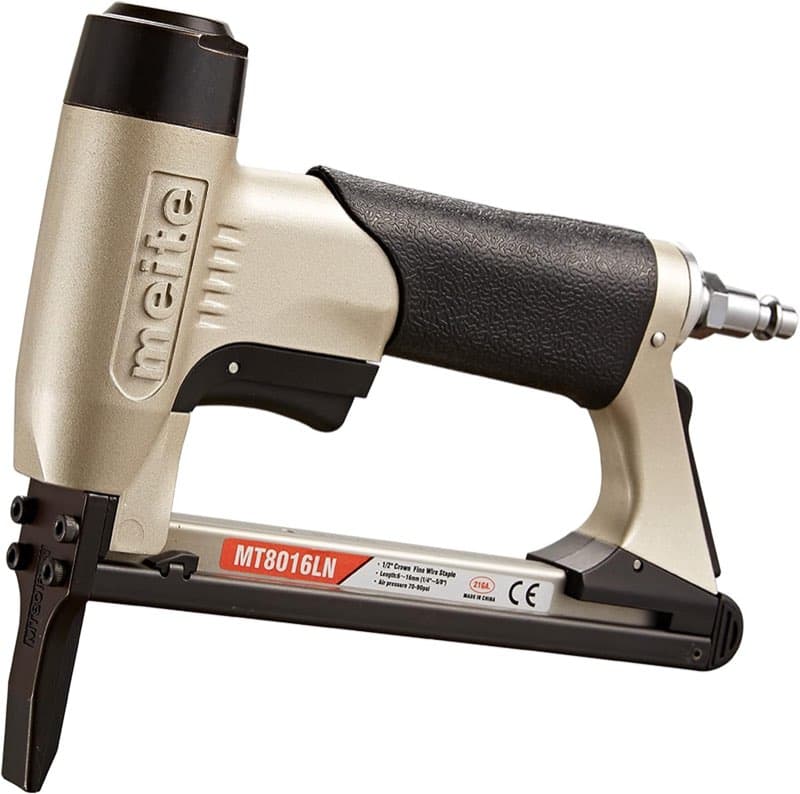
The WORKPRO Type 7116 and meite MT7116S take Type 71 staples; the WORKPRO Type 8016 and meite MT8016LN take Type 80. Shared 16 in the model name refers to length capacity, not cross-compatibility. The Clarke CSG1C listing names 8, 10 and 12 mm only, so do not assume it covers the full 6–16 mm band some Type 71 guns accept. Listings change; the data plate and current manual beat a marketplace title. When a seller says upholstery staples without a series number, stop: match tool model, series, approved lengths, then coating and quantity.
Type 90 is not an upgrade
Type 90 is a separate narrow-crown system for heavier tasks, not a larger Type 80 staple. It needs its own compatible gun. For chair fabric it is often excessive; for skirting or structural joints, fine-wire Type 71 or Type 80 is usually the wrong class entirely. Treat 71, 80 and 90 as distinct fit standards, match the series exactly, stay within the length range and test on scrap.
Common questions
Can I use Type 80 staples in a Type 71 gun?
Which is stronger, Type 71 or Type 80?
What does 7116 mean on a staple gun?
What staple length should I use for upholstery fabric?
Can I buy 3 mm Type 71 staples?
Why are Type 71 staples sometimes sold in larger boxes?
Are Type 90 staples suitable for upholstery chairs?

Peter F. is the editor for DIY & tools at productscompared.co.uk. Comparisons in this category are checked against amazon.co.uk listings, review evidence and public UK sources.
Related articles

Why a pneumatic stapler keeps jamming
Trace bent staples and misfires to the fastener, air supply or tool maintenance.

Pneumatic or electric stapler
Choose between compressed air, a mains lead and a cordless battery for your work.

When a fine-wire stapler is the wrong tool
Recognise jobs that need a heavier fastener, a different crown or another tool entirely.