Pneumatic stapler keeps jamming: find the cause

Why your pneumatic stapler keeps jamming: check staple series, air pressure, oil and the driver before you raise pressure or open the nose unsafely.
On this page
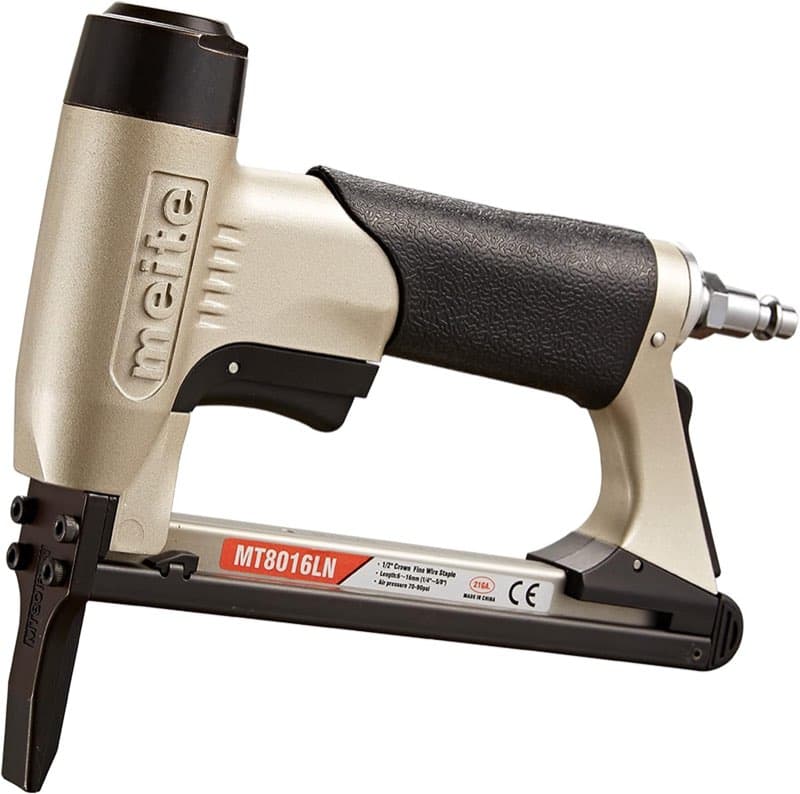
Your pneumatic stapler keeps jamming halfway through a job: one staple folds in the nose, the next shot goes sideways, and then the tool only clicks. The fastest fix is not more pressure. Work through the staple specification, air supply, lubrication and driver in that order, with the hose disconnected whenever you open the magazine or nose.
In short
Most repeated jams come from staples that do not exactly match the gun, restricted airflow, poor maintenance or a driver that cannot return freely. Disconnect the air before clearing the nose, never tie back the contact safety, and stop if the driver, magazine or safety mechanism appears damaged.
Start with the staples
Pneumatic staples are not interchangeable simply because they share a leg length. A gun needs the matching crown width and wire dimensions as well as an approved length. Type 71 and Type 80 belong to different series; a near match can bind, sit at an angle or fold when the driver hits it. Our Type 71 or Type 80 staples guide explains why the series matters, and the air stapler buying guide ties that to operating pressure.
Read the model plate and manual, then compare the specification with the writing on the staple box. Do not judge compatibility by eye. Check whether the strip slides through the open magazine under its own clearance, without force or sideways play. Inspect the strip for bent crowns, loose adhesive, corrosion or mixed leftovers. Load one clean strip in the orientation shown in the manual and close the follower positively. If a correct new strip still sits skewed, the magazine rail or follower may be worn.
When staples bend or shoot sideways
A staple folded across the nose often met resistance before it reached the workpiece. Remove it with the air disconnected, then inspect the exit path and driver tip for a burr or chip. Sideways shots can follow a loose slide, damaged nose or excessive movement in the magazine. Do not keep firing to see whether the fault clears. Material matters too: a staple that drives into softwood may buckle against a knot or metal fixing. Test on an offcut after the gun feeds correctly on scrap.
Check air pressure and the safety
An air stapler not firing can be an air-delivery problem even when the compressor gauge looks normal. The tank gauge shows stored pressure; a regulator shows the controlled outlet pressure, and both can fall differently while the tool cycles. A narrow hose, leaking coupling, partly closed valve or small compressor struggling to recover may provide enough air for a click but not a complete drive-and-return cycle. Set pressure only within the manufacturer’s range and watch the regulated gauge during several shots into scrap.
Listen for leaks at the coupling, cap and trigger, and check that fittings are fully seated. Replace a damaged hose rather than wrapping a pressurised repair. Higher pressure is not a remedy for insufficient air volume, and exceeding the tool rating can damage seals. The contact safety must be fully depressed in the intended sequence. The air stapler use guide covers loading and controlled test shots. HSE guidance for nail guns is clear that safety devices must not be defeated; never tape or tie the contact arm back to diagnose a misfire.
Distinguish a safety stop from a jam
A gun that remains silent may be behaving correctly because the contact arm is not moving far enough on an uneven surface. With air disconnected, check for adhesive, sawdust or a bent component around the accessible contact mechanism. Do not dismantle a spring-loaded safety assembly unless the manual provides a user procedure. If the safety sticks after superficial cleaning, the safe limit of DIY diagnosis has been reached.
Deal with oil, water and dirt
Pneumatic mechanisms need clean, dry air and the lubrication specified by the manufacturer. Too little oil can leave seals dragging, so the driver returns slowly or not at all. Too much is not better: excess oil can contribute to skipped firing, while oily residue attracts dust. Use pneumatic tool oil in the stated quantity. Some installations use an inline lubricator; mixing methods can over-oil the mechanism. More detail sits in oil and water in an air tool.
Water in the compressor tank and airline dilutes lubricant and encourages corrosion. Depressurise and drain the tank by the manufacturer’s procedure, check any moisture separator and inspect the hose. A daily drain is a common workshop routine where the compressor runs often. Do not open a pressurised drain or assume the tank is empty because the compressor is switched off. If rusty water or an uncertain receiver condition appears, deal with the compressor separately before blaming the stapler.
Inspect a driver that will not return
The driver is the blade that strikes the staple. After a shot it should retract far enough for the next fastener to move into position. If it remains visible in the nose, the follower may push a staple against the blade and create another jam. Common causes include a trapped fastener, dried contamination, inadequate lubrication, low air delivery, a bent blade or worn internal seals.
Disconnect the hose and remove the staple strip before looking into the nose. Use good lighting rather than a finger, because edges and trapped fasteners can be sharp. If the manual provides a tool-free nose release, open it exactly as shown and remove only the loose obstruction. Do not lever against the driver, file its edge or strike it with a hammer. A blade that repeatedly stays down, looks chipped or rubs one side of the channel indicates a mechanical problem and repair territory unless the manufacturer supplies user service parts.
Clear a jam safely
Treat every jam as though the tool could cycle when the obstruction moves. Keep people clear of the nose and wear the eye protection specified for the task. A staple puncture is a medical issue, not a workshop troubleshooting exercise.
- Take your finger off the trigger, point the nose in a safe direction and disconnect the air hose at the tool.
- Confirm that the tool is no longer connected to pressure, then remove the remaining staple strip.
- Open the nose only by the tool-free latch or the procedure in the model manual. Keep your face and hands out of the firing line.
- Remove the loose, bent staple with suitable pliers if it comes free without force. Do not drill, grind or hammer around the driver channel.
- Inspect the nose, driver and magazine for visible damage, debris and another trapped fastener.
- Close every latch fully, reload one correct strip and reconnect the air only after the tool is complete.
- Test at the lower end of the approved pressure range on a secure offcut, then adjust within that range only if the material requires it.
This sequence is a general safety framework, not a replacement for the model manual. Nose designs differ, and some are intended for service-centre access rather than user opening. If a fastener will not release with the provided jam-clearance method, leave it in place and arrange repair. For product types, specifications and current options, see our air stapler comparison.
Know when to stop
Stop using the stapler if the driver is cracked or bent, the magazine will not latch, the contact safety sticks, the body is damaged or air leaks continuously. The same applies when correct staples repeatedly bend after pressure, airflow and basic maintenance have been checked. Do not bypass a guard, hold a contact arm back or test with the nose facing open space. Do not exceed rated pressure to compensate for wear.
Keep a brief note of the staple series, pressure setting and symptom before seeking help. Type 71 staples with the driver down after every third shot at the specified pressure is more useful than a vague jam report. One malformed staple can be bad luck; the same failure under controlled, correct conditions needs repair or replacement.
Common questions
Why does my pneumatic stapler click but not fire?
Why do staples bend in the nose?
Can I use a different brand of staples?
Can too much oil make an air stapler jam?
Why does the driver not return after firing?
How do I clear a jam safely?
Is a jammed pneumatic stapler broken?

Peter F. is the editor for DIY & tools at productscompared.co.uk. Comparisons in this category are checked against amazon.co.uk listings, review evidence and public UK sources.
Related articles

Type 71 or Type 80 staples
Learn why these two staple series are not interchangeable and how to match a box to your tool.

Oil and water in an air tool
See how a few drops of oil and regular tank draining can prevent sluggish pneumatic tools.

How often to oil a pneumatic stapler
Use a practical maintenance routine without flooding the tool or attracting excess dirt.