How often to oil a pneumatic stapler: a schedule

Learn when to oil a pneumatic stapler, how many drops to use, and when to drain the compressor tank so moisture does not undo your lubrication work.
On this page
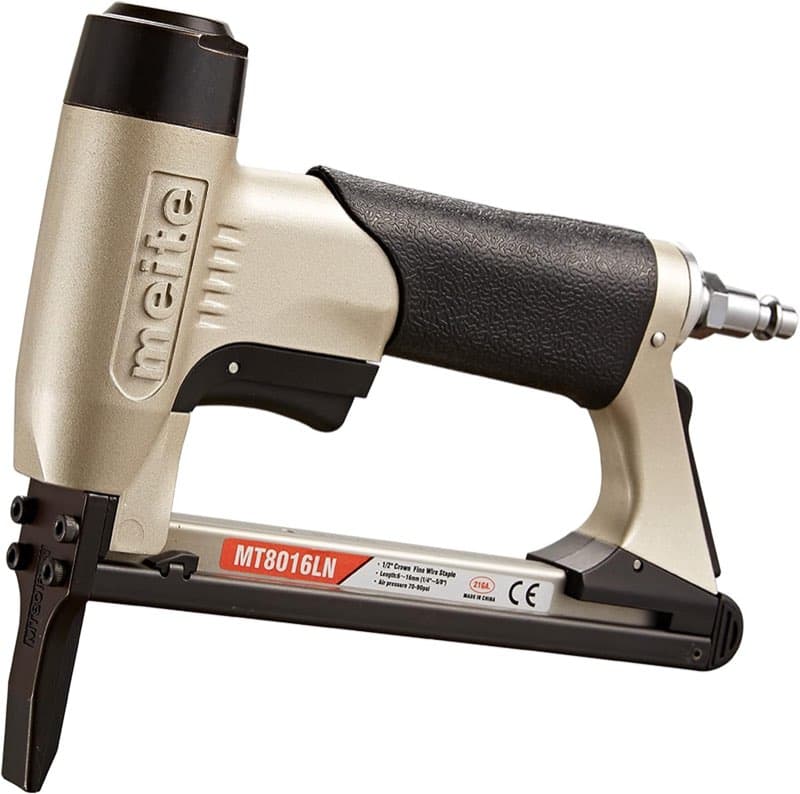
You connect the hose for a Saturday upholstery job and realise you cannot remember whether the stapler was oiled last week or last month. How often to oil a pneumatic stapler is best answered by working sessions, not by a vague monthly reminder: many conventional oil-lubricated tools need a few drops before use, while a busy working day may justify another small dose. The tool manual remains the final authority because oil-free designs and tools supplied by an in-line lubricator do not all follow the same routine.
In short
For a pneumatic stapler without an in-line oiler, use the quantity and frequency in its manual; a common pattern is a few drops of pneumatic-tool oil in the disconnected air inlet before each session. On a long, heavily used day, some manufacturers specify oiling once or twice daily. Drain moisture from the compressor tank at the end of each working day, and more often if the compressor manual or damp conditions require it.
Oil before every session
Think of oiling as part of connecting the stapler, not as a repair after it begins sticking. Published instructions commonly specify a small number of drops before work: one booklet gives three to five drops before use, while other guidance says two or three drops a day. Check your exact make and model before copying a number.
Use only oil labelled for pneumatic or air tools unless the manufacturer names something more specific. General workshop oils, penetrating sprays and motor oil can have the wrong viscosity for the seals. With the air hose disconnected, place the stated number of drops into the air inlet without contaminating the magazine or nose. Reconnect at the permitted pressure and fire several staples into scrap so the first oily exhaust stays off fabric or finished surfaces. Wear the eye and hearing protection required for the job, keep the nose pointed in a safe direction, and never hold down or defeat the contact safety to speed up this check.
Daily does not mean oil the tool every calendar day while it sits in a cupboard. If you use it for one hour on Saturday, oil it for that Saturday session. Each working start is a fresh opportunity to follow the before-work instruction rather than relying on earlier oil to last the week.
During a long working day
A second dose is not automatically needed at lunch, but it can be appropriate when the manual says once or twice daily or when the tool runs hard for many hours. Treat twice daily as two small, specified applications, not permission to pour a larger amount into the inlet in the morning. If another dose is due, disconnect during a planned break, inspect the coupling and hose, and test on scrap after reconnecting.
Do not use oil as the answer to every change in performance. A misfire can come from incorrect staples, low air pressure, a leaking coupling, moisture, a blocked nose or worn internal parts. Repeatedly adding oil may hide the diagnosis for a short time and can leave oil mist on the work, but it will not correct the wrong fastener or a damaged driver. If you are choosing or setting up the system, our air stapler comparison explains the wider tool category. The air stapler usage guide covers safe connection and operation. Neither replaces the model manual, particularly where pressure limits and lubrication differ.
After the stapler has sat unused
An idle tool may need a slightly different start. One booklet recommends three to five drops before normal use but six to ten drops when the tool has not been used for several days. That larger figure belongs to that instruction set; do not transfer it to oil-free models or lower-dose makers. Before reconnecting, look for rust, a damaged inlet, a loose magazine and dirt around the nose. Check that the trigger and contact safety move as the manual describes while the tool is disconnected, then cycle extra oil into scrap if the manual requires it. Do not leave the stapler on a pressurised hose between jobs.
Drain the compressor every working day
Lubrication addresses friction inside the stapler; draining addresses water collected by the compressor. Air entering the tank carries moisture, which can condense as the compressed air cools. Guidance for stapling equipment commonly says to drain the compressor tank at the end of every working day, giving you a second routine that belongs beside the oil bottle on the checklist.
Follow the compressor manual exactly: isolate the unit, release pressure as specified and open the correct drain only as instructed. Do not assume an air-line filter makes tank draining optional; empty filter bowls by their own instructions as well. Before the session, check lubrication. After the session, drain the receiver, then store the disconnected stapler somewhere dry.
Build a maintenance routine
A short written routine is more dependable than remembering a date. Keep the stapler manual and compressor manual accessible, then record their actual oil quantities, permitted pressure and draining method. If several people share the equipment, a simple sign-off prevents one person assuming somebody else added oil or emptied the tank.
- Before work, disconnect and inspect the hose, coupling, nose, magazine, trigger and safety mechanism for obvious damage or contamination.
- Add only the specified oil: put the manual's number of drops of pneumatic-tool oil into the air inlet, unless the model is oil-free or correctly supplied by an in-line lubricator.
- Reconnect and test on scrap: set pressure within the manufacturer's range, listen for leakage and fire enough test staples to circulate oil and confirm normal operation.
- Recheck during prolonged use: if the manual specifies once or twice daily lubrication, use a planned break for the second small application rather than over-oiling at the start.
- Drain moisture after work: isolate and drain the compressor and any filter bowl by their respective instructions, increasing checks only where the manuals and conditions call for it.
- Store everything dry and disconnected: wipe the exterior, remove the air supply and put the stapler away without staples or grime obstructing its nose.
An automatic in-line lubricator changes the oiling step, but does not abolish maintenance. Check that it contains the approved lubricant and delivers at the adjustment specified for the tool; too little fails to protect it, while too much sends avoidable oil downstream. Continue inspecting the connection, draining water and monitoring how the stapler cycles.
What is not a calendar job
There is no universal rule that every pneumatic stapler must be stripped down once a year. Watch for persistent air leakage, sluggish return, inconsistent driving depth, unusual noise or oil continually blowing from the exhaust. Disconnect the air before inspection, replace seals when the service information calls for it, and use a competent repairer when internal work is outside authorised user maintenance.
Too little lubrication can increase friction and wear in a tool designed for oil, but too much can contaminate the work and attract dirt. If the manual is missing, obtain it from the manufacturer or supplier using the exact model number rather than relying on a generic internet schedule.
The intervals here reflect common manufacturer and trade guidance on before-use drops, once-or-twice-daily heavy-use lubrication and end-of-day draining. Your stapler and compressor manuals remain the controlling sources for quantities, pressure handling, oil-free designs and servicing limits.
Common questions
Is oiling a pneumatic stapler once a week enough?
Should I oil a pneumatic stapler before every use?
Do I need to oil the stapler again during a long day?
How often should I drain the compressor tank?
What if oil sprays from the stapler exhaust?
Does an in-line lubricator remove the need for manual oiling?
Does a pneumatic stapler need a yearly strip-down?

Peter F. is the editor for DIY & tools at productscompared.co.uk. Comparisons in this category are checked against amazon.co.uk listings, review evidence and public UK sources.
Related articles

Oil and water in an air tool
A practical guide to lubricating an air tool and removing moisture from its compressor and air line.

Pneumatic stapler keeps jamming: find the cause
Find out why your pneumatic stapler keeps jamming, bending staples or failing to fire, with safe checks for staples, air, oil and the driver.
Compressor for a staple gun: what will it cost?
Price the compressor, hose and fittings behind an air stapler, and learn when a compact 6-litre unit is enough.