Independent comparisons. We may earn from shop links. More info

Air stapler for upholstery: Type 71 or Type 80?

Updated: October 2026

You have pulled new fabric around a dining-chair rail and need a staple that holds without leaving a heavy crown across the cloth. An air stapler for upholstery should normally use fine-wire Type 71 or Type 80 staples, not the thicker Type 90 staples sold for timber work. Choose the series first, then select leg length and decide whether the frame has recesses that justify a long nose. The [main air stapler comparison](/hub/staplers-and-nail-guns/air-stapler) identifies five fine-wire guns in the current set; this guide explains why each format suits a different fabric job.

You have pulled new fabric around a dining-chair rail and need a staple that holds without leaving a heavy crown across the cloth.

Our top picks

On this page

Choose Type 71 or Type 80 for the fabric

Type 71 is usually a 22-gauge fine-wire staple with a crown around 9 mm. Its finer wire and narrower crown can suit lighter cloth, decorative fabric and thin backing where a broad mark would be conspicuous. Type 80 is usually 21 gauge with a crown around 12.8 mm. The wider crown distributes load across more material and can suit heavier cloth or foam held under tension. The two series do not share a magazine. A Type 71 strip cannot be treated as a narrow Type 80 substitute, and Type 7116 on a listing denotes a particular fine-wire format rather than universal 16 mm compatibility. Check the gun plate and manufacturer documentation, then buy the exact series. Type 90 is an 18-gauge narrow-crown timber staple. Its heavier wire can mark or slice delicate cloth, so it is not the default seat-cover choice.

Select leg length on a real offcut

Staple length must pass through the fabric and any thin backing before gaining enough purchase in the timber. For a light cover directly over a sound frame, 6–10 mm can be a sensible test range; thicker folds, foam or webbing may require more. Fine-wire guns in this set mostly accept up to 16 mm, while the Clarke CSG1C listing names 8, 10 and 12 mm only. Make an offcut that reproduces the finished stack and start with the shortest plausible leg. A 16 mm staple in a thin rail can break through the other side. Most fine-wire guns here have no depth wheel, so the compressor regulator and scrap test are your controls. Our how to use an air stapler guide gives the loading, pressure and jam-clearing sequence.

Pay for a long nose only when access demands it

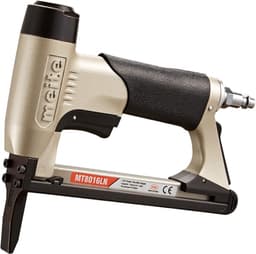
A long-nose gun reaches into channels, corners and close to shaped rails where the main body of a standard gun can hit the frame first. Reviewers of the meite MT8016LN specifically value that access around upholstery corners. The feature is useful for repeated chair work and recessed motorbike-seat edges, where holding a bulky nose at an angle can lead to poorly seated staples. The long nose does not change the staple series, increase leg length or create more power. The MT8016LN still uses 6–16 mm Type 80 staples. On a flat stool base or open frame edge, a standard-nose WORKPRO can be easier to place and costs less.

Fine-wire guns in this comparison

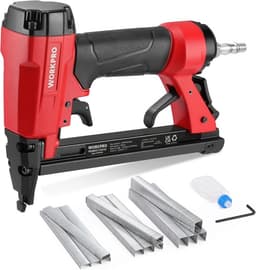
The meite MT8016LN is the long-nose Type 80 option at £59.90, with 4.5 stars from 215 amazon.co.uk reviews. It is our upholstery top pick because its review evidence is deeper than the other dedicated fabric guns and its nose reaches awkward corners. It has no depth wheel, staples are not listed in the box and the available listing data does not clearly state a contact safety. See the full reasoning in our best air stapler picks. The standard-nose WORKPRO W181014 is the Type 80 package with staples in the box when deep access is unnecessary. The WORKPRO W181011 uses Type 7116, includes 1,884 fasteners, and is the best-value fine-wire choice. For established Type 71 users, the meite MT7116S covers 6–16 mm, while the Clarke CSG1C lists only 8, 10 and 12 mm at £34.62. Stored reviews include early failure and a coupling mismatch.

Series first, then the nose

Choose the series printed on the gun, test the shortest plausible leg on a matching offcut, and pay for a long nose only when a standard nose cannot sit square. Every option here needs regulated air. Prices were recorded from amazon.co.uk on 15 October 2026 and may change.

Common questions

Is Type 80 stronger than Type 71?
Type 80 uses slightly heavier wire and a wider crown, which can spread load across heavier cloth or foam under tension. Type 71 is finer and can leave a less conspicuous fixing on light fabric. The material and frame decide; Type 80 is not automatically better.
Will Type 90 hold upholstery fabric?
It may hold it, but Type 90 is a thicker 18-gauge timber staple and can mark or cut delicate cloth. For chairs and seats, begin with Type 71 or Type 80 fine wire. Keep Type 90 for timber and sheet-material work unless the project specification says otherwise.
What staple length should I use for a seat cover?
Start with the shortest leg that passes through the cover and backing and gains secure purchase in the frame. Around 6–10 mm can be a starting test for light covers, but material thickness and timber density vary. Test a matching offcut and inspect for breakthrough.
Do I need a long nose for a dining chair?
Only if rails, channels or corners prevent a standard nose sitting squarely at the fixing point. A long nose improves access; it does not fire longer staples. For open edges and stool bases, a standard nose may be cheaper and easier to control.
Can I use Arrow staples in these guns?
Not unless the manufacturer explicitly names that exact Arrow series as compatible. Arrow T50 and Type 53 are not interchangeable with Type 71, Type 80 or Type 90. Match the complete series and dimensions rather than leg length alone.
Why did a staple slice the fabric?
Likely causes include wire that is too heavy, excessive pressure, an angled nose or too little support beneath the cloth. Stop and test Type 71 or Type 80 on an offcut at lower regulated pressure. Do not hide damage by firing more staples beside it.

Related pages

Sources

Public UK sources and amazon.co.uk listings used for this comparison. Listings checked on 15 October 2026.

  1. HSE: Nail guns in woodworking (retrieved 15 October 2026)
  2. HSE: PUWER overview (retrieved 15 October 2026)
  3. Control of Noise at Work Regulations 2005, regulation 4 (retrieved 15 October 2026)
  4. HSE INDG178: Written schemes of examination (retrieved 15 October 2026)
  5. HSE: Pressure Systems Safety Regulations (retrieved 15 October 2026)
  6. Clarke CSG1C instruction manual (retrieved 15 October 2026)
  7. Tacwise: 71 upholstery staple tacker (retrieved 15 October 2026)
  8. Advanced Fasteners: What staples do I need? (retrieved 15 October 2026)