Independent comparisons. We may earn from shop links. More info

TIG vs MIG welding gloves: which type to choose

Updated: October 2026

If you can hold a TIG torch but cannot feel the filler rod, a heavy gauntlet is working against the process. If you wear a thin TIG glove while MIG spatter lands on the cuff, you have made the opposite mistake. The TIG vs MIG welding gloves decision balances dexterity against heat, spatter and forearm coverage. One marketplace title that lists every process cannot remove that trade-off. See the products in the [welding gloves comparison](/hub/soldering-and-welding/welding-gloves), then use this guide to decide which family you need before choosing a brand. Prices below are stored GBP shelf prices.

If you can hold a TIG torch but cannot feel the filler rod, a heavy gauntlet is working against the process. If you wear a thin TIG glove while MIG spatter lands on the cuff, you have made the opposite mistake.

Our top picks

WZQH WZQH

Best overall

WZQH WZQH
9.4/10about £16.99
Intra-FIT Intra-FIT

Alternative

Intra-FIT Intra-FIT
9.4/10about £24.99
Predator By Ron Predator By Ron

Alternative

Predator By Ron Predator By Ron
9.2/10about £7.75
On this page

What TIG and MIG ask of the glove

TIG demands finer hand control. One hand holds the torch while the other feeds a slim filler rod. A stiff, heavily insulated glove or long fingertips can make that feed irregular. Goatskin is common in TIG gloves, and the material name alone does not prove certification. MIG feeds wire through the torch, so spatter and accumulated heat push the choice towards thicker leather and a longer cuff. Flux-core strengthens that case. Stick welding sits with the heavier gauntlets because slag and spatter are central hazards. A 14- to 16-inch split-cowhide gauntlet is the conventional shape. Prioritise dexterity when filler control is the limit, and a long gauntlet when hot particles reach the forearm. Neither thickness is an insulating glove for UK mains. Markings and temperature claims are in the welding gloves buying guide.

Type A and Type B explain the trade-off

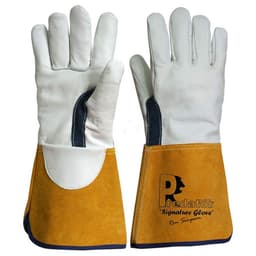
BS EN 12477 classifies welders’ gloves as Type A or Type B. Type A has higher minimum mechanical and thermal requirements and lower required dexterity. Type B raises the dexterity requirement and lowers some other minima. Public summaries commonly recommend Type A for processes other than TIG, and Type B for TIG. A public instruction sheet restating the standard describes dexterity level 1 as picking up a pin of 11 mm or smaller, and level 4 as a pin of 6.5 mm or smaller. That is a controlled test, not a promise about your filler rod. Both types still have contact-heat requirements. Do not infer the type from hide or title. None of these stored listings prints Type A or Type B. Predator By Ron is the most TIG-like construction. WZQH, RAPICCA, TOPDC and YESWELDER sit on the heavier side. Those are descriptions of stated materials, not certificates.
WZQH WZQH

Testsieger

WZQH WZQH
9.4/10about £16.99

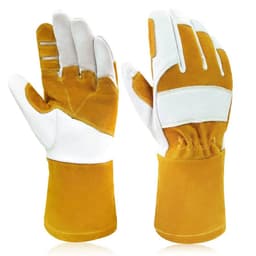
Goatskin and cowhide in this set

Predator By Ron is the clearest thin-glove candidate: a stated goatskin palm, 13 inches, 170 g, and about £7.75. Reviewers praise filler-rod feel. It has 4.6 stars from 134 reviews, no BS EN 12477 type and no numerical heat result. One busy-workshop reviewer said the glove lasted about two weeks. Do not use this thin pair as the default for heavy MIG or stick spatter. WZQH, TOPDC and RAPICCA each state a 16-inch format. WZQH claims 1.2 mm shoulder-split cowhide at about £16.99. TOPDC claims 1.2 mm at about £15.28. RAPICCA claims 1.5 mm at about £19.98. Their 350°C or 500°C seller lines are not EN 407 levels. Intra-FIT, about £24.99, claims a shaped grain-cowhide palm for MIG and is not as thin as the goatskin pair. For light TIG, start with the supple shape and accept that Predator does not document Type B. For spatter, start with a long cowhide gauntlet and accept that these listings do not document Type A.

If you weld with both processes

Two pairs are the cleanest solution when you regularly switch between TIG and MIG or stick. Keep a thin pair for filler control and a heavier long-cuff pair for spatter. Using a different weight on each hand can suit a specific setup, but both hands may enter the hazard zone, so do not downgrade one hand automatically. If you can own only one pair for occasional work, choose for the more severe exposure. A flexible MIG-oriented glove may manage light TIG. A thin TIG glove is the poorer compromise when heavy spatter is foreseeable, because the failure is loss of protection. Inspect the glove when you change process. A pinhole or charred fingertip means that pair is finished.

Common questions

Can one pair work for both TIG and MIG?
One flexible glove can be a compromise for light, occasional work, but it will not maximise both filler control and spatter protection. If you regularly do both processes, separate thin TIG and heavier long-cuff MIG pairs are the clearer choice.
Where does stick welding fit?
Stick or MMA belongs on the heavier-gauntlet side of this comparison because slag, spatter and heat are central hazards. Choose a long, suitably marked glove rather than treating a thin TIG glove as a universal welding pair.
Is every goatskin glove Type B?
No. Goatskin is a material, while Type B is a classification under BS EN 12477. Predator By Ron uses a goatskin palm and has TIG-like handling, but the stored listing does not state that it is Type B.
Why are TIG gloves thinner if the arc is hot?
TIG requires precise torch and filler-rod control, so the glove trades some bulk for dexterity. That does not remove heat risk. The glove is selected for a process with different hand demands and should not be crossed into heavy-spatter work without evidence.
Will a MIG gauntlet make TIG harder?
It can. Thick lining, stiff split leather and long fingertips can make a fine filler rod harder to feed consistently. A well-fitting flexible MIG glove may manage light TIG, but a dedicated dexterity-led glove gives better control.
Which stored listing is the TIG option?
Predator By Ron is the clearest TIG-shaped option because it states a soft goatskin palm and reviewers mention filler-rod feel. It is a conditional editorial pick, not a claim that the product is certified as BS EN 12477 Type B.

Related pages

Sources

Public UK sources and the stored amazon.co.uk listings in this set. Shelf prices were not rechecked live on 17 October 2026.

  1. BSI, BS EN 12477:2001 protective gloves for welders (retrieved 17 October 2026)
  2. SATRA, EN 12477 table (retrieved 17 October 2026)
  3. BSI project summary, welders’ gloves (retrieved 17 October 2026)
  4. SATRA, EN 407:2020 (retrieved 17 October 2026)
  5. Polyco Healthline, contact heat (retrieved 17 October 2026)
  6. HSE, welding controls (retrieved 17 October 2026)
  7. HSE, PPE overview (retrieved 17 October 2026)
  8. GOV.UK, PPE marking, UKCA and CE (retrieved 17 October 2026)