Independent comparisons. We may earn from shop links. More info

Welding gloves buying guide

Updated: October 2026

You may be standing in front of a small MIG set with a marketplace page promising 500°C protection, yet that number does not tell you whether the glove suits the process. This welding gloves buying guide explains how to choose by process, printed standard, cuff, leather and fit before price or review count. The [welding gloves comparison](/hub/soldering-and-welding/welding-gloves) shows the stored amazon.co.uk products side by side. None of those listings prints a BS EN 12477 Type A or Type B mark, so separate what the seller states from what the glove documents. Prices are stored GBP shelf prices. We did not lab-test these gloves. A qualifying purchase through our links can earn a commission at no extra cost to you.

You may be standing in front of a small MIG set with a marketplace page promising 500°C protection, yet that number does not tell you whether the glove suits the process.

Our top picks

WZQH WZQH

Best overall

WZQH WZQH
9.4/10about £16.99
UCI Ultimate Industrial WGR

Preis-Tipp

UCI Ultimate Industrial WGR
9.4/10about £7.07
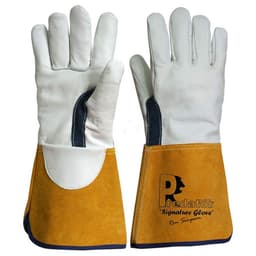
Predator By Ron Predator By Ron

Alternative

Predator By Ron Predator By Ron
9.2/10about £7.75
On this page

Choose Type A or Type B for the process

BS EN 12477 is the British Standard for protective gloves used in manual metal welding, cutting and allied processes. It divides gloves into Type A and Type B. Type A sets higher minimum mechanical and thermal requirements but only dexterity level 1. Type B lowers some protection minima in exchange for dexterity level 4. In buying language, Type A is normally associated with MIG, MMA or stick welding and other work with more spatter. Type B is normally chosen for TIG, where you must control a torch and feed a fine filler rod. That distinction is a trade-off, not a quality ladder. A bulky lined gauntlet can make a TIG filler rod harder to control. A thin TIG glove used for high-spatter MIG or stick may be overwhelmed sooner. Our TIG versus MIG welding gloves guide explores that process choice. Look for the complete marking rather than inferring a type from colour, leather or a title. Goatskin often appears in TIG gloves, and split cowhide in heavier gauntlets. Neither hide proves the type. In this set the Predator By Ron is described as goatskin and several 14- to 16-inch products are cowhide, but none prints Type A or Type B.

Balance cuff length, leather and fit

A welding cuff should close the route between glove and sleeve so sparks do not reach bare wrist or forearm. The products here range from a stated 13 inches for the goatskin pair to 14 or 16 inches, with some long gauntlets described as about 40 cm. One public manufacturer summary of EN 12477 gives a minimum overall length of 340 mm for size 10. That does not certify any product here. It shows why a short wrist glove and a proper gauntlet are not interchangeable. A 16-inch lined cowhide gauntlet gives useful reach for overhead sparks or an exposed forearm, and it also adds bulk. A thinner goatskin palm can improve touch at the torch and gives up resilience around heavier spatter. If the process needs both fine control and substantial heat, two pairs are a more honest solution than one glove that is meant to excel at both. A tight glove can tire the hand. A loose one lets the fingers slide and weakens the grip. Stored reviews mention long fingers, oversized pairs and gloves that slip off smaller hands. L, size 10, one size and XL are not interchangeable.
WZQH WZQH

Testsieger

WZQH WZQH
9.4/10about £16.99

Read a temperature line as a claim, not a holding time

A marketplace bullet saying 500°C is not automatically EN 407 contact-heat level 4. In the EN 407 contact-heat method, the four levels correspond to 100°C, 250°C, 350°C and 500°C. The test looks for at least 15 seconds before the temperature inside rises by 10°C under defined conditions. It does not mean you can grip an object at that temperature for 15 seconds in every job, and it does not promise minutes of protection. Both Type A and Type B require contact-heat level 1 as a minimum, while their other heat, flame and dexterity requirements differ. A bare temperature, an ANSI/ISEA heat attribute or the words heat resistant cannot be converted into an EN 407 score without the proper code. AUAUY states 200°C. WZQH states 350°C for a short period and warns that prolonged heat can char the leather. Several others advertise 500°C. None of those lines includes an EN 407 performance code in the material reviewed. No code, no inferred level.

Check the marks, instructions and electrical limit

For a UK purchase, look for the product marking, the applicable standard and readable English instructions or a declaration that identifies what was assessed. Great Britain currently accepts UKCA or CE marking for PPE under the applicable arrangements, but a logo alone does not tell you whether the glove is Type A, Type B or assessed for another risk. A workplace buyer should check the supplied declaration rather than the product title. EN 388 is a mechanical-risk standard. Ultimate Industrial WGR states EN 388 4123, which is more useful than no code for the risks it covers, and it does not make the glove an EN 12477 welding glove. QeeLink names EN 388 and EN 407 without performance digits, and a stored review reports that a certificate was not in the box. Ask the seller for the declaration. Do not fill in the missing values yourself. Welding gloves are not insulating gloves for UK mains. A BSI project summary for the welding-glove standard discusses resistance only up to 100 V DC and points to EN 60903 for gloves intended to protect against electrical shock. Do not read that as protection from a 230 V supply. Price comes last. The stored set runs from about £7 to £25. A higher price may buy a shaped palm, thicker leather or a longer cuff. It does not create a missing type mark.

Common questions

Do I need Type A or Type B welding gloves?
Choose a marked Type A glove when MIG, stick, flux-core or heavier spatter is the main hazard. Choose a marked Type B glove when TIG filler control and dexterity are central. The process and the risk assessment decide. Leather type or a marketplace title cannot prove the classification, and none of the stored listings in this set prints either type.
Is a 500°C claim the same as EN 407 level 4?
No. EN 407 level 4 is a defined contact-heat test at 500°C, including a threshold time before heat rises inside the glove. A bare 500°C seller sentence without the EN 407 code and documentation is not evidence that the glove achieved that level. Several listings here print a degree and no performance code.
Are welding gloves safe for 230 V mains?
No ordinary welding glove should be treated as electrical insulating PPE for 230 V mains. Welding standards address welding hazards, not general shock protection. A BSI summary of the welding-glove standard discusses resistance only up to 100 V DC. Electrical work needs correct isolation and, where specified, gloves assessed to the appropriate electrical standard.
How long should a welding-glove cuff be?
It must cover the gap between glove and protective sleeve for your welding position. In this set, 14- to 16-inch or roughly 40 cm gauntlets give more forearm coverage than the 13-inch TIG-style pair, but extra length can reduce comfort and control. A short wrist glove and a gauntlet are not interchangeable.
Is cowhide or goatskin better?
Cowhide, particularly split cowhide, usually suits heavier gauntlets for MIG, stick and spatter. Goatskin is commonly selected for TIG because it can provide better touch. The printed standard, fit and construction still matter more than the animal hide named in the title. Neither hide proves a BS EN 12477 type on its own.
What does EN 388 4123 mean on a welding glove?
It is a stated mechanical-risk performance code, not a welding-glove Type A or Type B classification. Ultimate Industrial WGR prints EN 388 4123. That can tell you something about mechanical protection. You should still look for BS EN 12477 if you need documented suitability for welding hazards.

Related pages

Sources

Public UK sources and the stored amazon.co.uk listings in this set. Shelf prices were not rechecked live on 17 October 2026.

  1. BSI, BS EN 12477:2001 protective gloves for welders (retrieved 17 October 2026)
  2. SATRA, EN 12477 table (retrieved 17 October 2026)
  3. BSI project summary, welders’ gloves (retrieved 17 October 2026)
  4. SATRA, EN 407:2020 (retrieved 17 October 2026)
  5. Polyco Healthline, contact heat (retrieved 17 October 2026)
  6. HSE, welding controls (retrieved 17 October 2026)
  7. HSE, PPE overview (retrieved 17 October 2026)
  8. GOV.UK, PPE marking, UKCA and CE (retrieved 17 October 2026)