Independent comparisons. We may earn from shop links. More info

Best TIG welder UK

Updated: 18 October 2026

The best TIG welder UK shoppers can buy is not the highest star average or the largest output number. It has to suit the metal, show a supply you can verify, and arrive without an unsafe plug or gas connection. In this four-machine set the evidence does not support one overall winner. The [TIG welding machine comparison](/hub/soldering-and-welding/tig-welding-machine) holds the specifications. Here each model gets a job it may suit and a reason to skip it. Prices are GBP from the 16 October 2026 amazon.co.uk snapshot. We did not lab-test these machines. A qualifying purchase through our links can earn a commission at no extra cost to you.

The best TIG welder UK shoppers can buy is not the highest star average or the largest output number. It has to suit the metal, show a supply you can verify, and arrive without an unsafe plug or gas connection.

Our top picks

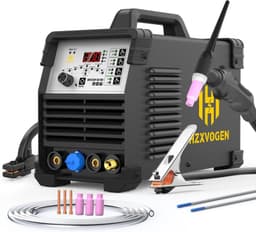
H HZXVOGEN H HZXVOGEN HVT250P

Best overall

H HZXVOGEN H HZXVOGEN HVT250P
9.8/10about £254.99
HITBOX HITBOX HBT250P

Rank 2

HITBOX HITBOX HBT250P
8.6/10about £339.99
On this page

What best has to mean

A useful recommendation begins with the job. Aluminium normally calls for AC/DC. Mild steel and stainless steel can be welded with DC. The next test is supply, not sales rank. A rank in TIG Welding Equipment shows marketplace activity, and that category can include accessories. It is not a test of electrical safety or bead quality. None of these four extracts states input current, so a 200 A output claim can still need more than a household 13 A socket. The checklist order is in the TIG welder buying guide. The H HZXVOGEN shows 4.9 from 13, with the five texts labelled United States. The HITBOX has 4.3 from 62, including a bridged-fuse report. Both SSimder ASINs show 3.8 from 167 because they share one review pool. No machine here receives a top-pick or best-value award.

For aluminium: H HZXVOGEN or HITBOX, with conditions

The H HZXVOGEN HVT250P is the lower-priced AC/DC option at £254.99. It names HF start, pulse, square wave, and stick, plus a WP-17 torch, earth clamp, electrode holder, and argon hose. It is also the heaviest here at 13.5 kg, the pedal is extra, and input current and duty cycle are absent. Choose it only if the manual gives a credible input and the delivered lead matches. Skip it if you need UK review evidence, a verified 13 A machine, or a pedal in the box. The HITBOX HBT250P is 8.6 kg and publishes 0.5–200 Hz, HF start, and 2T/4T. It may suit an experienced hobby user who will inspect the machine before use. The pedal is not included, thermal duty is unstated, and the included-components field does not prove a regulator. UK reviews report about 27 A, a bridged 13 A fuse, and leaking gas-hose joints. Do not energise a unit whose fuse is bypassed. Wording that fuses changed from 2024 does not prove the unit in front of you. Why aluminium sits on this side of the fork is on AC DC TIG vs DC TIG.
H HZXVOGEN H HZXVOGEN HVT250P

Testsieger

H HZXVOGEN H HZXVOGEN HVT250P
9.8/10about £254.99

For steel only: the two SSimder listings

SSimder B0FVWWVWB1 is £104.49 and names lift TIG, stick, a WP-17 torch, holder, earth clamp, and manual. At 6.82 kg it is easy to store. For DC practice on clean mild steel or stainless steel you do not need unused AC controls. The bullets state 10–140 A, although the model string says TIG-200. The older B08QVQ9FKH is £119.99 and 6 kg. Its bullet says aluminium is not applicable, and it names 7018, 6013, and 6010 rods. The title says 140 A and the table prints 200 A. Paying £15.50 more does not add a separate review pool. Both share 3.8 from 167. Shared UK feedback describes a 50 A fuse in a 13 A plug and refers to 22.7 A. That fuse removes intended protection. It does not turn BS 1363 hardware into a high-current connector. Either row is only a conditional steel candidate when the plug is unaltered and the stated input matches the supply. Skip both if the fuse is wrong or aluminium is on the job list.

Who should buy none of these

Buy none of the four for daily production, coded work, or a procedure that needs a documented duty cycle and a stated input. None of the extracts prints a thermal duty cycle, and all omit input current in the specification table. A specialist machine that states a 13 A input and a duty percentage at a named output gives you evidence these rows do not. Leave the shortlist if you cannot inspect the plug safely or arrange a qualified electrical assessment. A hot plug, a repeated trip, a bridged fuse, or an oversized fuse is not a technique issue. Stop, isolate the machine, and use your return rights rather than striking an arc to test it. A torch in the photograph is not a kit. Confirm the regulator, cylinder, consumables, PPE, and fume control separately. A beginner who wants one documented package may be better served by a UK-supported kit with explicit input and duty, even above this shelf-price band.

Common questions

Which of these four should a beginner buy?
There is no unconditional beginner pick. For aluminium, investigate the H HZXVOGEN or the HITBOX only after you verify supply and plug details. For steel-only practice, either SSimder has the DC process, but altered-fuse reports mean the delivered unit and the manual must pass inspection first.
Is the HITBOX best because it ranks highly?
No. An Amazon sales rank reflects sales activity within a changing category, not an independent test. The HITBOX has useful AC/DC controls and UK feedback, but reports of a bridged fuse and gas leaks prevent a blanket recommendation for every buyer.
Why not call the 4.9 H HZXVOGEN the winner?
The average covers only 13 reviews, and all five texts in the extract are labelled United States. It also lacks stated input current and duty cycle. Those limitations leave too little UK-specific evidence for a top-pick award on this page.
Are the two SSimder models two test results?
No. Both ASINs display the same 3.8-from-167 review pool, so treat it as shared feedback. Their prices, weights, and listing details differ, but the repeated rating is not independent confirmation of either machine.
Is the cheaper SSimder enough for steel?
Its DC process can be appropriate for mild steel and stainless steel, and £104.49 is the lowest extract price. It is only enough if its genuine input requirement suits your supply and the plug fuse is correct. It is not the choice for ordinary aluminium TIG.
Does a higher-priced UK-supported machine belong in another class?
Often, yes. A higher price may buy an explicit input rating, a duty cycle at a named current, a regulator package, and accessible support. Compare the complete working system and the documentation, not only maximum amps or the inverter price.

Related pages

Sources

HSE and British Standards pages, the R-Tech 13 A example, and the amazon.co.uk listings for these four ASINs. Listing snapshot 16 October 2026.

  1. HSE, mild steel welding fume (retrieved 16 October 2026)
  2. HSE WL3, welding fume control (retrieved 16 October 2026)
  3. HSE, asphyxiation hazards in welding (retrieved 16 October 2026)
  4. HSE, other welding risks (retrieved 16 October 2026)
  5. HSE, welding controls (retrieved 16 October 2026)
  6. BS EN IEC 60974-1, welding power sources (retrieved 16 October 2026)
  7. BS EN 60974-6:2016, limited duty equipment (retrieved 16 October 2026)
  8. R-Tech TIG 160 A, 13 A example (retrieved 16 October 2026)