Independent comparisons. We may earn from shop links. More info

TIG welder 13 amp plug

Updated: October 2026

A TIG welder on a 13 amp plug is safe to use from a household socket only when the manufacturer’s input specification, plug, fuse, cable and circuit all support that arrangement. The shape of the plug is not proof. In this comparison set, none of the four extract tables states input current, while UK reviews describe a bridged fuse on the HITBOX and a 50 A fuse inside a SSimder plug. Those reports require a stop-and-check response, not a welding technique. The [TIG welding machine comparison](/hub/soldering-and-welding/tig-welding-machine) records the listing evidence. We did not lab-test these machines. A qualifying purchase through our links can earn a commission at no extra cost to you.

A TIG welder on a 13 amp plug is safe to use from a household socket only when the manufacturer’s input specification, plug, fuse, cable and circuit all support that arrangement. The shape of the plug is not proof.

Our top picks

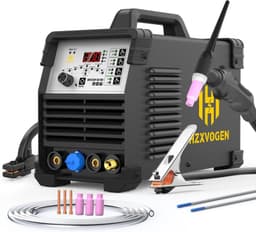
H HZXVOGEN H HZXVOGEN HVT250P

Best overall

H HZXVOGEN H HZXVOGEN HVT250P
9.8/10about £254.99
HITBOX HITBOX HBT250P

Rank 2

HITBOX HITBOX HBT250P
8.6/10about £339.99
On this page

What a 13 A socket is designed to do

BS 1363 covers the familiar UK 13 A plug and socket system used in homes and light industrial settings. The plug fuse protects the flexible lead and appliance arrangement. It is not a performance limiter to bypass when a welder asks for more current. Wire across a fuse, foil around it, or a fuse marked above the permitted plug rating defeats that protection. Do not energise a welder in that condition. Input current is different from the welding output on the front panel. A machine may deliver 140 A or 200 A at low welding voltage while drawing a smaller, but still substantial, current from 230 V mains. “200 A TIG” does not mean 200 A comes through the wall, and it does not prove a 13 A socket is adequate. You need the rated input in the manual or on a credible nameplate, together with the manufacturer’s circuit requirement. As simple arithmetic, 13 A at 230 V is about 3 kW. That does not let you declare a machine safe from a 3 kW shopping-table cell, because efficiency, power factor, peak demand, duty cycle and listing accuracy still matter. The SSimder table prints 3 kW, yet reviews cite a manual figure of 22.7 A. Ask the seller or manufacturer to resolve the conflict. A shared garage circuit, an extension, a hot plug, repeated trips, discolouration or a burning smell are stop signs. Never fit a larger protective device to see if it holds.

What a documented 13 A welder looks like

A credible 13 A claim appears in the technical documentation, not only as a moulded plug on the lead. As a contrast, the R-Tech TIG160FPP manual states 220/240 V and 13 A input, alongside a 35% duty cycle at 160 A. That gives a defined supply requirement and an output condition. It does not prove every 160 A machine is 13 A. It shows the level of documentation to look for. A 200 A machine can require a different installation. Sealey’s TIGACDC200 instructions state 25.2 A rated input in TIG mode and say maximum output requires a 32 A fused supply installed with professional electrical involvement. That is not the HITBOX or H HZXVOGEN specification. It shows why matching headline output does not establish matching input. None of the four Amazon extract tables reaches that clarity. H HZXVOGEN says 240 V but gives no input current or plug type. HITBOX says 240 V while its input field remains absent. Both SSimder rows show 220 V and 3 kW, yet their shared review record introduces the conflicting 22.7 A claim. If the delivered manual also omits rated input, return the machine or seek written confirmation rather than calculating your own safe output ceiling. A low duty cycle does not fix an unsuitable connection. For broader selection criteria, use the TIG welder buying guide.
H HZXVOGEN H HZXVOGEN HVT250P

Testsieger

H HZXVOGEN H HZXVOGEN HVT250P
9.8/10about £254.99

What the UK reviews report

The HITBOX HBT250P has UK reviews describing a 13 A plug with its fuse bridged and one reviewer citing a draw of about 27 A. Its listing says fuses were changed from 2024, but that statement cannot verify every unit already manufactured, returned or held in stock. Isolate the machine and inspect the plug only if you are competent to do so. Otherwise have a qualified person inspect it. Any bypassed fuse means reject or return the unit. The two SSimder ASINs share a 3.8-from-167 review pool, so their fuse reports should not be counted as two independent tests. Reviews describe a 50 A fuse in a 13 A plug and refer to 22.7 A input. A 50 A fuse is not a valid way to obtain more current from BS 1363 hardware. Even if the inverter appears to run at a low setting, the incorrect fuse removes expected protection and the unit should not be used. H HZXVOGEN lacks the same UK review evidence because the five review texts in the extract are labelled United States. That absence is not reassurance. US experience cannot establish the suitability of a UK plug or 230 V installation, and the input field is still missing. Its 4.9 average from 13 reviews should have no role in deciding whether your garage socket is adequate. A sales rank or star average cannot certify an electrical installation.

When return or an electrician is the next step

Return the machine if the fitted plug has a bridged or oversized fuse, the cable or case is damaged, or the supplied documentation conflicts in a way the seller cannot resolve. Under the Consumer Rights Act 2015, goods must meet relevant quality and description requirements. Those rights are not permission to energise suspect equipment while a dispute is open. Photograph the condition without modifying it and follow the retailer’s return process. Call a qualified electrician when the manufacturer specifies more than 13 A or requires a dedicated 16 A or 32 A arrangement. The electrician assesses circuit design, protective devices, cable size, isolation and the appropriate industrial connector. The answer is a correctly designed installation, not a 13 A plug with stronger fuse wire. ParkerBrand makes the same buyer-facing point for its equipment: do not replace a specified 16 A plug with a 13 A one. Stop immediately if the plug or socket becomes hot, protection trips repeatedly, the arc causes severe dimming, or insulation smells. Isolate the supply and have the machine and installation checked. Do not treat those symptoms as settings to tune around. Once the electrical side is confirmed, continue with how to set up a TIG welder for gas, return, PPE and fume controls.

Common questions

If it has a 13 A plug, can I use a garage socket?
Not automatically. Check the manufacturer’s rated input current, required circuit, correct fuse and the condition of the socket and lead. A plug may have been fitted incorrectly, and none of these four extract tables states input current clearly enough to decide from the listing.
What if the plug fuse has wire across it or says 50 A?
Do not use the machine. A bridge or oversized fuse defeats the intended protection of the BS 1363 plug arrangement. Isolate it, document the condition and return it or have it examined by a qualified person without first striking an arc.
The HITBOX says fuses changed after 2024. Should I still check?
Yes. Seller wording cannot establish the condition of the individual unit delivered to you, particularly where stock, returns and manufacturing dates can vary. Reports of bridged fuses justify checking the actual plug before use, not assuming the issue has disappeared.
Does the SSimder 3 kW field prove it fits 13 A?
No. Although 13 A at 230 V is arithmetically close to 3 kW, the shared reviews cite 22.7 A and the listing does not provide a dependable input specification. Efficiency, power factor and demand also matter. Ask for authoritative documentation rather than resolving the conflict yourself.
Who should fit a 32 A welder outlet?
A qualified electrician should design and install it after assessing the existing supply and circuit. A dedicated outlet can require correctly sized cable, protective devices, isolation and an industrial connector. It is not a plug-swap job.
Is a tripped breaker a welding-technique problem?
No. Repeated tripping indicates an electrical demand or fault that the protective device is responding to. Stop, isolate the welder and have the equipment and circuit assessed. Never defeat or enlarge protection to keep welding.

Related pages

Sources

HSE and British Standards pages, the R-Tech 13 A example, and the amazon.co.uk listings for these four ASINs. Listing snapshot 16 October 2026.

  1. HSE, mild steel welding fume (retrieved 16 October 2026)
  2. HSE WL3, welding fume control (retrieved 16 October 2026)
  3. HSE, asphyxiation hazards in welding (retrieved 16 October 2026)
  4. HSE, other welding risks (retrieved 16 October 2026)
  5. HSE, welding controls (retrieved 16 October 2026)
  6. BS EN IEC 60974-1, welding power sources (retrieved 16 October 2026)
  7. BS EN 60974-6:2016, limited duty equipment (retrieved 16 October 2026)
  8. R-Tech TIG 160 A, 13 A example (retrieved 16 October 2026)