Independent comparisons. We may earn from shop links. More info

AC DC TIG vs DC TIG

Updated: October 2026

The AC DC TIG vs DC TIG decision is straightforward once you name the metal. If the work is mild steel or stainless steel, DC is the normal process and AC is optional expense. If ordinary aluminium is on the job list, choose an AC/DC machine, because AC provides the cleaning action that deals with the oxide layer. A torch, a pulse setting, or a larger amp number cannot add that process to a DC inverter. The [TIG welding machine comparison](/hub/soldering-and-welding/tig-welding-machine) includes two machines on each side of this fork. This page says what the distinction changes, and what it does not. Listings only; not a weld trial. A qualifying purchase can earn a commission at no extra cost to you.

The AC DC TIG vs DC TIG decision is straightforward once you name the metal. If the work is mild steel or stainless steel, DC is the normal process and AC is optional expense.

Our top picks

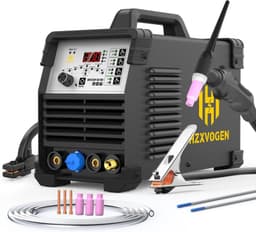
H HZXVOGEN H HZXVOGEN HVT250P

Best overall

H HZXVOGEN H HZXVOGEN HVT250P
9.8/10about £254.99
HITBOX HITBOX HBT250P

Alternative

HITBOX HITBOX HBT250P
8.6/10about £339.99
SSimder SSimder 140A (B08QVQ9FKH)

Alternative

SSimder SSimder 140A (B08QVQ9FKH)
7.6/10about £119.99
On this page

When DC is the whole machine you need

Direct-current electrode negative, usually shortened to DCEN, puts more heat in the work and is the standard TIG arrangement for mild steel and stainless steel. The arc is stable, penetration is controllable, and the machine is simpler. If the realistic jobs are stainless brackets, steel tube, or bench practice, a DC inverter can meet the process without charging you for AC balance and waveform controls you never use. The two SSimder listings are the DC examples. B0FVWWVWB1 names lift TIG and states 10–140 A in its bullets. B08QVQ9FKH does not identify arc start, and its bullet says aluminium is not applicable. Both also offer stick welding, and both list a torch, an electrode holder, a return clamp, and a manual. Their limits are not caused by DC. The newer model string says TIG-200 despite 140 A bullets. The older title says 140 A and the table prints 200 A. Their shared UK review pool contains a 50 A fuse in a 13 A plug and a 22.7 A input figure. DC can be the correct process for steel, and the supply still has to be honest. Those separate gaps are in the TIG welder buying guide. Arc starting is a distinction inside DC machines, not an AC/DC divide. Lift TIG starts by touching and lifting the tungsten. HF start establishes the arc without that deliberate contact. HF can reduce tungsten contamination. Lift TIG remains workable for hobby steel. Choosing HF does not make a DC machine suitable for aluminium.

When aluminium means you need AC

Aluminium quickly forms an oxide layer whose melting temperature sits far above the metal underneath. Brushing the surface is not enough, because the film reforms. During AC TIG, the electrode-positive part of the cycle provides oxide-cleaning action, and the electrode-negative part directs heat into the work. That is why ordinary aluminium TIG is an AC job. In this comparison, the H HZXVOGEN HVT250P and the HITBOX HBT250P are the only listings that claim AC. Both name HF start, and both also provide DC for steel and stainless steel. The H HZXVOGEN adds square wave and pulse without a numeric pulse range. The HITBOX states 0.5–200 Hz. Neither includes a foot pedal, although the H HZXVOGEN says one is supported. Those feature lists do not prove the thickness claims. The H HZXVOGEN bullet says 0.5–5 mm aluminium and the HITBOX material line mentions 0.3 mm. Neither figure is a controlled result here. Treat them as listing claims. AC does not repair an unsuitable supply. The H HZXVOGEN listing has no input current, and its review texts are labelled United States. The HITBOX has mostly UK feedback, including about 27 A and a bridged 13 A fuse. Aluminium is a reason to choose the AC side. It is not permission to ignore the plug.
H HZXVOGEN H HZXVOGEN HVT250P

Testsieger

H HZXVOGEN H HZXVOGEN HVT250P
9.8/10about £254.99

AC balance is not thermal duty cycle

AC balance changes how much of each cycle favours oxide cleaning against penetration and electrode cooling. More electrode-positive time increases cleaning and puts more heat into the tungsten. More electrode-negative time directs more heat into the work. Start from the machine’s own manual rather than copying a percentage from another brand. The HITBOX listing shows 10–90%. That figure is AC balance. It does not mean the welder can run for nine minutes out of ten, and it must not go into a duty-cycle comparison. Thermal duty cycle is stated at a particular output current and describes allowed welding time in ten minutes. None of the four listings publishes that thermal figure. Square wave is another AC control, not a different metal process. A modern square-wave machine can switch quickly between polarities. The words alone do not establish arc quality. Pulse works on suitable DC or AC designs and moves between a higher and a lower current. It can help on thin stainless steel. It is not oxide-cleaning AC, and it cannot convert a DC machine for aluminium. First setup and shielding checks are in how to set up a TIG welder.

The recommendation, with its condition

Buy AC/DC if aluminium is a genuine present or future requirement. Inside these four listings, that means investigating the H HZXVOGEN or the HITBOX, and verifying input current, plug, duty cycle, and package contents before use. The lower H HZXVOGEN price is offset by a small US-labelled review sample. The HITBOX has more UK evidence and also has serious fuse and hose complaints. Neither earns an unconditional recommendation. Buy DC if you will weld only mild steel and stainless steel and you want lower cost and simpler controls. The SSimder pair illustrates that route at £104.49 and £119.99. Their shared review pool, conflicting amperage fields, and fuse reports still need a resolution. The right process does not rescue poor electrical documentation. Do not plan around niche demonstrations of DC aluminium. Specialist techniques on particular thick sections are not a beginner route for ordinary aluminium sheet, and they do not turn the DC SSimder listings into AC/DC inverters. After the process, check the electrical demand on its own. A 200 A output label is not a 13 A input claim. The TIG welder 13 amp plug page is that next check.

Common questions

Can you weld aluminium with either SSimder?
Do not buy either listing for ordinary aluminium TIG. Both are presented as DC machines, and B08QVQ9FKH explicitly says aluminium is not applicable. A different torch or tungsten cannot add the AC oxide-cleaning cycle that the inverter does not generate.
If you only weld stainless steel, why pay for AC?
You generally do not need to. Stainless steel is normally TIG welded on DCEN, so a documented DC machine can be the better-value process choice. Pay for AC only if aluminium, or another AC application, is a realistic requirement.
Is the HITBOX 10–90% figure a duty cycle?
No. In this listing it refers to AC balance, which changes the split between cleaning and penetration in the alternating cycle. Thermal duty cycle describes welding time at a stated current within a ten-minute period, and that figure is absent from the listing.
Does square wave matter for aluminium?
Square-wave AC can switch polarity quickly and allow control of the arc, the cleaning, and the penetration. Its presence alone does not prove performance. Supply, duty cycle, adjustment range, torch capacity, and technique still decide whether a machine suits the job.
Can a lift-TIG torch on a MIG welder create AC?
No. Lift start describes how the arc begins. It does not change the power source from DC to AC. The inverter has to generate a suitable AC welding output. Accessories cannot add that function to a DC-only machine.
Is DC aluminium ever legitimate?
Specialist DC techniques exist for particular materials, thicknesses, and shielding arrangements. They are not a sound general buying route for ordinary aluminium fabrication. For a beginner choosing one machine for typical aluminium work, AC/DC is the clear recommendation.

Related pages

Sources

HSE and British Standards pages, the R-Tech 13 A example, and the amazon.co.uk listings for these four ASINs. Listing snapshot 16 October 2026.

  1. HSE, mild steel welding fume (retrieved 16 October 2026)
  2. HSE WL3, welding fume control (retrieved 16 October 2026)
  3. HSE, asphyxiation hazards in welding (retrieved 16 October 2026)
  4. HSE, other welding risks (retrieved 16 October 2026)
  5. HSE, welding controls (retrieved 16 October 2026)
  6. BS EN IEC 60974-1, welding power sources (retrieved 16 October 2026)
  7. BS EN 60974-6:2016, limited duty equipment (retrieved 16 October 2026)
  8. R-Tech TIG 160 A, 13 A example (retrieved 16 October 2026)