Independent comparisons. We may earn from shop links. More info

Flux core vs gas MIG

Updated: October 2026

You can buy a cylinder and a solid-wire MIG set, or you can buy a gasless inverter and a spool of flux-cored wire and be welding before the gas man calls back. Flux core vs gas MIG is that choice, and it is mostly about what shields the puddle when the air moves. Self-shielded wire is the better process when wind would strip a gas shield off an outdoor repair. Gas MIG is the better process when the work is clean thin steel indoors and you can live with a cylinder. Neither is a cheaper way of doing the other job badly. The [flux core wire welder comparison](/hub/soldering-and-welding/flux-core-wire-welder) ranks machines only after you have picked the process. Four of the five listings we kept cannot run gas MIG at all. This page is from the Products Compared editorial team, drawn from those amazon.co.uk listings and from TWI, BOC, Sealey and HSE, on 16 October 2026. We did not compare beads in a lab. A qualifying purchase can earn us a commission at no extra cost to you.

You can buy a cylinder and a solid-wire MIG set, or you can buy a gasless inverter and a spool of flux-cored wire and be welding before the gas man calls back.

Our top picks

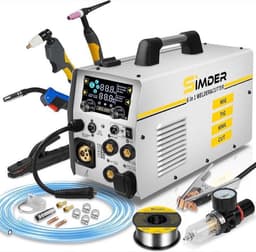
SSimder SSimder MIG-250 combo

Best overall

SSimder SSimder MIG-250 combo
7.6/10about £279.99
HITBOX HITBOX HBM200

Rank 2

HITBOX HITBOX HBM200
9.1/10about £99.99
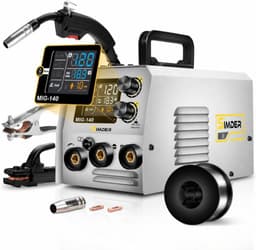
SSimder SSimder MIG-140

Best value

SSimder SSimder MIG-140
8.9/10about £79.99
On this page

What each process is shielding

Both processes melt a wire into the joint with an electric arc. The difference is where the shield comes from. In gas MIG you feed solid wire and you open a cylinder, usually an argon and carbon dioxide mix for mild steel. The gas flows through the torch and blankets the puddle. If the flow is wrong, the stick-out is wild, or the plate is dirty, BOC’s shielding-gas notes describe porosity: holes from too much gas, too little gas, or air that got in. You can see the puddle. You do not chip a crust between passes. Self-shielded flux-cored wire is a tube filled with flux. As it burns it makes its own gas and a slag cover. TWI’s FCAW notes separate that outdoor-style wire from gas-shielded flux core, sometimes called dual shield, which still needs a cylinder and still suffers if wind disturbs the gas. Saying “flux core” on its own is ambiguous. In this category the included spools are the self-shielded kind: E71T-GS on the SSimder MIG-140, 0.8 mm flux-cored wire on the HITBOX and PLASMARGON boxes. You do not connect a bottle for that process. The gas is made in the arc, and the slag is the other half of the shield. Stick welding sits beside both, and every listing in the set claims it. The electrode coating makes its own gas, which is why BOC points out that MMA is not ruined by a draught in the way MIG is. Polarity follows the wire, not the brand of inverter. Most self-shielded flux core runs electrode negative. Solid wire with gas usually runs electrode positive. The packet is the instruction.

Outdoors and draughts

A gas shield is a soft column of argon mix. A breeze across a driveway, a fan you put on for the fumes, or a draught through a roller door is enough to blow it aside. BOC says MIG suffers in draughts. TWI says the same of gas-shielded flux core: once the wind disturbs the gas, the process suffers. Sealey’s MIG buying guide is direct about the purchase that follows. If you work outdoors, buy a machine that can run gasless, because the gas is blown away. That is the condition for choosing flux core. A hinge on a gate, a trailer bracket, a repair you cannot drag into a still workshop: self-shielded wire keeps a shield when a cylinder would be feeding the hedge. You pay for that in slag and in smoke. Every pass grows a crust you chip and brush before you continue. The Weld Space, writing for home welders, describes gasless work as smokier. We are not going to invent a percentage for how much more fume flux core makes. HSE’s WL3 sheet puts flux-cored arc welding and MIG in the same fume-control table. No bottle does not mean less fume. Indoors you still want local exhaust. Outdoors you still want respiratory protection. Turning the cylinder off and running solid wire “because it is only a tack” leaves the puddle open to air. Self-shielded wire is a different consumable, not solid wire with the regulator closed. Plug ratings and duty cycle stay on the buying guide.
SSimder SSimder MIG-250 combo

Testsieger

SSimder SSimder MIG-250 combo
7.6/10about £279.99

Indoors on thin steel

Bring the same joint inside, on clean 1 mm sheet, and the ranking flips. Gas MIG is the usual tidy choice. You can see the puddle, you are not chipping slag out of a cosmetic seam, and the heat is easier to keep low enough that the panel stays a panel. Sealey’s guide allows thin car metal to stay on a lower-amp set when the input really is 13 A. That sentence has a condition our five listings do not meet: none of them states the input current. A gas set that publishes 13 A is a different shortlist from a 200 A gasless title with a silent plug rating. Flux core can still join mild steel indoors. It is the worse choice when the sheet is thin and the bead will be seen. Forum welders who do run gasless on about 0.7–0.8 mm talk about short tacks, bright metal and backing, and they still describe gas as the easier route. Burn-through is a heat problem, not a brand problem. That job, including what an MOT tester expects of a structural patch, is on the car bodywork page. Fume does not relax because you are in a garage. HSE wants engineering control indoors for welding of any duration. A flux-core session with the door open is not the control. Cylinder gas is a real object in the corner. Size and rental sit outside this comparison. What matters is whether you can store one, and whether the machine has a gas valve. On four of these listings, it does not.

One machine or two

PLASMARGON MIG-200 at £69.99, SSimder MIG-140 at £79.99, HITBOX HBM200 at £99.99 and HITBOX HBM1200, listed at £149.99, are gasless machines that also claim stick and lift TIG. They do not claim gas MIG. Buying one of them in case you add gas later buys a later second machine. The HBM200 remains the conditional gasless pick for occasional mild steel because it states an effective 140 A and has 4.4 from 573 ratings. That is a process-limited recommendation. It is not a gas MIG welder that happens to include a spool. The SSimder MIG-250 at £279.99 is the only kept listing that claims both gas MIG and flux core, plus plasma cutting. The torches for TIG and plasma are in the included list. A gas fitting is mentioned in the bullets. No flux-cored spool is named, the welding duty cycle is not stated, and the average is 5.0 from six ratings. Plasma cut figures in the listing disagree with each other. The seller says it does not weld aluminium. If you know you will do both processes, it is the only box in this set that says so, and the evidence is thin enough that you should read the live listing before you treat the claim as a workshop plan. Choose self-shielded flux core when the repair is mild steel and the air moves, and buy a gasless inverter on purpose. Choose gas MIG when the steel is clean and thin and the workshop is still, and buy a machine that states a gas process, a supply current, and a duty cycle. Choose the MIG-250 only when you truly want both in one unit and you accept six ratings and conflicting cut numbers. Stick remains the third outdoor option when the joint is thick enough for a rod. It is claimed on all five. It still needs a filter, a dry electrode, and the same fume control.

Common questions

When is flux core the better process?
When you are joining mild steel in wind or in a draught that would blow a gas shield away, and you can chip slag between passes. Gate brackets, trailers and outdoor repairs fit. You still control the fume. Flux core is not the better process for a clean, visible thin panel indoors, where gas MIG is usually the tidier weld.
When is gas MIG the better process?
When the work is clean thin steel in still air, and you can place a cylinder. You see the puddle and you do not chip slag. The machine has to claim a gas process. Four of the five listings here do not. A lower-amp set can suit car-sized sheet only if the input current is actually stated, which these five do not do.
Can you run solid wire with the gas turned off?
You can feed the wire. You do not get a sound gasless weld. Solid wire needs the shielding gas. Closing the valve leaves the puddle open to air and tends to leave porosity. Self-shielded flux-cored wire is the consumable that makes its own shield. It is not solid wire on an empty cylinder, and the polarity is often different.
Does flux core make less fume because there is no bottle?
No. The absence of a cylinder means the shield is coming from the flux, not that the fume has gone. HSE includes flux-cored arc welding in the same control guidance as MIG. Indoors you still want local exhaust. Outdoors you still want respiratory protection. We are not quoting an emission percentage the sources do not give.
Which machine in this set can do both?
Only the SSimder MIG-250, at £279.99, claims gas MIG and flux core, and it also claims plasma cutting. It has six ratings, no flux-cored spool in the included list, and plasma figures that do not match each other. The other four are gasless. Adding a cylinder later is not a feature they claim.
Do you still chip slag with gas MIG?
Not on solid wire with a proper gas shield. The slag crust belongs to flux-cored wire and to stick electrodes. If you are chipping a solid-wire MIG bead, something else is on the plate, or you are not running the process you think you are. Flux core, by contrast, needs the chip and a wire brush before every following pass.
Is stick a third option outdoors?
Yes, when the joint suits a rod. The coating makes its own gas, so a draught does not strip the shield the way it strips MIG gas. All five listings claim stick. It is slower than wire, and it is still a fume and filter job. It is a reasonable way to weld a thick bracket outside if you do not want a spool at all.

Related pages

Sources

Public UK sources and the amazon.co.uk listings in this set, last checked on 17 October 2026.

  1. HSE, mild steel welding fume (retrieved 17 October 2026)
  2. HSE, welding controls (retrieved 17 October 2026)
  3. HSE WL3, welding fume (retrieved 17 October 2026)
  4. BS EN ISO 16321-2:2021, eye and face protection for welding (retrieved 17 October 2026)
  5. Basic Welding, what duty cycle means (retrieved 17 October 2026)
  6. Sealey MIG140i instructions (retrieved 17 October 2026)
  7. TWI, flux-cored arc welding FAQ (retrieved 17 October 2026)
  8. GOV.UK MOT inspection manual, appendix A (retrieved 17 October 2026)