Independent comparisons. We may earn from shop links. More info

Flux core welder buying guide

Updated: October 2026

You are standing in a garage with a 13 A socket, a rusty gate bracket, and a listing that says 200 A. That number is the easiest thing on the page and the least useful if the machine trips, overheats, or arrives without the parts the title implied. A flux core welder buying guide for the UK starts with the supply you can actually use, then the duty cycle at a stated current, then the wire and the box. The [flux core wire welder comparison](/hub/soldering-and-welding/flux-core-wire-welder) holds the five amazon.co.uk listings we kept, from £69.99 to £279.99. This page is the criteria behind that table, checked on 16 October 2026. We did not weld with the machines. A qualifying purchase can earn a commission at no extra cost to you.

You are standing in a garage with a 13 A socket, a rusty gate bracket, and a listing that says 200 A.

Our top picks

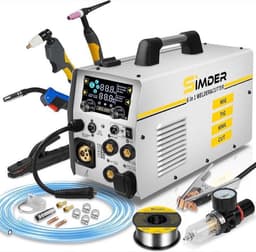
SSimder SSimder MIG-250 combo

Best overall

SSimder SSimder MIG-250 combo
7.6/10about £279.99
HITBOX HITBOX HBM200

Rank 2

HITBOX HITBOX HBM200
9.1/10about £99.99
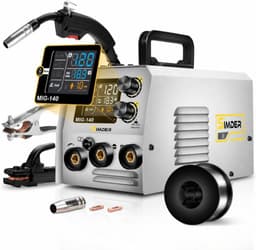
SSimder SSimder MIG-140

Best value

SSimder SSimder MIG-140
8.9/10about £79.99
On this page

What a UK flux core welder has to match

UK mains are 230 V, and the ordinary wall plug is BS 1363, fused at 13 A. Several of these inverters are titled 230 V or 240 V, which is the right family of supply. None of the five kept listings states the input current or the plug fitted to the lead. A 200 A figure on the front is an output claim, not a promise that the machine will run that output from a household socket. Foster Industrial treats about 200 A as the practical ceiling of a 240 V machine, and treats amperage as something you match to thickness. Sealey’s MIG140i instructions are a useful contrast, and that model is not one of the five. Sealey says the flux-cored-only inverter needs at least 16 A, and a 32 A fused supply for full output. Its published duty cycle falls from 100% at 44 A to 60% at 109 A and 10% at 140 A. That is what a written supply and a written duty cycle look like. Our five do not give you that pair of facts. The SIP WELDMATE 100 A, also outside the set, was listed at £126 on 16 October 2026 with a stated 13 A supply and 100 A at 15% at 40 °C. It shows that a lower headline can be the machine that tells you the socket. Treat a 110 V title the same way you would treat the wrong plug on a kettle. On the same day, amazon.co.uk was still showing 110 V AZZUNO and AWT gasless welders in this search. Those machines are built for a US-style supply. A step-down transformer is not a tidy fix for a first welder. If the voltage in the title is 110 V, leave the listing.

Duty cycle at a stated current

Duty cycle is a 10-minute test, not a mood. BS EN IEC 60974-1, as welding suppliers such as BWS explain it, asks how many minutes in ten the machine can weld at a stated current before it must rest. A rating taken at 20 °C looks kinder than the same percentage at 40 °C. A 60% figure with no current beside it is not a specification you can plan a repair around. Only the HITBOX HBM200 in this set prints a duty-cycle line, and the wording stays as it appears: “60%-140A” at 40 °C. The same bullets say the effective welding current is 140 A, even though the title says 200 A. We do not tidy that printed line into a neat “60% at 140 A”. We also do not treat the HBM1200 technical field “92@60%” as a duty cycle, because the file does not label it as one. The PLASMARGON MIG-200, the SSimder MIG-140 and the SSimder MIG-250 do not state a duty cycle at all. A cheaper box with no duty cycle can still be the right machine for a ten-minute bracket, and it is a poor machine to buy if you expect to lay bead after bead on 4 mm steel. Express Weldcare’s hobby guide talks about duty cycles around 30% for occasional use. That is their framing, not a measurement of these ASINs. If a published line, with a current and a temperature, matters more to you than the lowest shelf price, the HBM200 is the only kept file that even attempts the sentence.
SSimder SSimder MIG-250 combo

Testsieger

SSimder SSimder MIG-250 combo
7.6/10about £279.99

Process, wire and what is in the box

Gasless flux core is the job this category is for. The wire is a soft tube. Compounds in the core make shielding gas and slag as they burn, so you do not connect a cylinder for that process. Four of the five listings are that kind of inverter, and they also claim stick and lift TIG. The fifth, the SSimder MIG-250 at £279.99, is the only one that claims gas MIG as well as flux core, and it adds plasma cutting. If you still want a cylinder for clean indoor sheet, that is a different purchase, covered on flux core vs gas MIG. The PLASMARGON includes a small spool of 0.8 mm flux-cored wire and states 0.8 and 1.0 mm. The SSimder MIG-140 includes a spool described as 1 lb of E71T-GS. The HBM200 includes 0.5 kg of 0.8 mm. The HBM1200 includes 0.8 mm wire and says 0.8 and 1.0 mm. The MIG-250 does not name a flux-cored spool. Foster notes that flux-cored wire wants a knurled drive roll. The packet, not the title, also decides polarity. Most self-shielded wire runs electrode negative. Lift TIG in the title is a socket, not a torch, on the four cheaper machines. The PLASMARGON, MIG-140, HBM200 and HBM1200 do not list a TIG torch. The MIG-250 does list TIG and plasma torches, and the seller says the DC machine does not weld aluminium. None of the five lists a welding helmet. Budget for a filter to BS EN ISO 16321-2, gloves, and a way to deal with fume before the first arc. HSE’s mild-steel bulletin treats welding fume, including this process, as a health risk: local exhaust indoors, and respiratory protection outdoors or when extraction is not enough.

Thickness as a rule of thumb

Foster’s guide uses about 35–40 A for each millimetre of steel as their rule of thumb. On that arithmetic, a short bead in 2 mm mild steel sits near 70–80 A, and 4 mm sits near 140–160 A. It is a supplier’s planning figure, not a weld we made with these inverters, and it assumes the machine can actually hold that current for the length of the joint. A title that says 200 A does not prove the 4 mm end of the sum. The sellers’ own ranges are claims. PLASMARGON states 0.8–4 mm for gasless MIG. SSimder’s MIG-140 talks about an 18–20 gauge example and stick up to 3/16 inch, which is a light-gauge illustration, not a sill specification. HBM1200 states MIG 0.8–5 mm, ARC 1–6 mm and TIG 1–4 mm, with stainless only in TIG and the torch not included. HBM200 and the MIG-250 do not state a welding thickness. The HBM200’s useful number is the effective 140 A, which on Foster’s thumb sits nearer 3.5–4 mm than the 200 A in the title. A gate hinge and a 0.8 mm car skin are not the same purchase. Thin sheet is where flux core burns through, and that limit is the subject of the car bodywork page. If the listing gives you a voltage, a wire size and a price, and withholds the plug and the duty cycle, buy it for short mild-steel repairs and keep the thickness claim in the seller-says column.

Common questions

What should you check before buying a gasless MIG welder in the UK?
Check 230 or 240 V in the title, then look for an input current or a BS 1363 plug, which none of these five states. Next, look for a duty cycle written next to a current and a temperature. Then check the wire diameter in the box, whether a TIG torch or a helmet is actually listed, and whether the process is gasless only. A 200 A headline does not answer any of those questions.
Does 200 A mean the machine welds at 200 A from a 13 A socket?
No. Output amps and the current drawn from the wall are different numbers. Sealey’s MIG140i, which is not in this set, asks for at least 16 A and a 32 A supply at full output, and its duty cycle at 140 A is only 10%. None of the five kept listings states a plug rating, so none of them should be treated as safe at full output on a 13 A socket.
Why does duty cycle matter more than the headline amp?
You weld for minutes, then the machine rests, inside a 10-minute period under BS EN IEC 60974-1. A machine that can show 200 A for a few seconds and then cut out is not the same tool as one that holds a lower current for several minutes. Only the HBM200 prints a duty-cycle line, “60%-140A” at 40 °C, and that line is left as printed.
What wire size do these kits actually include?
Three of the gasless kits include about 0.8 mm flux-cored wire: PLASMARGON, HBM200 (0.5 kg) and HBM1200. The SSimder MIG-140 includes a 1 lb spool described as E71T-GS in 0.030 and 0.035 inch. The MIG-250 does not name a spool. Several listings also say they accept 1.0 mm. The packet still decides polarity and the tip size.
Is lift TIG included when the title says 3-in-1?
On the four cheaper machines, no. They claim a lift TIG process and do not list a torch. You would buy the torch separately, and you still would not have a helmet in these boxes. The MIG-250 does list a TIG torch. The seller also says that machine is DC only and does not weld aluminium.
How do you treat a 110 V listing on amazon.co.uk?
Leave it if you are wiring a UK socket. Listings such as the AZZUNO and AWT 110 V sets were still in this search on 16 October 2026. They are the wrong mains. Do not copy US advice that treats a 110 V welder as a normal house-socket tool. In the UK the ordinary plug is 230 V and 13 A, and even that plug is not automatically enough for a 200 A inverter.

Related pages

Sources

Public UK sources and the amazon.co.uk listings in this set, last checked on 17 October 2026.

  1. HSE, mild steel welding fume (retrieved 17 October 2026)
  2. HSE, welding controls (retrieved 17 October 2026)
  3. HSE WL3, welding fume (retrieved 17 October 2026)
  4. BS EN ISO 16321-2:2021, eye and face protection for welding (retrieved 17 October 2026)
  5. Basic Welding, what duty cycle means (retrieved 17 October 2026)
  6. Sealey MIG140i instructions (retrieved 17 October 2026)
  7. TWI, flux-cored arc welding FAQ (retrieved 17 October 2026)
  8. GOV.UK MOT inspection manual, appendix A (retrieved 17 October 2026)