Transport argon cylinder in a car UK: valve shut, then drive
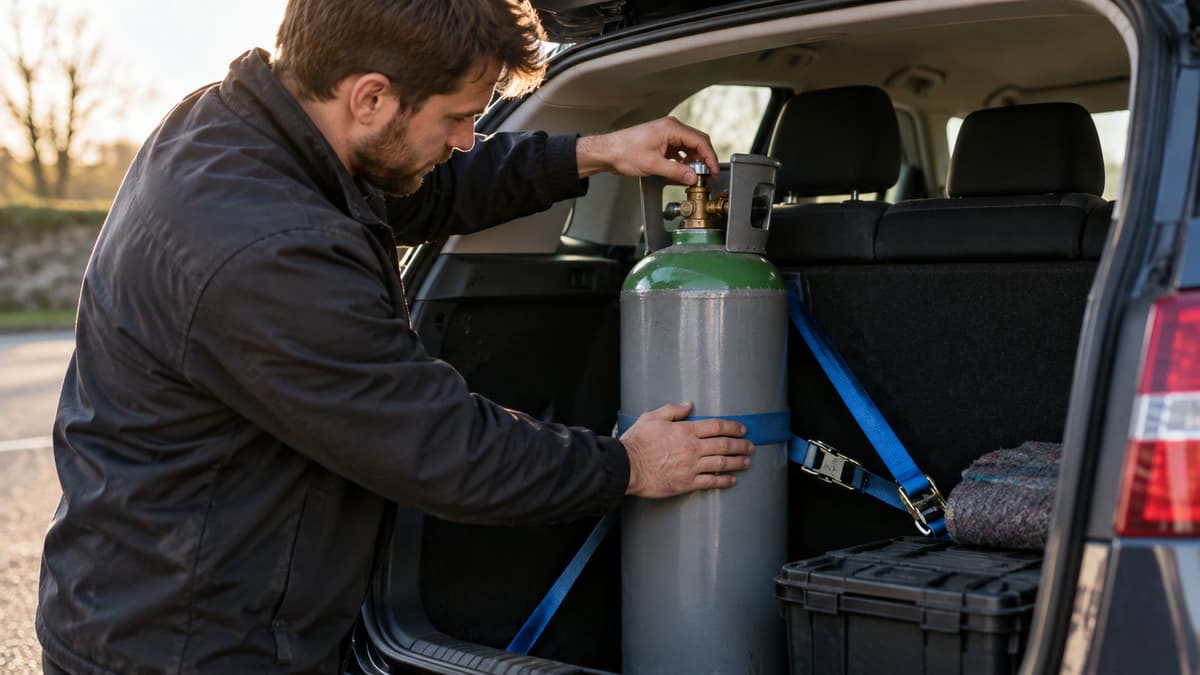
Moving one argon cylinder in a UK car means a shut valve, a strap and ventilation. Work carriage is a different regime. This page is not a legal clearance.
On this page

The bottle is paid for and the supplier shuts at five. The search you typed, transport argon cylinder in a car UK, is one private cylinder and a hatchback boot built for shopping. Shut the valve, stop the cylinder moving, and give any leak a path that is not your face. Those habits get a single bottle home. They leave the legal question with the label, with CDG 2009, and with whether the journey is private or carriage as work.
A welding cylinder is a pressure vessel with a valve, not a crate you wedge beside the wellies. Argon does not burn the way a fuel gas does, and it has no smell, so a weeping joint in a closed cabin does not announce itself. HSE INDG297 was written with oxy-fuel in mind. It still says to close the valve, prefer an open-backed vehicle, and treat an enclosed load space as something that needs ventilation beyond the cab. A pickup bed and a family hatchback are different machines.
In short
Transport of one argon cylinder in a car is a short journey with the valve shut, the cylinder strapped, and a path for gas to leave the load space. Public-road carriage sits under CDG 2009 and ADR, small-load thresholds exist, and this page will not calculate them or clear your boot. Leaving the cylinder in the car all day is storage, and a trip that is paid work sits in a different regime from a private buyer collecting one bottle.
What the gas is in transport terms
Compressed argon is listed as UN 1006 on the GOV.UK page about dangerous-goods vehicle tests. That page is guidance on an ADR test for vehicles that carry dangerous goods, not a permit for a hobby trip. Treating the number as a ban on cars, or as approval, over-reads a vehicle-testing page.
An argon and carbon dioxide mix can carry a different UN number. Air Liquide lists one argon/CO2 shielding mix as UN 1956. The diamond and the proper shipping name on your cylinder are what count.
A title that only says argon CO2 has not named the entry. On the argon gas cylinder comparison, the SWP WG/1368 is a disposable listed as argon/CO2 with the mix unstated, at a stated 60 L and 1.28 kg. Do not assign UN 1006 or UN 1956 from that title. If the label is silent, ask.
CDG 2009 brings public-road movements into the ADR framework. BCGA CP 50, issued in October 2023, says public-road carriage of cylinders sits under those rules, that small-load thresholds exist, and that police and DVSA check vehicles. This article does not quote a kilogram allowance. The label, the quantity on the cylinder, and the current text of CDG 2009 are the inputs.
Argon does not feed a fire the way oxygen does, and a leak can still thin the oxygen in a closed cabin. INDG297 was written for oxy-fuel, so it will not clear a private car in one line. BOC handling notes sit beside the regulations. They do not replace your label.
Habits that apply even to one bottle
Close the valve before the cylinder moves. Turn it until it seats, then stop. A regulator left on is a second joint, so the trip should depend on the cylinder valve. Left cracked open, a valve can fill a boot on a twenty-minute drive, and argon gives you nothing to smell.
Stop the cylinder moving. A tall bottle will lie down unless you prevent it, and a hard brake throws that mass at the seat backs or the tailgate. Upright, wedged, and held with a strap that does not stretch is what survives a roundabout. A bungee as the only restraint lengthens under load. If a valve guard came with the cylinder, fit it so the valve is not what hits the floor.
INDG297 prefers an open-backed vehicle. An enclosed load space needs ventilation beyond the cab, so a leak is not shared with the people. A pickup bed is close to that.
A hatchback is one cabin, and a cracked window is not a designed vent. A saloon parcel shelf is rarely gas-tight. Keep the trip short, and treat a closed cabin as the weak case.
The drive home is the transport. Three hours in a sun-heated car means the car has become the store. Unload at the end. At home the cylinder stands upright, valve shut, ventilated, and away from fuel. Beside the welding table it needs a strap too, so a tugged hose cannot topple it.
A private load and carriage as work
Private describes why you are driving. It does not lift the car out of CDG 2009. This piece is for one cylinder bought for a home garage.
BCGA CP 50 points at public-road carriage, small-load thresholds, and checks by police and DVSA. A threshold can lighten the duties on a small quantity. Whether your bottle qualifies depends on the UN number, the amount, and the regulation.
Carriage as work is a different diary. You move gas because a job needs it, the van is the work van, and the trip repeats. Training, paperwork, and an ADR vehicle test live there.
The GOV.UK page that names UN 1006 is about those vehicle tests. It does not enrol a hatchback, and it does not answer the question for a business van. If you are paid to carry gas, read CP 50 before you load.
A mate's van sits in the middle. One cylinder, once, with nobody paying you to carry gas, is close to the private case. You still owe a shut valve, a strap, and a load space that is not your breathing space.
Boot, van, and leaving it in the car
Use the load space rather than the back seat. The seat is directly behind the driver. A boot is still enclosed, and it is further from your head.
Strap the bottle low so braking does not throw it forward. On a hatchback, with the shelf out, boot and cabin are one volume. Keep the trip short, and unload even if you have more stops.
An open trailer is closer to the open-backed preference in INDG297 when the cylinder is upright, strapped, and the valve is protected. It does not fix a bottle left in the sun all afternoon. A slack strap and a hot cylinder are storage. Without a tie-down that holds the cylinder upright, the trailer is no upgrade on the boot.
A disposable is still a pressure container. The SWP WG/1368 is listed at £17.99, at 1.28 kg, with a stated 60 L, and 4.6 from 160 amazon.co.uk reviews. Reviewers describe about 5 to 20 minutes of welding. Strap it and shut it. Nearly empty can still mean pressure left inside.
A refillable is heavier. Look for a test mark before you accept the exchange. Refuse a missing guard or a damaged valve rather than carrying the cylinder with your palm on the outlet. If your vehicle has nowhere to strap it, come back with a strap.
A welding helmet in the boot is kit for later. The lens does nothing if the cabin is short of oxygen, and the helmet will not restrain the cylinder. Spend the strap on the gas.
What this article will not clear you to do
It will not tell you that a car boot is always acceptable for an argon cylinder. INDG297 prefers an open-backed vehicle. A family car is a compromise you manage with a shut valve, a real strap and a short journey, or you choose another vehicle. That is a decision for one trip.
It will not calculate a small-load threshold or stand in for CDG 2009, BCGA CP 50, or your hire contract. Applying a threshold means the regulation, your UN number, and your quantity. If you carry gas as work, ask inside that regime before the van is loaded.
It will not stretch these habits into a clearance for oxygen, acetylene, or a mixed fuel-gas load. Those duties are stricter because those gases misbehave in a way shielding argon does not. If the label names something else, stop and read it.
It will not bless overnight storage in the vehicle, a cylinder free to roll, a regulator as the only seal, or a window crack described as ventilation. The ordinary failures are a locked garage, a bungee, and a valve a quarter turn off its seat. Take the cylinder home, stand it upright, and shut the valve. The transport problem ends when the car no longer contains the gas.
Common questions
Is argon UN 1006?
Do I need an ADR licence for one bottle?
Should the valve be open or shut?
Boot, back seat, or open trailer?
Can I leave it in the car all day?
Does a disposable cylinder count?
Who checks vehicles?

Peter F. is the editor for DIY & tools at productscompared.co.uk. Comparisons in this category are checked against amazon.co.uk listings, review evidence and public UK sources.
Related articles

How to store a welding cylinder at home
Upright, valve shut and ventilated. A car boot is a journey, not the place a cylinder lives.

When a disposable MIG bottle is the wrong buy
A stated 60 L cartridge can be finished in minutes. The limit is gas volume, not a faulty welder.

How often a gas cylinder is tested
The interval is stamped on the cylinder and set out in ADR practice, not written in the product title.