Gas cylinder test date UK: read the shoulder stamp

The gas cylinder test date is stamped on the shoulder. See why 10 years is the usual maximum, when 15 is allowed, and why a listing bullet is not the stamp.
On this page
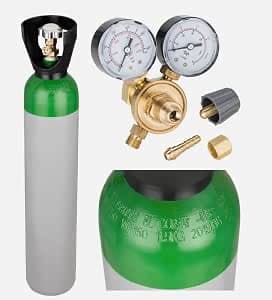
You are standing in the garage with a torch on the shoulder of a welding cylinder, or you are on amazon.co.uk looking at a bullet that says valid until 2030. Those are different kinds of evidence. The gas cylinder test date UK practice actually uses is the stamp on the metal, read against the interval that belongs to that cylinder. A product title will not carry it. Until the cylinder is in your hands, the bullet is a claim you still have to verify.
Refillable argon and argon-mix bottles are transportable pressure equipment, periodically inspected and then kept in use for a set number of years. Disposable cartridges never enter that cycle. This article uses seller text from one amazon.co.uk listing in our argon gas cylinder comparison, plus public UK guidance. We have not inspected a shoulder or pressure-tested a cylinder. If you buy through a link, we may earn a commission, which does not change the stamp.
In short
The test date that matters is stamped on the cylinder shoulder. Published UK material usually gives compressed gases such as argon a 10-year maximum, and a 15-year interval only where a competent authority has authorised it. Treat a valid-until line on amazon.co.uk as a seller claim until you can read the stamp, and leave disposable bottles out of that retest cycle.
The date is on the cylinder
The gas cylinder test date sits on the shoulder below the valve, stamped into the metal. You want the latest inspection date if an earlier manufacture date is also there. A later stamp resets the clock. Layouts differ by maker and by the inspection body, so expect a month and year. A valid-until sentence is a listing habit, not the usual mark on the steel.
Take the valve guard off if it covers the stamps, wipe the shoulder, and hold a torch at a low angle so the digits throw a shadow. Photograph the ring before you pay for a second-hand bottle, and again when a filled cylinder arrives. If paint, a collar or corrosion hides the marks, you do not have a date. Guessing from the paint colour keeps out-of-date cylinders in use.
A pi mark can sit in that same band. GOV.UK guidance on placing transportable pressure equipment on the market says periodic inspection can be carried out by an EU or Northern Ireland body, and the cylinder can stay pi-marked. The mark records that route. It is not a date. You still need the month and year, and the interval that inspection used. If a rental collar and the stamp disagree, ask which mark the company will honour before you move the cylinder.
Ten years is the usual published interval
For a refillable cylinder of a compressed gas such as argon, public UK material usually discusses 10 years. Marine Guidance Note 374 from the Maritime and Coastguard Agency includes a table, citing BS EN 1968 practice, that puts compressed gases such as argon, nitrogen and helium at 10 years. The note is written for ships. It does not replace the stamp on a garage cylinder.
The Vehicle Certification Agency's page on cylinders for gases discusses ADR's normal maximum interval as 10 years. A 15-year extension exists only when the competent authority has authorised it, under P15Y and similar schemes. That page leads on LPG, then on steel and aluminium, so do not copy the opening LPG line onto a welding cylinder. The maritime table is the closer published example for argon.
The Carriage of Dangerous Goods and Use of Transportable Pressure Equipment Regulations 2009 are the UK instrument on legislation.gov.uk. This article does not paraphrase a numbered rule from that text. For a purchase, use the date on the shoulder and the interval marked with it. A TIG welding machine manual does not lengthen either figure, and a MIG manual does not either.
A stamp that reads March 2020, on a 10-year interval, falls due in March 2030. That is arithmetic, not a reading of any listing. The month counts.
When 15 years is real
Fifteen years applies when the competent authority has authorised it and the cylinder is marked for that scheme. P15Y is the label the Vehicle Certification Agency uses. It is not a default because the bottle looks clean or cost more. If the shoulder shows 10 years, add 10. If it shows the authorised 15-year mark, add 15 to the last test date, month included. A seller who types "15 years" into a bullet has not authorised the extension.
A seller bullet is not a stamp
In our argon comparison, the Gray Eagle PM0410, sold as the Gray Eagle 8 L 82/18, ASIN B0H3417V96, is the row that prints a production year and a validity year. The seller states 2020 and valid until 2030. The listing also states an 8 litre cylinder, 1.2 cubic metres, 82% argon and 18% CO2, 150 bar, 16 kg full and 11 kg empty, and a mini regulator.
The outlet is stated as L 21.8 x 1/14, not as BS 341 No. 3, so a British regulator you already own may not screw on. The price in the file is £169.99. There is no amazon.co.uk review line, so there is no star rating to quote. A 2020 date plus 10 years lands in 2030, which matches the usual gap and still has to be checked on the metal. EN 1964-1 is a seller standard line, and we have not compared it with the shoulder. Consider this row if you want a cylinder sold as full, with a stated mix and a regulator in the box, and you can confirm the L 21.8 outlet. Skip it if you need BS 341 No. 3, pure argon, or UK owner reviews.
Disposables are not exchange cylinders
A non-refillable cartridge is a different object. BSI records BS EN 12205, for non-refillable metallic gas cylinders, as superseded, and that family is not the periodic inspection used for refillable cylinders. You do not return a disposable MIG bottle at year 10 for a new stamp and a refill. You use the gas and dispose of the shell as the supplier tells you. The word approved in a listing does not put that cartridge on a 10-year ADR clock.
Some small cylinders are refillable, and some larger shells are single-use, so size is a weak clue. If the label says non-refillable, do not refill it. A regulator that threads on beside a welder does not make a second fill acceptable. What you feel in use is volume: many disposables cover minutes of arc, then they are empty. That is not a failed 10-year test.
For gas on a refillable clock, buy a cylinder and read the stamp from day one. If you would rather not own one, flux-cored wire removes the bottle and the test date, with a different weld and a different fume load. Neither choice inspects a shell for you.
If the date has passed, stop
When the interval after the last stamp has run out, stop treating the cylinder as in date. Expect a filler or an exchange supplier to refuse it. The next inspection belongs to a body allowed to do periodic inspection. GOV.UK's guidance points to an EU or Northern Ireland body, after which the cylinder can remain pi-marked.
A compressor at home does not leave a stamp a supplier has to accept. Book the inspection before the day you meant to weld, and ask which body the supplier accepts.
A deep gouge, fire discoloration, a bulge, a bent valve, or a stamp you cannot read stops the cylinder even if the date is still ahead. Speak to the supplier or an inspection body first. Argon and an argon/CO2 mix have no smell. Check a joint you have just made with soapy solution, not a flame. The set does not store the cylinder date.
"DOT approved" in a bullet, or a US Department of Transportation specification, is not a UK periodic inspection. Read a date, or accept that you do not have one.
Common questions
Is every argon cylinder tested every 10 years?
What is a 15-year interval?
Can I trust valid until 2030 in a listing?
Do disposable bottles get retested?
What if the date is past?
Who is allowed to retest a cylinder?
Is a DOT stamp a UK test?

Peter F. is the editor for DIY & tools at productscompared.co.uk. Comparisons in this category are checked against amazon.co.uk listings, review evidence and public UK sources.
Related articles

How to store a welding cylinder at home
Upright, valve shut and ventilated, away from fuel. A garage shelf is a store, not a test bench.

When a disposable MIG bottle is the wrong buy
A small non-refillable cartridge can finish mid-bead. The limit is gas volume, not a mystery fault in the set.

Carrying a welding cylinder in a car
Valve shut, secured and ventilated for a private trip. Work carriage is a different regime from a one-off lift.