Disposable MIG gas bottle runs out: what to check first

A disposable MIG gas bottle runs out in minutes, because 60 litres is a small gas volume. What UK reviews show, and when a cartridge is the wrong buy.
On this page

You are halfway along a patch on a trailer bracket, the arc still sounds right, and then the bead turns porous and the shield disappears. The wire is still feeding. The bottle you fitted yesterday, the one with 60 litres printed on the label, is already finished. A disposable MIG gas bottle runs out in that short window because the label is a small volume of gas.
That 60 litre figure is the amount of shielding gas, stated as if it were free at atmospheric pressure. It is not the water capacity of a workshop cylinder. The cartridge in your hand is the small number on that scale.
Prices below are the amazon.co.uk shelf prices in our argon gas cylinder comparison. A qualifying purchase from those links can earn a commission at no extra cost to you. They are not a gas-supplier rental or a refill tariff, and a listing can move. The sums show what each container claims to hold, and where a disposable stops being the sensible order.
In short
A 60 litre disposable is a short MIG cartridge. Sealey pairs that figure with 100 g, and the large SWP sample describes about 5 to 20 minutes of welding. Keep one for a small repair when the regulator already fits. Step up for a panel, a set of arches, or any job you will repeat this month. Leave the empty £306 shell unless you can already fill it.
What the 60 litre label is
Litre means two different things on a welding shelf. On a workshop cylinder it is often the water capacity of the steel. Gas goes in under pressure, so an 8 litre cylinder can hold well over a thousand litres of shielding gas. On these MIG cartridges, 60 litres is the gas itself. Sealey prints that figure beside a 100 g component on the pure-argon MIG/ARG/100 and the 80/20 MIG/MIX/100. Argon weighs roughly 1.8 grams per litre at ordinary pressure, so about 100 g fills about 60 litres once you release it. The listing is not a 60 litre tank.
The SWP WG/1368, at £17.99 and 1.28 kg, prints 60 litres and Argon CO2 with no gas mass and no mix ratio. The 1.28 kg includes the steel, so it is not 1.28 kg of gas. Sixty litres at 6 litres a minute is 10 minutes of flow, at 10 litres a minute it is 6 minutes, and a BOC example at 15 litres a minute spends the same label in about four minutes.
Sealey also prints about one hour, marked approximate, and tells you to check the fill. That hour needs about 1 litre a minute. For scale, Bottle Gases lists a 2.2 litre pure-argon cylinder at 100 bar with a stated 220 litres and an M10 thread. A disposable marked 60 litres has already given you its gas volume, and it is the smaller number.
What UK reviews on the SWP bottle say
The SWP WG/1368 is the only large amazon.co.uk sample in the set: 4.6 from 160 reviews. Reviewers call it handy, and some prefer the weld to gasless wire. The times they give are about 5 to 10 minutes, about 10 to 15 minutes, and about 20 minutes. The complaint that repeats is how soon the gas ends, which is what a 60 litre label allows at a normal flow.
One buyer weighed a second bottle at about 110 g above an empty one. That single report lines up with the 100 g Sealey prints on its own 60 litre bottles. It does not describe every cartridge. A full small bottle that runs out is still a full small bottle.
One buyer later decided a leak was the regulator. If the hiss continues with the cylinder valve shut, the regulator or a joint is the fault. If a second bottle dies in the same few minutes and the gauge moves only while you weld, the volume is the cause. A further review said the fitting was smaller than a workshop regulator, a 4 mm hose against an 8 mm hose, and the thread is not stated. The bottle can be the wrong buy because it will not connect.
The Sealey hour line
The MIG/ARG/100, at £31.68, is sold as argon with 100 g stated, weighs 1.27 kg, and gives no CO2 percentage. The MIG/MIX/100, at £32.11 and 1.25 kg, prints 80% argon and 20% CO2, again with 100 g. Both claim about one hour, marked approximate, and both say they fit Sealey and other regulators. Neither names the thread. Stars are 3.7 from 16 reviews on the pure argon, and 3.4 from five on the 80/20.
Two UK reviews are filed for the pure argon: one pleased buyer on a small repair, and one who said it arrived empty and lasted two or three minutes. On the 80/20, one note only says it is a gas cylinder. The other says two bottles ran out while welding car arches. Five reviews cannot prove that every mix bottle dies on an arch. They do fit a 100 g fill better than an hour of arc.
Two or three minutes, with the buyer calling the bottle empty, is a return. Ten to twenty minutes on a bottle that had weight in it is the label doing what it says. Test the pure-argon Sealey on scrap the day it arrives. Do not book a day of aluminium against the approximate hour.
When a cartridge is still rational
A disposable still makes sense for one short repair you will not repeat next weekend. Adams Gas puts these bottles with occasional and mobile work, and says to step up once welding is regular. A bracket, a hinge, a few tacks: one SWP cartridge at £17.99 can do that if you accept an unstated mix and an unnamed thread.
Take the Sealey MIG/MIX/100 when the short job is mild steel and you want 80/20 printed. The £32.11 buys that sentence, with the same 100 g limit and no thread name. It is a weak plan for the arches in that review. The pure-argon MIG/ARG/100 is only for a short TIG or aluminium attempt. It is the wrong gas for ordinary steel MIG, and the empty-arrival note is why you test it the day it arrives.
Stop at the cartridge when the job is a panel, when you weld most weekends, or when your regulator is a British workshop fitting and the listing will not name a thread. Three bottles at £17.99 are three short sessions. In a breeze, shielding blows off the joint, and flux-cored wire on a flux-core wire welder can be the better tool for a gate. Gasless wire has its own fume and a rougher bead.
The next container
Sealey's MIGMIX2.2 is the disposable that moves the clock. Listed at £57.17, it is 430 g and 2.2 litres of 84% argon and 16% CO2, 110 bar at 20°C, with an M10 thread and an item weight of 2.91 kg. There are no amazon.co.uk reviews, so the fill is a listing claim. Ignore the catalogue size of 1 × 1 × 1 cm. M10 will not fit a BS 341 No. 3 regulator, so buy it only when that thread is already yours.
A seller claim of about 30 minutes at 6 litres a minute belongs to a 2.2 litre bottle, not to a 100 g cartridge. Half an hour at that flow is about 180 litres, near the 220 litres stated for a separate 2.2 litre pure-argon bottle at 100 bar. Do not copy those figures onto this 84/16 mix.
The four-pack, MIGMIX2.24 at £192.57, is four of those 430 g bottles and weighs 11.6 kg. It undercuts four singles at £57.17 if you will use four, and it has no reviews. Four disposables still empty in turn, and the pack only helps when M10 is already sorted.
Gray Eagle is the filled bottle in the comparison: 8 litres, a stated 1.2 cubic metres of 82/18 at 150 bar, a mini regulator, £169.99, and 16 kg full. That is about twenty times the gas on a 60 litre cartridge. The outlet is L 21.8 × 1/14, not BS 341 No. 3, and with no reviews the fill stays a seller statement. Skip the £306.07 shell: 60 cubic feet, CGA580, ships empty, and this comparison has no UK fill price.
Common questions
Is 60 litres a workshop cylinder?
Why do reviews say 5 to 20 minutes?
Is an empty-on-arrival review the same as a small fill?
When is a disposable still the right buy?
Does the four-pack fix the problem?
Should I buy the empty £306 shell instead?
Will a lower flow make a 100 g bottle last an hour?

Peter F. is the editor for DIY & tools at productscompared.co.uk. Comparisons in this category are checked against amazon.co.uk listings, review evidence and public UK sources.
Related articles
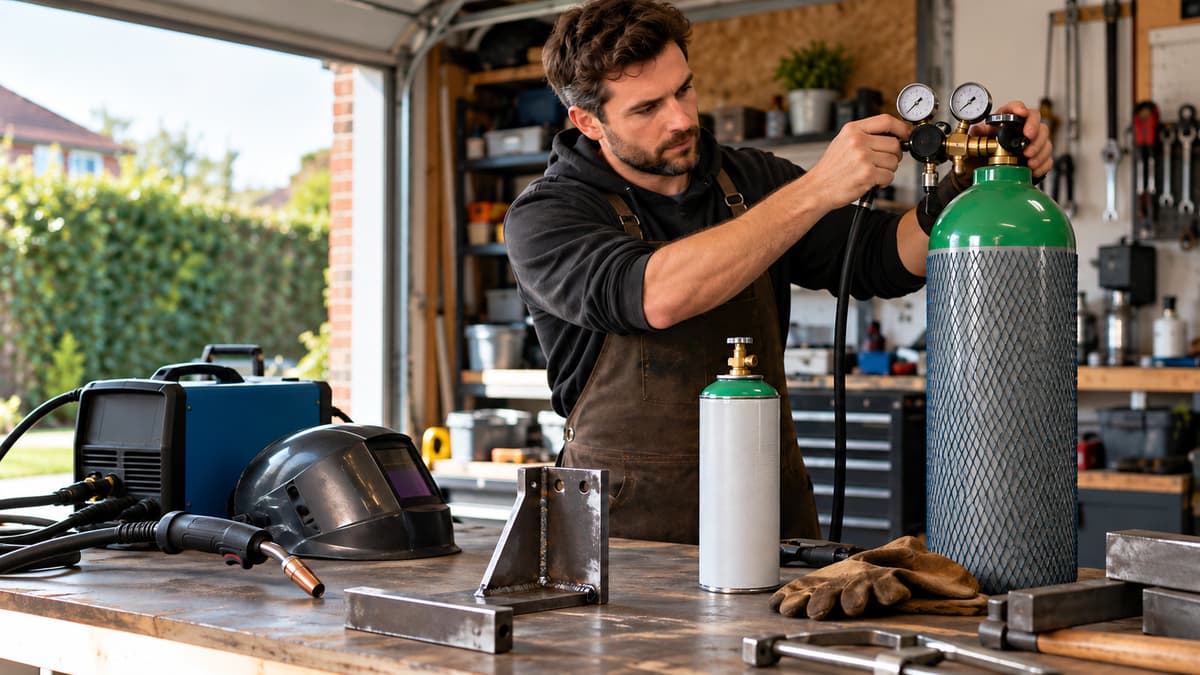
What shielding gas costs in Britain
Shelf price hides how little gas a disposable holds, and what a filled cylinder changes on the bill.
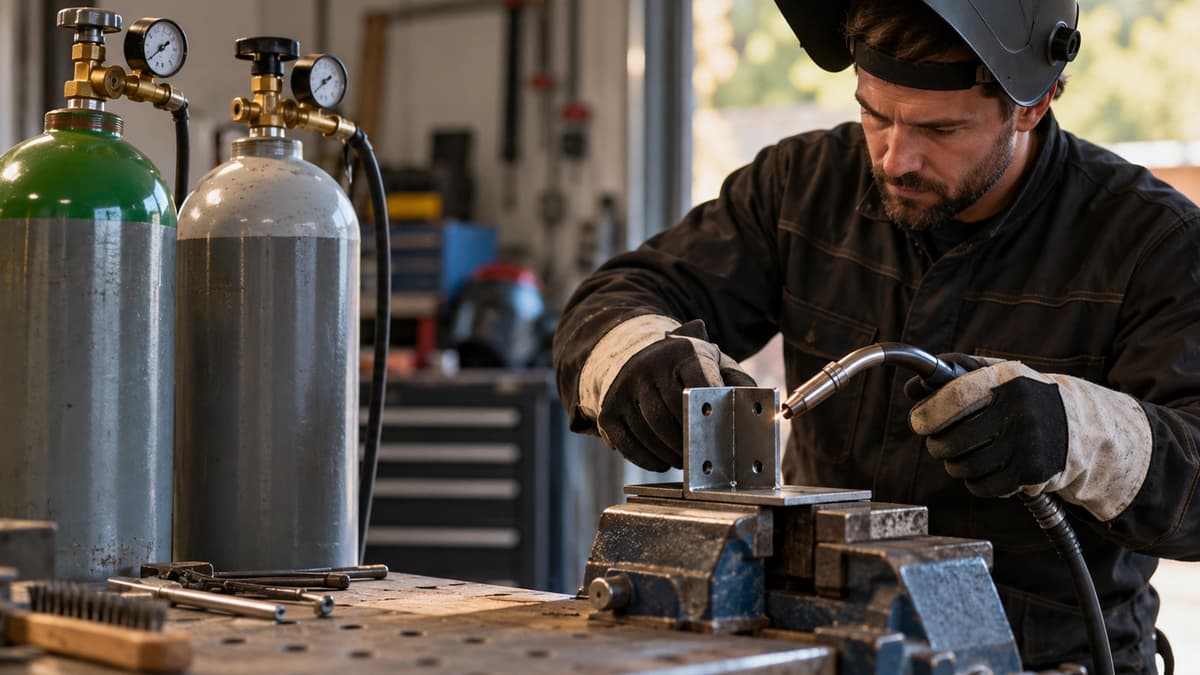
Pure argon or an argon mix
Steel MIG and aluminium TIG do not want the same bottle. How to read the label before you order.
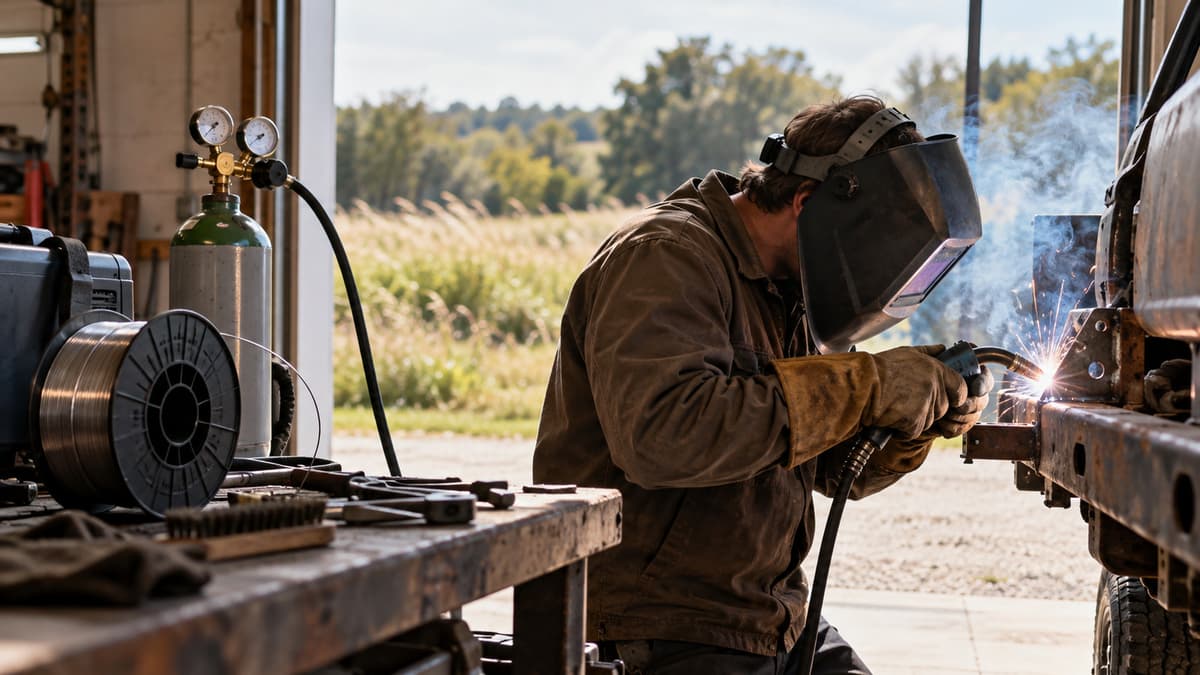
Gasless wire or a gas bottle
Outdoor wind against indoor fume and weld appearance, when you are choosing a first setup.