Pure argon or argon CO2: which label matches the metal
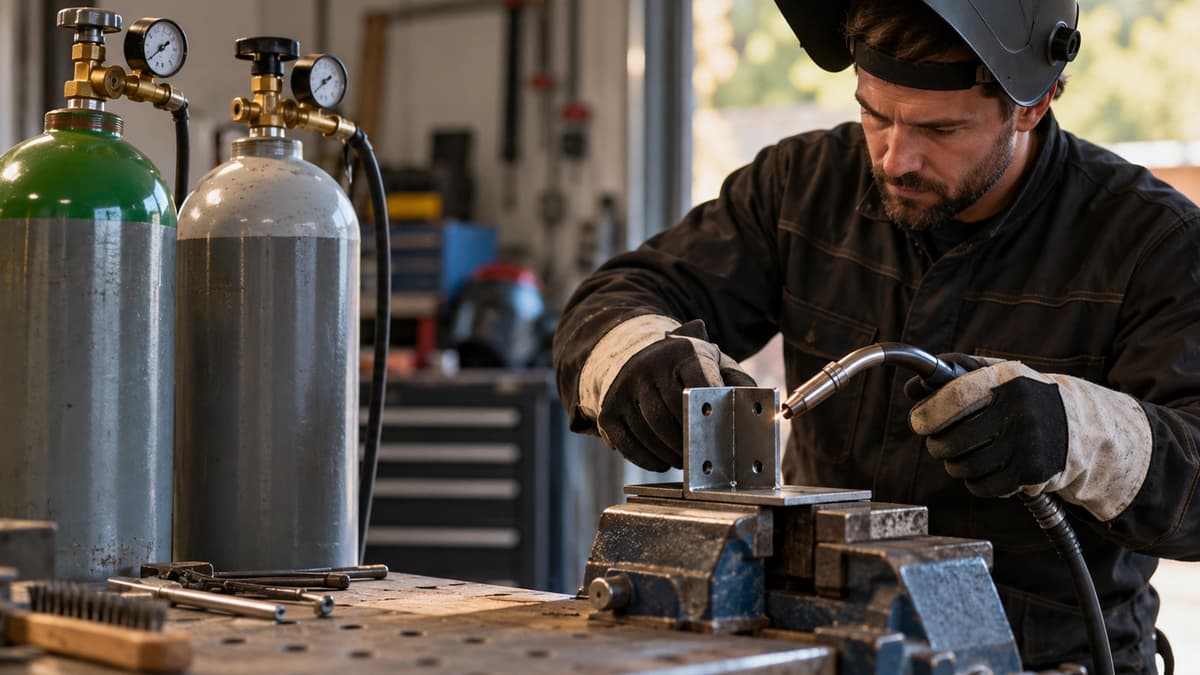
Pure argon or argon CO2 depends on the metal. Mild-steel MIG wants a stated mix. Aluminium TIG wants argon. An unstated disposable is neither of those.
On this page

You have a mild-steel bracket in the vice and two bottles on the bench. One label says argon. The other says argon and carbon dioxide, sometimes with numbers and sometimes without. Pure argon or argon CO2 decides whether that bracket, or an aluminium piece on a TIG torch, sees a gas that matches the metal. On steel, pure argon is the gas a major supplier calls unstable for MIG. On aluminium, a CO2 mix dirties the puddle. Prices, percentages and review lines come from amazon.co.uk listings stored for the argon gas cylinder comparison, and from notes published by BOC, Adams Gas and ESAB UK. We did not run a weld. A stored price can move. A qualifying purchase through our links can earn a commission at no extra cost to you.
In short
Mild-steel MIG wants an argon and CO2 mix with the percentages printed on the bottle. Aluminium TIG, and aluminium MIG, start on pure argon. In this stored set the named mixes run from 14% to 20% CO2. None of those shares is the low-CO2 gas BOC points to for austenitic stainless. The cheapest bottle, the SWP WG/1368, never states a ratio, so it is not a stand-in for 80/20.
Two jobs that do not share a bottle
Adams Gas splits the workshop the way a careful label does. Mild-steel MIG takes a mix. TIG, and aluminium, take pure argon. This stored set has no pure CO2 bottle, so carbon dioxide on its own stays a supplier note. BOC's shielding-gas brochure treats 80% argon and 20% CO2 as M21, the name you will see on a steel MIG data sheet. The same brochure calls pure argon unstable for MIG on steel.
ESAB UK puts pure argon as the starting gas for aluminium, on MIG and on TIG. Helium can come later, on thicker aluminium, as a hotter addition. If you are setting up a TIG welding machine for an aluminium repair, the label you want is argon, with no CO2 percentage beside it. A MIG mix stays a MIG mix when the regulator happens to fit the TIG torch.
The only disposable in this set sold as argon is the Sealey MIG/ARG/100, ASIN B00K1UMA8O, at £31.68. It states 60 litres and 100 g, and it marks about one hour as approximate. The amazon.co.uk line is 3.7 from 16 reviews. One of the two reviews in the file says the bottle arrived empty and lasted two or three minutes. The thread is not named.
On the steel side, the Sealey MIG/MIX/100, ASIN B000R9XWN6, states 80% argon and 20% CO2 at £32.11, again with 60 litres, 100 g and an approximate one-hour line. The star line is 3.4 from five reviews. One review says two bottles ran out while welding car arches, which fits a 100 g fill. The 80/20 label answers the chemistry. It does not promise a panel's worth of arc time.
What the percentages in this set are
The useful comparison is the percentage the seller was willing to print. A 60 litre claim, on its own, has already been described by reviewers as a few minutes of welding.
- SWP WG/1368, ASIN B00793QH94: argon/CO2, ratio not stated, £17.99. You cannot treat it as 80/20.
- Sealey MIG/MIX/100: 80% argon / 20% CO2, £32.11. 100 g stated; five reviews.
- Sealey MIGMIX2.2, ASIN B0BZ5B3L5F: 84% argon / 16% CO2, £57.17. No reviews; M10 thread.
- Gray Eagle 8 L, ASIN B0H3417V96: 82% argon / 18% CO2, £169.99. L 21.8 outlet; no reviews.
- BricoLoco 1 L, ASIN B0BH77DR6P: 86% argon / 14% CO2, £78.29. 14% CO2 conflicts with a stainless claim.
- Sealey MIG/ARG/100: argon, no CO2 percentage, £31.68. One report of an empty arrival.
- 60 cu ft steel, ASIN B0CQ5NKMNC: ships empty, £306.07. CGA580 shell, no gas on delivery.
The SWP WG/1368 is the top pick because it carries 4.6 from 160 amazon.co.uk reviews, the only large sample here. Reviewers describe about 5 to 20 minutes of welding. One UK review said the fitting was smaller than a normal regulator and mentioned a 4 mm hose against an 8 mm hose. That covers a short MIG session with an unknown ratio, and it is a weak buy when you need a named mix, TIG, or aluminium.
BOC attaches the M21 name to 80/20, so a procedure that prints 80/20 is met by the Sealey MIG/MIX/100, not by a bottle that prints 84/16. The Sealey MIGMIX2.2 states 430 g and 2.2 litres at 110 bar and 20°C, M10 thread, item weight 2.91 kg, and there is no review line. On stated gas mass it is the best value among the named-mix disposables, because 430 g is a different fill from the 100 g cartridges. You know the label. You do not have owner evidence that it arrived full. The four-pack, ASIN B0BZ89YXB1, is £192.57 for four stated 430 g cylinders at 11.6 kg, still M10 and 110 bar. The catalogue size says 1 × 1 × 1 cm, which cannot describe that pack.
The Gray Eagle is the only bottle sold as full: a stated 1.2 cubic metres in an 8 litre cylinder at 150 bar, with a mini regulator. Full weight is 16 kg and empty weight is 11 kg, at 140 mm across and 673 mm tall. The fill, a 2030 validity date and an EN 1964-1 line are seller statements. The outlet is L 21.8 × 1/14, which is not BS 341 No. 3. Confirm that nut before you treat 1.2 cubic metres as gas you can use.
The stainless limit these mixes miss
BOC's brochure treats Argoshield as too high in CO2 for austenitic stainless, and it points to mixes kept under about 3% CO2 for L-grade stainless. Fourteen percent, and the 16%, 18% and 20% bottles beside it, sit well above that line. The BricoLoco is a 1 litre disposable at 1.2 kg. The regulator, clamps and hose are a different listing, the outlet thread is not stated, and there is no review line. The stainless sentence in the description conflicts with the BOC caution. It can be a small mild-steel cartridge if you already own the regulator.
The SWP bottle cannot fill the gap, because an unstated ratio is not a promise of low CO2. Pure argon is the aluminium candidate, and it is the gas BOC calls unstable for MIG on steel. Stainless MIG is a third job, and this set does not contain a bottle for it. If the job is stick, rod type lives on the welding electrodes comparison.
What this article will not assign
Putting 80/20 or 84/16 onto ASIN B00793QH94 would turn the cheapest bottle into a specified mix the listing never printed. Review times describe volume. They do not reveal the chemistry. Helium stays off the list for a first aluminium weld. ESAB UK's starting gas is pure argon, this set has no helium mix, and a helium price would be an invention.
The steel cylinder at £306.07 ships empty. It is rated at 60 cubic feet, with a CGA580 valve and a 3/4 inch NGT inlet, the North American argon outlet rather than BS 341 No. 3. Weight is 13.2 kg, a bullet says DOT approved, and there is no review line. This comparison has no UK price for filling the shell. With no gas inside, there is no mix to classify.
BS 341 No. 3 is what a British argon regulator expects. The Gray Eagle states L 21.8 × 1/14. The 430 g Sealey bottles state M10. The 60 litre Sealey disposables, the SWP and the BricoLoco leave the thread unnamed. The right chemistry on the wrong nut is a full bottle you cannot connect. Whether the machine should be MIG or TIG sits on the MIG or TIG subpage. Every stored price sits on the argon gas cylinder comparison.
Common questions
What gas for mild-steel MIG?
What gas for aluminium TIG?
Is 84/16 close to 80/20?
Can I use Argoshield on stainless?
What is in the SWP bottle?
Do I need helium?
Can I use MIG gas for TIG aluminium?
Which comparison page lists the bottles?

Peter F. is the editor for DIY & tools at productscompared.co.uk. Comparisons in this category are checked against amazon.co.uk listings, review evidence and public UK sources.
Related articles

When a disposable MIG bottle is the wrong buy
A stated 60 L cartridge can be empty in minutes. The limit is the gas volume, not a fault in the welder.
What shielding gas costs in Britain
The shelf price of a disposable hides how little gas is inside compared with a filled exchange cylinder.
Gasless wire or a gas bottle
Flux-cored wire skips the bottle. You trade that convenience for more fume and a different bead outdoors.