Independent comparisons. We may earn from shop links. More info

USB socket vs plug charger

Updated: October 2026

The phone brick has lived in the bedside socket for two years, and you are deciding whether to replace the plate or buy another charger you can unplug. A USB socket vs plug charger choice is between two objects. One is a fixed UK 13 A double with a charging module behind the face. The other is a plug that occupies one outlet and leaves when the cable standard changes. The wall side is the four British General plates in the [USB socket comparison](/hub/sockets-and-extension-leads/usb-socket). The plug-in charger is not a product row here. Updated 16 October 2026.

The phone brick has lived in the bedside socket for two years, and you are deciding whether to replace the plate or buy another charger you can unplug. A USB socket vs plug charger choice is between two objects.

Our top picks

On this page

What each object is

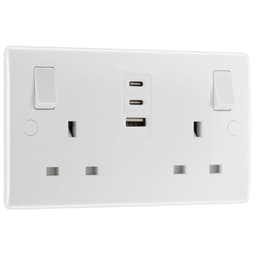
A USB wall socket in this set is a switched double faceplate with USB ports on the same face as two 13 A outlets. The USB figure is 12 W, 15 W, or 30 W, read as a shared total. The 3120 W attribute is 13 A at 240 V, not the charging power. Fitting one means the back box has room and that you can isolate the circuit. The how-to, including when to stop, is how to fit a USB socket. A plug-in charger is a 3-pin plug with a USB lead or a USB socket in the body. You can unplug it when a port dies without touching a terminal. It uses one of the 13 A outlets the plate would have freed. Buy it from a seller you can trace, and treat USB-PD as a handshake over USB-C. Tidy is the point of the plate, not a higher wattage.

When the wall socket is the better buy

Fit a plate where a brick is in the way every day and the devices are phones or a light tablet. The £12.99 and £15.99 plates each give you one USB-C port and two USB-A ports, and they leave both 13 A outlets free. The £20 plate adds a second USB-C port and is the only one that names PD and QC and prints BS 1363. The £8.86 plate only makes sense for USB-A, with a 12 W share reviewers found tight for two phones overnight. The plate wins on clutter, not on speed. A square 15 W reviewer could not finish a laptop charge on USB-C. If the module hums or loses a port, you change a faceplate. Who should buy which plate is on the best USB wall socket page.

When the plug-in charger is the better buy

Keep a plug-in charger when the watts, the connector, or the box is still unsettled. A laptop that wants more than these plates claim is the clear case. This set stops at 30 W stated, shared, and a 15 W review already failed a laptop. A laptop brick in a 13 A socket remains the reliable arrangement. Buy the plug if the back box is shallow. The 12 W and 30 W listings say 25 mm minimum, and the two 15 W listings state no depth at all. Forcing a plate until it is flat is how a face cracks. Buy the plug if you rent, if the connector may change again, or if you want to throw the charger away when it fails. These listings do not print a standby-watt figure.

A sensible mix

Most homes do not need one answer in every room. Two or three plates where a brick is always in the way, plus plug-in chargers everywhere else, survives the next cable. Put the plate beside the bed if the box closes without force. Leave the home-office laptop on its own charger. Use a plug-in USB-C charger for a guest room and any device that needs more than 30 W. Do not fill the house with the £8.86 plate because the star line is 4.7. It has no USB-C port. Watts and the BS 1363 line sit on the USB wall socket buying guide. The wall plate and the plug are not substitutes on the same comparison table.

Common questions

Which is better for a bedside phone?
A wall plate, if the back box will take the module and you want both 13 A outlets free. The £12.99 or £15.99 plates cover one USB-C phone. A plug-in charger is the better bedside buy if the box is tight or you would rather replace a charger than a faceplate.
Which is better for a laptop?
The laptop’s own charger, in a 13 A socket. These plates top out at a stated 30 W, shared, and a 15 W USB-C review did not finish a laptop charge. A plug-in charger is a laptop supply only if its own rating says so.
What happens when USB changes again?
You unplug a charger and buy another. A wall plate stays until you isolate the circuit and change the face. That is the real cost of the tidy look. If you expect the connector in your house to move again within a year or two, keep the fixed wiring as a plain double and let the charger carry the USB standard.
Does a wall plate free the 13 A sockets?
Yes. The USB ports sit on the face, so both outlets stay free while a phone charges. A plug-in charger takes one of those outlets. The gain disappears if the module is so deep that the plate will not fit.
Is a plug-in charger less safe?
We are not claiming that. A wall plate in this set has reports of heat and of ports that died within months. Choose a traceable product either way, and do not treat a star rating as a safety certificate.
What if the back box is shallow?
Prefer the plug-in charger until you know the box will close. A printed 25 mm minimum is not a guarantee, and the 15 W plates do not state a depth. Changing the box is an electrician’s job if you are not already doing that work.

Related pages

Sources

Public UK sources on BS 1363, Part P, bathrooms, and back-box depth. amazon.co.uk listings for B0D2F4MZXK, B0D2DVZY8H, B0D2DX8RN9, and B0DN255MB4 checked 16 October 2026. Prices move.

  1. BSI Knowledge, changes to the BS 1363 series (retrieved 16 October 2026)
  2. GOV.UK, replacements and repairs to your home (retrieved 16 October 2026)
  3. Welsh Government, building regulations: electrics (retrieved 16 October 2026)
  4. IET, Part P frequently asked questions (retrieved 16 October 2026)
  5. IET, Part P in Scotland and Northern Ireland (retrieved 16 October 2026)
  6. Electrical Safety First, bathrooms (retrieved 16 October 2026)
  7. BG Electrical, USB charging socket example (retrieved 16 October 2026)
  8. BuildWiz, USB socket (retrieved 16 October 2026)
  9. Communities NI, electrical safety standards for private tenancies 2024 (retrieved 16 October 2026)