Independent comparisons. We may earn from shop links. More info

How to fit a USB socket

Updated: October 2026

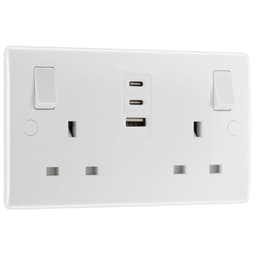
You are swapping a plain double socket for a USB double in the same place, on the same circuit, and you want the phone brick gone. How to fit a USB socket, in that narrow case, is a like-for-like replacement: isolate the circuit, prove it is dead, and put every conductor back as you found it. It is not a new point, not a bathroom upgrade, and not a reason to open the USB module. Which of the four British General plates to buy is the [USB socket comparison](/hub/sockets-and-extension-leads/usb-socket). Updated 16 October 2026 from public UK guidance and those listings. We did not watch an installation.

You are swapping a plain double socket for a USB double in the same place, on the same circuit, and you want the phone brick gone.

Our top picks

On this page

The job this page covers

The job is a double socket replaced by a double socket in the same box, on a circuit that already exists, in a room that is not a special location. England and Wales treat that replacement as minor work. GOV.UK’s householder booklet and the Welsh Government’s electrics page both list a socket replacement among minor work. Non-notifiable is not the same as unskilled. If you cannot identify the cables, do not do it. Scotland does not use England’s Part P schemes. Northern Ireland private tenancies have a five-year electrical inspection under the 2024 standards. A new cable, a new box cut into the wall, or anything within reach of a bath is a different job. Watts and ports belong on the USB wall socket buying guide, not in the screwdriver stage.

Isolate and prove dead

Switching the rocker off is not isolation. Turn the circuit off at the consumer unit. If you are not sure which breaker feeds the socket, turn the whole installation off. Prove the conductors dead with a two-pole tester or a socket tester you already know how to use. A neon screwdriver is a poor substitute. Prove the tester on a known live circuit before you trust a dead reading at this box. Photograph the old connections before you loosen anything, including which conductors share a terminal. These plates claim angled, colour-coded terminals and captive screws. That helps you see the terminal. It does not tell you which of two brown wires was in the live. If the old socket has a metal back box, note where the earth fly-lead goes. Do not open the USB circuit board.

Put the wires back as found

New UK colours are brown for line, blue for neutral, and green-and-yellow for earth. Older cable can be red, black, and green. Match the function. Bare earth needs a green-and-yellow sleeve. A ring often has two of each conductor, plus a fly-lead to a metal box. Put them back in the arrangement you photographed. Do not leave copper showing outside the terminal. The new fixing screws are not always the right length. On the square 15 W plate, one fitter reused the old screws because the new bolts were too long. One square 15 W face cracked when it was tightened on plastic dado trunking. If the plate will not sit flat, use the USB socket back box depth guide. Fit the screw caps, then restore power and test the outlets and the USB ports.

When to stop and call an electrician

Stop before you start if you cannot prove the circuit dead, if the insulation is nicked or heat-damaged, if the colours match neither scheme, or if the wall would have to be cut. Stop if the room is a bathroom or the socket is outdoors. Electrical Safety First allows a 13 A socket only where it can sit at least 2.5 m from the bath or shower tray, and none of these four plates states an IP rating. Stop if the plate buzzes harshly or runs extremely hot. One round 15 W review describes a hum that went quiet only when a USB device was plugged in. Switch the circuit off and leave it off. If you would rather not change the plate, a plug-in charger is the other route in USB socket vs plug charger.

Common questions

Do I have to tell building control?
In England and Wales, a like-for-like socket swap on an existing circuit is minor work and is not normally notifiable. A new circuit, a consumer unit, or a special location is different. Scotland does not use the English Part P schemes.
How do I make sure the socket is dead?
Turn the circuit off at the consumer unit, not only at the socket rocker. Prove the conductors dead with a tester you know how to use, and prove the tester itself. If the reading does not make sense, stop and get an electrician.
What if the new plate will not sit flat?
Do not keep tightening it. A square 15 W face cracked under hand pressure on dado trunking, and 30 W reviewers describe a module that crowds a shallow or plaster-filled box. Reuse shorter original screws only if they clamp the plate properly. If the cables have no room, the job has left like-for-like territory.
Can I do this in a kitchen or bathroom?
A straight replacement in a kitchen can still be minor work. A bathroom is a special location. These plates do not state an IP rating, and a product page that asks about a bathroom without answering is not permission. Near a bath or shower, use a qualified electrician.
The USB side buzzes or the plate got very hot. What now?
Switch the circuit off and leave it off. A hum that only stops when a lead is plugged in, or a faceplate cracked from heat, is a fault. Do not open the USB board. Replace the plate or have an electrician do it.
Should a tenant do this in a rented home?
Ask the landlord first. In Northern Ireland, private tenancies have a five-year electrical inspection, and an unapproved socket change can sit badly against that record. Elsewhere, the tenancy agreement often forbids alterations. A plug-in charger that you can remove when you leave does not change the fixed wiring.

Related pages

Sources

Public UK sources on BS 1363, Part P, bathrooms, and back-box depth. amazon.co.uk listings for B0D2F4MZXK, B0D2DVZY8H, B0D2DX8RN9, and B0DN255MB4 checked 16 October 2026. Prices move.

  1. BSI Knowledge, changes to the BS 1363 series (retrieved 16 October 2026)
  2. GOV.UK, replacements and repairs to your home (retrieved 16 October 2026)
  3. Welsh Government, building regulations: electrics (retrieved 16 October 2026)
  4. IET, Part P frequently asked questions (retrieved 16 October 2026)
  5. IET, Part P in Scotland and Northern Ireland (retrieved 16 October 2026)
  6. Electrical Safety First, bathrooms (retrieved 16 October 2026)
  7. BG Electrical, USB charging socket example (retrieved 16 October 2026)
  8. BuildWiz, USB socket (retrieved 16 October 2026)
  9. Communities NI, electrical safety standards for private tenancies 2024 (retrieved 16 October 2026)