Independent comparisons. We may earn from shop links. More info

USB socket back box depth

Updated: October 2026

You have a 25 mm back box behind a double socket, the new plate’s bullet says minimum 25 mm, and the module still will not sit flush. USB socket back box depth is that gap between a printed minimum and a box that already holds a ring. This page stays on depth and cable bulk. It does not rank finishes or watts. The four British General plates, and which one to buy once the box is deep enough, are in the [USB socket comparison](/hub/sockets-and-extension-leads/usb-socket). Updated 16 October 2026 from those listings and public UK fitting guides. We did not measure a box in a lab.

You have a 25 mm back box behind a double socket, the new plate’s bullet says minimum 25 mm, and the module still will not sit flush.

Our top picks

On this page

What 25 mm on the listing means

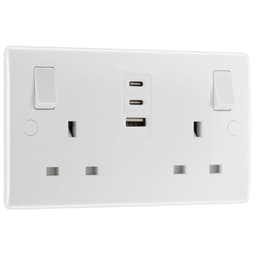
A 25 mm line is the maker’s minimum mounting depth, written as if the box had room to spare. It is not a survey of your wall. Only two plates print it. The 12 W square plate, model 922UAA12-01, says it fits a 25 mm mounting box. The 30 W round plate, model 822UACC30-01, says a minimum of 25 mm. The figure is the depth the module wants, not the depth of an empty box. BuildWiz tells electricians to treat 25 mm as an idealised minimum and to allow 35 mm when a ring’s cables are already in there. None of those guides measured B0D2F4MZXK or B0DN255MB4. Minimum and this box will close are different sentences.

A box that already holds a ring

A typical UK double on a ring has two sheathed cables, so two line conductors, two neutrals, and two earths, plus a green-and-yellow fly-lead if the box is metal. Bare earth needs a sleeve. Those conductors loop behind the module, where a plain socket had empty air. A plate that fits 25 mm on a product page can still stand proud. Dot-and-dab and dry-lining boxes are a further squeeze. Reviewers of the 30 W plate describe plaster-filled boxes with almost no slack. One fitter got the plate into a metal box where another USB plate would not. That shows box shape matters. It does not show that every 25 mm metal box will do the same. If you are about to isolate and swap, the sequence is on how to fit a USB socket. Check the depth first, with the power already proved dead.

What these four plates actually state

Two listings give you a number and two give you none. B0D2F4MZXK, the £8.86 USB-A plate, states 25 mm. B0DN255MB4, the £20 plate, states 25 mm. B0D2DVZY8H, the £12.99 round 15 W plate, states no depth. B0D2DX8RN9, the £15.99 square 15 W plate, states no depth. A missing line is not proof that the 15 W module is shallower. The 30 W reviews describe a crowded back and dot-and-dab walls that barely close. A faceplate that cracked from heat is a fault to abandon. The square 15 W sample has a crack from overtightening on plastic dado trunking. Ports and watts, after the box is settled, are on the best USB wall socket page.

When the box will not close

Stop when the face will not meet the wall without a bend in the plate or a trapped conductor. Heat that cracks plastic is not cured by another half-turn of the screw. Switch off, and leave the circuit off, if the plate is already hot or split. A spacer ring can stand the plate off the wall and recover a few millimetres. BuildWiz calls that the ugly retrofit. A deeper box, 35 mm rather than 25 mm, is the cleaner fix when the wall is being opened anyway. Cutting plaster or chasing a solid wall is not a like-for-like socket swap. The watts and the ports are on the USB wall socket buying guide. Measure first, then buy.

Common questions

Will a USB socket fit a 25 mm box?
Sometimes, once the cables are in the box, and sometimes not. Two of these plates state a 25 mm minimum, and 30 W reviewers still describe a tight fit. BuildWiz treats 35 mm as the allowance when a ring is already there. That figure is their guide, not a lab measurement of these ASINs.
Why does the listing say 25 mm if other guides say 35 mm?
The listing is a minimum for the module. The guides are talking about a box that already contains two cables, earth sleeving, and the bends a ring needs. Both can be true. A 25 mm stamp does not promise your plate will close, and a 35 mm rule of thumb does not mean every 25 mm box fails.
Two of these plates do not state a depth. What then?
The £12.99 round 15 W plate and the £15.99 square 15 W plate print no millimetre depth. Measure the box you have, with the cables in place, before you order. One reviewer found the round module left some space. Another cracked a square face by overtightening. Neither anecdote replaces a stated depth.
The plate will not sit flat. Should I tighten it harder?
No. One square 15 W face cracked when it was tightened by hand on dado trunking. If the screws are too long, sound original screws are a better clamp than forcing the new ones. If the module hits the cables, more torque will not move the brickwork. Stop and deal with the box.
Is a dot-and-dab or dry-lining wall different from a solid wall?
Yes. Reviewers of the 30 W plate describe plaster-filled and dot-and-dab boxes with almost no slack. A solid-wall metal box can still be only 25 mm deep. A dry-lining box that twists as you tighten is a reason to stop.
Can a spacer or a deeper box solve it?
A spacer can stand the plate proud and recover a few millimetres. A deeper box is the proper fix when you are already opening the wall, and 35 mm is the depth BuildWiz suggests once the box is not empty. Cutting that opening is beyond a straight socket swap.

Related pages

Sources

Public UK sources on BS 1363, Part P, bathrooms, and back-box depth. amazon.co.uk listings for B0D2F4MZXK, B0D2DVZY8H, B0D2DX8RN9, and B0DN255MB4 checked 16 October 2026. Prices move.

  1. BSI Knowledge, changes to the BS 1363 series (retrieved 16 October 2026)
  2. GOV.UK, replacements and repairs to your home (retrieved 16 October 2026)
  3. Welsh Government, building regulations: electrics (retrieved 16 October 2026)
  4. IET, Part P frequently asked questions (retrieved 16 October 2026)
  5. IET, Part P in Scotland and Northern Ireland (retrieved 16 October 2026)
  6. Electrical Safety First, bathrooms (retrieved 16 October 2026)
  7. BG Electrical, USB charging socket example (retrieved 16 October 2026)
  8. BuildWiz, USB socket (retrieved 16 October 2026)
  9. Communities NI, electrical safety standards for private tenancies 2024 (retrieved 16 October 2026)