Independent comparisons. We may earn from shop links. More info

How to fit an outdoor socket: stop before terminals

Updated: 23 October 2026

You have a pre-wired garden box with a 13 A plug, or a hard-wired twin and a drill, and both parcels look like one Saturday job. They are not. This page on how to fit an outdoor socket stays with the plug-in case, then stops before terminals on a new circuit. It is from the Products Compared editorial team on 21 October 2026. The products are the eleven rows in the [garden sockets comparison](/hub/sockets-and-extension-leads/garden-sockets). Nothing here was wired as a lab test. A qualifying purchase can earn a commission at no extra cost to you. Screws on a lead you can unplug are not a new circuit.

You have a pre-wired garden box with a 13 A plug, or a hard-wired twin and a drill, and both parcels look like one Saturday job. They are not.

Our top picks

RICOKEY RICOKEY IP66 double

Best value

RICOKEY RICOKEY IP66 double
9.7/10about £12.98
LIKEEM LIKEEM IP66 double, 3 m

Alternative

LIKEEM LIKEEM IP66 double, 3 m
8.6/10about £18.99
On this page

Check which object is in the box

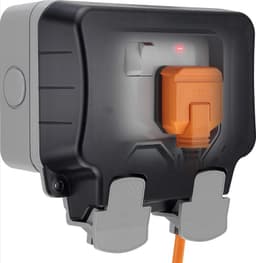
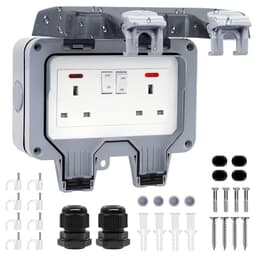
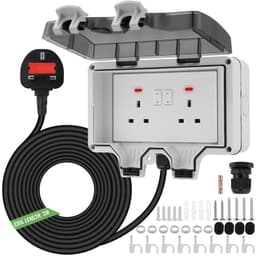
Open the carton before you mark the wall. A pre-wired kit has a flex and a UK plug: 3 m on LIKEEM and the shorter SURAIELEC, 6 m on BSEED, 10 m on Zenmos and the longer SURAIELEC, 15 m on Kukkasilta. A hard-wired twin has no lead. BG Storm, RICOKEY and Darbony are that object. If there is no plug, the steps below do not apply. The orange Masterplug is a rewireable flex joint, not a wall twin. Do not cut a moulded plug off to make a hole work. If the lead will not reach without that cut, you need a longer lead or a hard-wired outlet connected by someone competent. Which object you bought is on the outdoor socket buying guide.

Mount the box and lay the lead out

Fix the box to a sound wall the mower will not strike, with screws that bite. One Homebuilding source suggests at least 30 cm above the ground. Treat that as the speaker’s advice, not as a clause of BS 7671. On the 10 m SURAIELEC, a reviewer said the joining screws were unusable. On Zenmos, unused entries were left open. Cap every hole you are not using. Shut the lid. IP66 here is a closed enclosure, not an open face in the rain. Uncoil the lead fully. Electrical Safety First says not to daisy-chain, and a coil inside the enclosure heats under load. Do not bury ordinary flex. The indoor end is one BS 1363 plug in one socket.

The indoor socket has to be on a 30 mA device

The kit does not contain the RCD. The indoor socket, or its circuit, has to be on a 30 mA device already. Press that test button on the maker’s schedule. Electrical Safety First says use an RCD outdoors, and test the one on a pond pump at least every three months. If the fusebox has no 30 mA device, their householder fallback is a plug-in RCD for portable outdoor use. That is not a new fixed circuit, and their wiring note does not count a portable RCD as the RCD for a new fixed socket-outlet. Plugging a pre-wired box into a protected socket is the end of the householder steps. If the next tool is a terminal screwdriver, you have left this page.

Stop when you are about to wire a circuit

Stop before you connect a hard-wired twin, add a spur, or bury a run to a shed. Do not bore a timber-frame wall. A plug-in lead should not be opened to match an old red-and-black drawing. Current fixed cable is brown, blue, and green-and-yellow. In England a new circuit is notifiable under Approved Document P and tested to BS 7671. Stop as well for melted plastic, no 30 mA device, or any test you cannot do to BS 7671. A mower or pond pump is on outdoor socket for a lawn mower.

Common questions

What can I do without opening a consumer unit?
Fix the pre-wired box to a sound wall, cap every hole, shut the lid, uncoil the lead, and plug into an indoor socket already on a 30 mA device. Press that test button on the maker’s schedule. You are not joining cable. If the carton has no plug, those steps do not apply.
Where should the flex run, and what must I not bury?
Keep it off the mower, the door and the chair, and uncoil it. Do not daisy-chain, and do not coil it inside an enclosure under load. Do not bury ordinary flex. A buried shed run is for someone who can test to BS 7671. Regulation 522.8.10 sets no single depth.
How do I know the indoor socket is on a 30 mA device?
Look for an RCD or RCBO that covers that circuit, then use the test button. If nothing trips, do not guess. When the board has no RCD, Electrical Safety First’s householder fallback is a plug-in RCD for portable use. That is not the sign-off for a new fixed socket.
What if I am about to wire a hard-wired socket?
Stop, unless you already work to BS 7671 and the job is one you may notify or certify. Isolate before you touch a conductor. BG, RICOKEY and Darbony have no lead. The cable is the next problem, not the wall plugs in the bag.
Why do old guides mention red and black?
Red and black were the old live and neutral colours on fixed cable. Current cable is brown and blue, with green-and-yellow earth. Copying the old drawing swaps wires. A pre-wired garden kit should not be opened to match those colours.
Can I drill any outside wall?
No. B&Q says not to bore a timber-frame wall, because of the vapour barrier. A spur through masonry is still the job this page stops at. Drilling so you can cut a moulded plug off is not a method here. If the plug will not pass, change the plan.
When do I stop?
Stop for a new circuit, a buried cable, a distant shed, a timber-frame wall, melted plastic, no 30 mA device, or a test you cannot do to BS 7671. Plugging in is the householder job. Terminating a new cable is not. NICEIC notes that some garden work is notifiable. The electrician says which.

Related pages

Sources

Sources taken from the research digest. Listings were scored on 21 October 2026. This page did not run a lab test.

  1. IET Wiring Matters — 30 mA RCD for socket-outlets (retrieved 21.10.2026)
  2. Electrical Safety First — wiring regulations help (retrieved 21.10.2026)
  3. NICEIC — gardens and electrics (retrieved 21.10.2026)
  4. Approved Document P — electrical safety in dwellings (retrieved 21.10.2026)
  5. Northern Connectors — what IP44 means (retrieved 21.10.2026)
  6. Clarion — IP ratings, including IP66 (retrieved 21.10.2026)
  7. Electrical Safety First — extension leads and cable reels (retrieved 21.10.2026)
  8. NAPIT — burying cables and regulation 522.8.10 (retrieved 21.10.2026)