Independent comparisons. We may earn from shop links. More info

Outdoor socket buying guide: check the object first

Updated: 23 October 2026

You have a patio or a pond near the house, and the amazon.co.uk title already says garden and IP66. That title still covers four objects: a hard-wired twin with no lead, a plug-in box on a flex, an orange inline connector, and an enclosure around an ordinary extension lead. This outdoor socket buying guide puts the checks in order before a brand. It is from the Products Compared editorial team on 21 October 2026. The eleven listings in the [garden sockets comparison](/hub/sockets-and-extension-leads/garden-sockets) are the basket. Stars and prices are the amazon.co.uk figures captured that day, not a lab test. A qualifying purchase can earn a commission at no extra cost to you.

You have a patio or a pond near the house, and the amazon.co.uk title already says garden and IP66.

Our top picks

RICOKEY RICOKEY IP66 double

Best value

RICOKEY RICOKEY IP66 double
9.7/10about £12.98
LIKEEM LIKEEM IP66 double, 3 m

Alternative

LIKEEM LIKEEM IP66 double, 3 m
8.6/10about £18.99
On this page

Four products share the garden-socket title

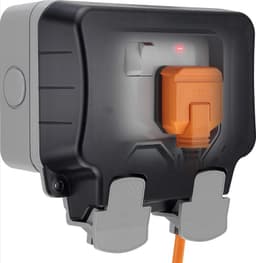
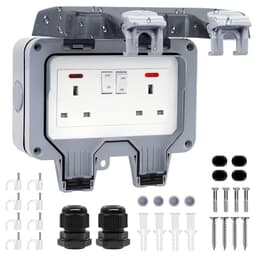
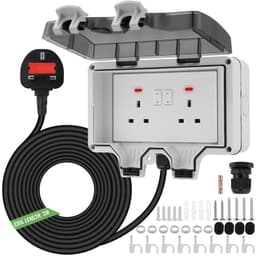
Start with the carton. A hard-wired twin here has terminals and no lead: the BG Storm, the RICOKEY socket-only twin, and the Darbony black twin. A plug-in twin arrives with a UK 13 A plug, at 3 m, 6 m, 10 m or 15 m in this capture. You screw the box to a wall and plug the other end into an indoor socket. The orange Masterplug is a rewireable inline connector, one outlet, for a flex you already own. The dark grey Masterplug box is about 351 by 220 by 126.5 mm and holds a 10 m four-gang lead. It is an enclosure, not an IP66 twin. The hard-wired pick is on the best outdoor socket page.

Read the IP code that is printed

BS 7671 does not fix one IP number for every garden. Electrical Safety First’s patio note starts at IP44 and moves toward IP55 or IP66 when jets are likely. Check the numeral that this ASIN actually prints. IP44, on the orange inline connector, is splashing water, as Northern Connectors describes it. IP54, in the Masterplug enclosure bullets, is not the jet test. IP66, on the twins, is dust-tight and protected against powerful water jets while the enclosure is closed as tested. The IP code still does not put a 30 mA device in the box.

One plug is one 13 A ceiling

None of the eleven rows states an RCD inside the product. Kukkasilta’s bullets name a 13 A fuse, which is the fuse in a BS 1363 plug, not a residual-current device. IET Wiring Matters sets out regulation 411.3.3: 30 mA additional protection for socket-outlets up to 32 A in a home, and for mobile equipment up to 32 A used outdoors. A plug-in box uses the indoor socket’s protection. A pre-wired kit shares one 13 A fuse across every outlet. Two switches are not 26 A. The lead-or-terminals fork is on plug in outdoor socket or wired.

Keep conflicts out of the basket

Several files print a second identity beside a UK 13 A Type G title. Darbony’s voltage field says 110. UK mains are nominally 230 V, so do not average 110 and 230. Zenmos prints 3 A in a highlight and 13 A in the amperage field. Keep 13 A. The Masterplug enclosure field says 10 A and Type B, while the item type describes a 13 A lead. Kukkasilta’s title says 15 m and a part line says MP22-N-10M, with Type B beside Type G. This page does not pick a winner.

Common questions

What should I check before the brand?
Check the object, then the IP numeral on that ASIN, then whether a 30 mA RCD already protects the supply, then whether one 13 A plug feeds every outlet. Brand and colour come after. A grey IP66 photo can still be a socket with no lead, or a 15 m flex. If the file also says 110 V, 3 A or Type B, resolve that before you compare stars.
Is IP66 the same as waterproof?
No. IP66 means dust-tight and protected against powerful water jets while the enclosure is closed as tested. Clarion’s summary is a 12.5 mm nozzle, 100 litres a minute, from 3 m, for at least 3 minutes. It is not immersion, and it is not a reason to hose an open face. IP44 on the orange connector is splash only.
Does a plug-in box still need a 30 mA RCD?
Yes. No staged row states an RCD in the box. Regulation 411.3.3 asks for 30 mA protection on home socket-outlets up to 32 A and on outdoor mobile equipment up to 32 A. The kit uses the indoor socket’s device. A portable adaptor is not that RCD for a new fixed socket-outlet. If the board has none, stop.
Do two gangs mean 26 A?
No. On a pre-wired kit both outlets share the 13 A fuse in the plug. Two switches isolate the faces. They do not double the current. A hard-wired twin is on the circuit that was connected to it. A mower and a pressure washer together are how that shared fuse overheats.
Why does one listing say 110 V or 3 A?
Those cells conflict with a UK 13 A Type G title. Darbony’s voltage field says 110. A Zenmos highlight says 3 A while the amperage field says 13 A. Keep the 13 A reading and treat the odd cell as a catalogue error. Do not average the two numbers.
Is a weatherproof box the same as an IP66 twin?
No. The Masterplug enclosure holds a 10 m four-gang lead, and the bullets say IP54, citing BS EN 62208:2011. An IP66 twin is a two-outlet wall socket. The enclosure suits a bulky plug that will not fit a twin lid. It is the wrong object when you wanted two IP66 faces on the brick.
When do I stop and call an electrician?
Stop when there is no 30 mA device, when you need a new circuit or a buried shed run, when you cannot test to BS 7671, or when a socket has melted. In England a new circuit is the notifiable Part P case. Plugging in a pre-wired box is not that case. A no-electrician bullet does not cover terminals on a new cable.

Related pages

Sources

Sources taken from the research digest. Listings were scored on 21 October 2026. This page did not run a lab test.

  1. IET Wiring Matters — 30 mA RCD for socket-outlets (retrieved 21.10.2026)
  2. Electrical Safety First — wiring regulations help (retrieved 21.10.2026)
  3. NICEIC — gardens and electrics (retrieved 21.10.2026)
  4. Approved Document P — electrical safety in dwellings (retrieved 21.10.2026)
  5. Northern Connectors — what IP44 means (retrieved 21.10.2026)
  6. Clarion — IP ratings, including IP66 (retrieved 21.10.2026)
  7. Electrical Safety First — extension leads and cable reels (retrieved 21.10.2026)
  8. NAPIT — burying cables and regulation 522.8.10 (retrieved 21.10.2026)