Wall mounted extension lead kitchen: off the top

A wall mounted extension lead in a kitchen must stay off the hob and out of the sink splash, inside its amp rating. A kettle may already fill that rating.
On this page
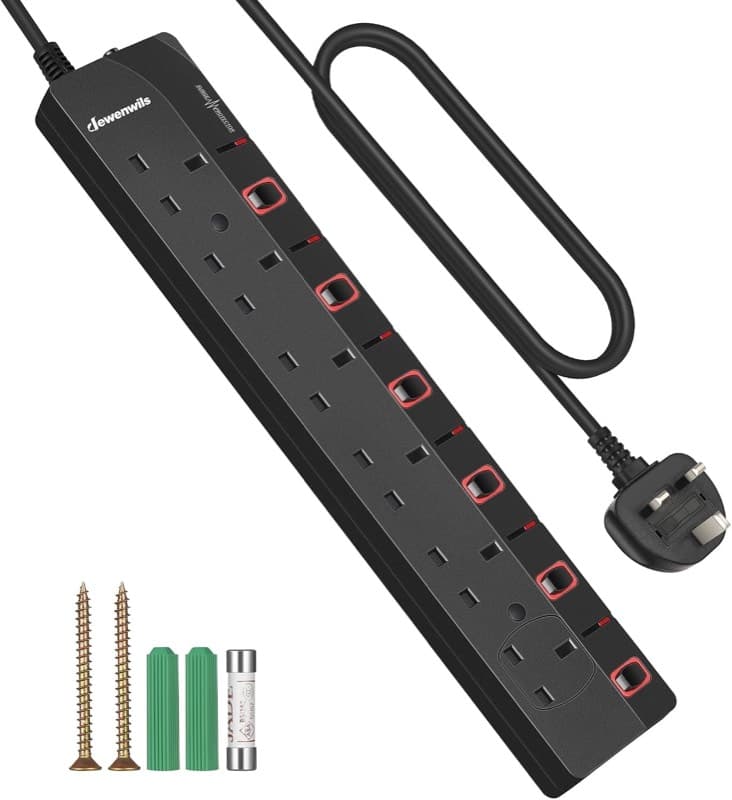
The kettle, the toaster and a phone charger are arguing over two sockets, and a four-way has crept along the worktop towards the sink. A wall mounted extension lead kitchen setup can lift that lead off the surface if you screw it somewhere dry, keep it off the hob, and stay inside the amp rating. It cannot turn one wall socket into a second circuit. Six outlets on one 13 A lead are still one 13 A lead, and a kettle is often most of that figure on its own.
Product figures are amazon.co.uk listings in the wall-mounted extension lead comparison. Loading rules are Electrical Safety First. The England note on extra sockets is GOV.UK's replacements page. We did not test a lead in a splash zone. A qualifying purchase through our links can earn a commission at no extra cost to you.
In short
Mount one indoor lead off the worktop, clear of the hob and the sink, and only for loads that fit the printed rating. Do not daisy-chain a second strip under the cupboard. A kettle plus other heat appliances may already be over a 13 A lead. If the strip would stay there every day, fit sockets. A kitchen sink is not the bath-or-shower notification case, and a wet plug is still a stop.
Why worktops collect leads
A typical UK kitchen was planned around a kettle and a toaster, then gained a coffee machine, a radio and a charger. The twin socket is full before breakfast. The spare lead pretends the wall grew new outlets, and it stays on the worktop because nobody wants to unplug the toaster to boil the kettle.
Electrical Safety First's advice is the part kitchens break first: know the rating, do not plug one lead into another, and buy from a reputable source. The extension lead rating is printed on the lead. Many leads are 13 A. Some are less. A UK 13 amp socket on the wall does not raise a lower number. The outlets on a six-way share that one number. Filling them with heat is how you pass it.
DEWENWILS B091DRYXDQ is the example, because it is built to leave the worktop. It is a black 6-way, stated 3 m, with a switch per socket and two rear screw mounts, £16.99, 4.6 from 2,224 reviews. The attribute line says 13 A. A dry wall fixing removes the chopping-board problem and leaves the 13 A ceiling in place. A bullet that mentions 270 J, beside a field that says 13 A, is a muddled surge line. Ignore it as protection.
A 2-way is sometimes the more honest kitchen lead. PIBEEX B09G2QH53B is stated as 3 m, with a 13 A fuse and BS 1363/A in the bullet, at £13.99 and 4.6 from 1,777 reviews. Two outlets make it harder to run the toaster, the kettle and the charger at once. That friction is useful only if the thing you do plug in is inside the rating.
Splash, heat and trailing cables
Do not run the flex across the drainer, through a puddle by the sink, or along the front lip where wet hands reach. A wall mount only helps if it sits outside that splash. Under a wall cupboard, away from the bowl, is a common place. Directly above the kettle spout, where steam lives, is a poor one. None of these listings states an IP rating we would call splash-proof. Silence means dry use.
A lead behind the hob, or against a toaster left on, cooks the sheath. Rear screw mounts lift the body off the worktop. They do not make the cable heatproof. Keep the strip and the flex off the hob, the grill vent and the back of a heat appliance. If the only route crosses that heat, move the appliance or fit a socket. Electrical Safety First rejects taped joints.
A trailing lead snags a wrist while you carry a pan. The plug pulls half out, the pins arc, and the face warms. Screw the lead up and dress the spare length. Do not coil it into a fist behind the bread bin. Uncoil rules are in unwind cable reels before use. Prefer a straight 2 m or 3 m lead in the same room. Brown marks, a soft face or hot plastic mean you unplug it and leave it unplugged.
When to fit sockets instead
A lead at every meal is wiring you did not design. Electrical Safety First points that habit towards more sockets, fitted by a registered electrician. A kettle in the wall and a charger on a small adapter is a fair split. A kettle, a toaster and a grill on one lead fails the rating. This page will not invent a combined watt figure. If the plates sum above the lead, stop sharing.
In England, GOV.UK's replacements note lists extra sockets on an existing circuit, outside a bath or shower, among work that often does not need notifying. A new circuit does. A general kitchen is not put in the bath-and-shower special location. Water is still a shock problem. The paperwork is in when a new socket needs an electrician. This page does not describe how to add the socket.
A plug adapter in the kettle's socket solves a phone and steals the kettle. A fixed USB plate can leave the 13 A outlets free. That choice is in USB wall socket or plug adapter. Do not stack the adapter on the kitchen lead and then another lead on the adapter.
Under-cupboard lighting and a radio suit a mounted strip, if their plates fit inside 13 A with margin. The kettle stays in the wall. Rear screws do not make a second ring circuit. One lead, one wall plug, and no second strip in the first: that is the rule in do not daisy-chain extension leads.
What the listed leads will and will not do
The same DEWENWILS lead will not give you six times 13 A, or a surge rating you can trust while 270 J and 13 A sit on different lines. Mount it on a dry wall, keep the cable loose, and put low loads in it. If a review says the mounts pull out, believe your fixings. Do not put it over a hob.
TOPREK B0DT64B91Z is a wood-effect 3-way, stated 2 m, 1,800 J claimed, one USB-C and one USB-A, £18.99, 4.6 from 562 reviews. Reviews say some rear slots will not hang, which puts the strip back on the worktop. The 6-way sibling, B0F6CRXCDC, at £22.99, uses one switch and four side slots, so you cannot kill one hot appliance without killing the radio.
ANVODE B0FC24NY8J is a 4-way, stated 2 m, with end screw holes, £18.99, 4.6 from 69 reviews, and no joule figure. End holes can suit a short run where a rear mount would land on a grout line. Two metres may not reach a high cupboard. None of these rows states an IP rating. Do not take them outside.
When the lead has become furniture, a surface socket is the next step. Metal-clad and plastic boxes are in the surface-mounted socket comparison. They need connecting, and they do not lie in the sink. About £17 is the right money for small loads on a dry wall, and the wrong money for a kettle every morning.
Before you fill the strip, stop if one of these fails. The plug is a BS 1363 UK plug, intact. The lead is the only extension device in that wall socket. The plates you will plug in sum to no more than the printed amps. The body and the cable are off the hob and out of the sink splash. A kettle that fails the sum goes back to the wall socket on its own.
Common questions
Can an extension lead run along a kitchen worktop?
Is a wall-mounted lead better than a reel?
What about sockets near a sink?
Can I daisy-chain under-cupboard leads?
Does a kettle belong on a small-rated lead?
When is a new socket the better spend?
Do the screw mounts make it safe beside the hob?
Which listing is the kitchen example?

Peter F. is the editor for DIY & tools at productscompared.co.uk. Comparisons in this category are checked against amazon.co.uk listings, review evidence and public UK sources.
Related articles

Daisy chain extension lead: stop at one
Two strips under a cupboard are still one wall plug. A second lead does not give the kettle its own 13 A.
USB wall socket vs plug adapter: which fits
A phone charger on the only free kitchen socket is why the kettle has nowhere to go. A plate is a different job.

Part P new socket: when to call an electrician
A kitchen is not automatically a special location in the England note. A new circuit still is. A lead is not that circuit.