UPS extension lead UK: battery versus surge strip
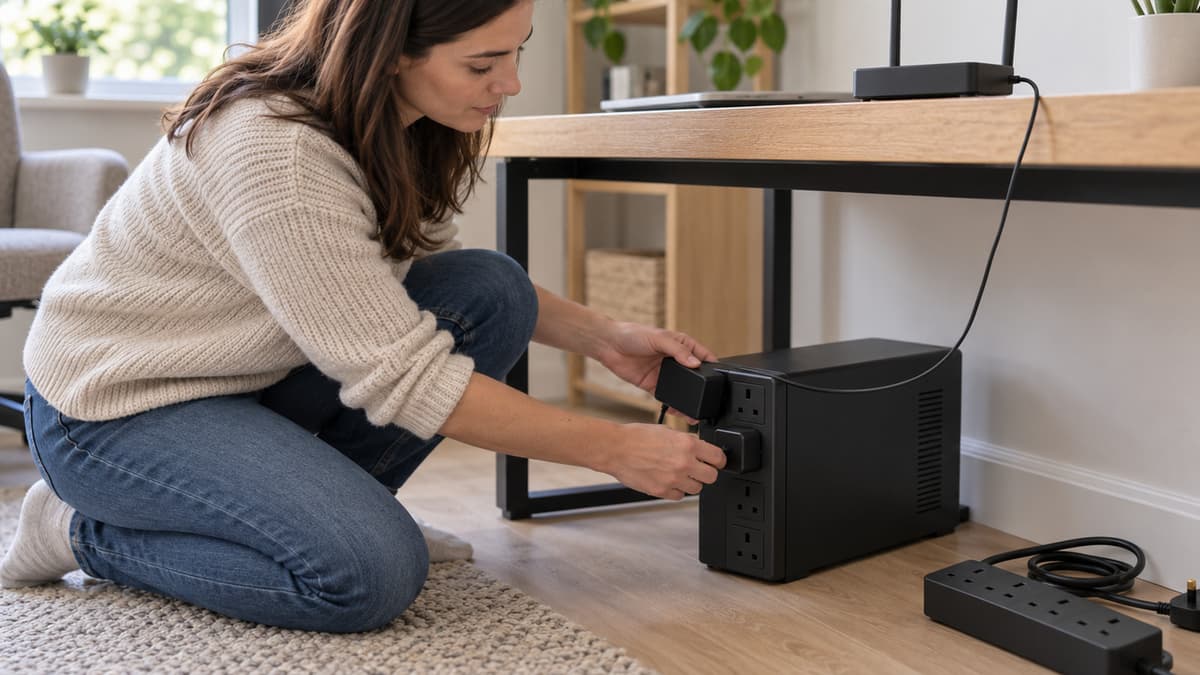
A UPS extension lead UK shoppers meet is often a C14 lead for a battery unit, not the battery. A surge strip does not keep a router on in a power cut.
On this page
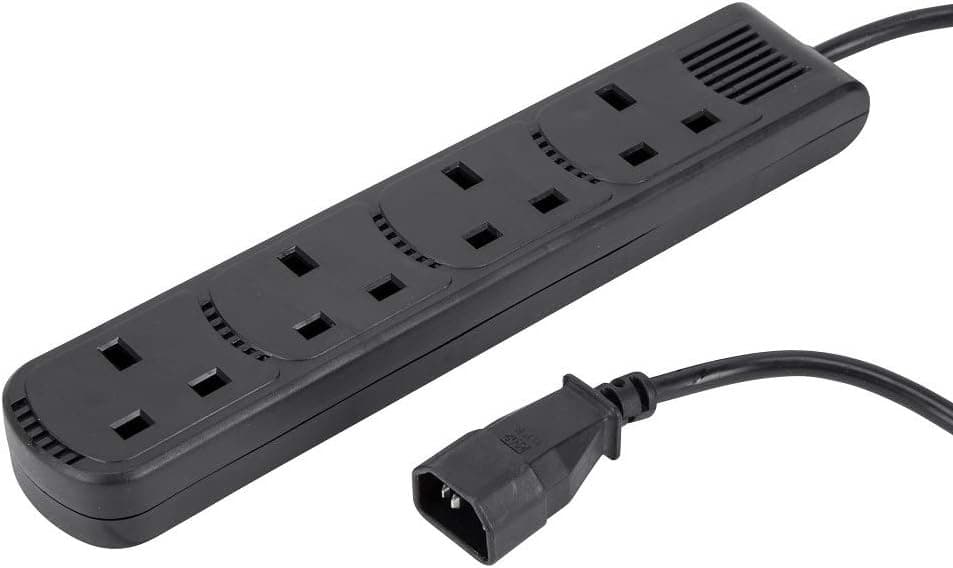
The router drops every time the lights blink, and the strip under the desk says surge on the carton. A UPS extension lead UK search usually wants a battery that keeps a small load alive for a few minutes. The products in this hub's UPS comparison are not that battery. They are leads, mostly a C14 plug and UK sockets, for a UPS you already have.
A surge figure on a different listing does not store energy for a power cut. Prices are amazon.co.uk listings in the UPS extension lead comparison. Plug and daisy-chain rules are Electrical Safety First. We did not time a battery, and we will not invent a runtime.
In short
A surge strip does not run a router when the mains fails. A UPS does, only while its battery lasts and only inside its rating. This comparison sells the lead that plugs into a UPS, not the UPS.
The top pick, Computer Spares B082VJLJLZ, is a 1 m C14 lead to four UK sockets at about £11.49. PRO ELEC B0839TYRH7 is the 2 m alternative, claimed at 10 A. Do not daisy-chain either lead, and do not treat it as an RCD or a new circuit.
A surge strip is not a battery
Surge protection, when it is real, clamps a short spike on a supply that is still there. The lights stay on. A power cut is the event where the voltage goes to zero and stays there. Nothing in a surge-only strip replaces that missing voltage. The router, the fibre box and the phone charger go dark together. A joule number and no battery means you bought the spike device.
Some indoor strips in the wall-mounted extension lead comparison print a joule claim and then undermine it. DEWENWILS B091DRYXDQ mentions 270 J in a bullet, while a surge field on the same listing says 13 A, which is a current. TOPREK's wood-effect 3-way, B0DT64B91Z, states 1,800 J at £18.99. Those are listing lines, not a test we ran, and neither line is a battery.
Do not add the joules up across two strips. Electrical Safety First forbids daisy-chaining, and two surge strips in series are still two extension devices. A plain lead with no joule line is an honest lead. PIBEEX B09G2QH53B names a 13 A fuse and BS 1363/A and does not pretend to be a surge product. It will not hold a router up.
A strip that has taken a serious spike can be finished even if the sockets still pass mains. If it is discoloured, smells hot, or was in the room when a storm took out other kit, replace it. Do not open it.
What a UPS lead in this hub actually is
PRO ELEC B0839TYRH7 has a C14 plug, the square IEC connector that goes into many small UPS outputs, and four UK sockets. Stated length 2 m, 10 A claimed, hanging holes, about £5.19, 4.8 from 79 reviews. The listing claims IEC 60320 and BS 1363-2. There is no surge joule figure and no battery.
The 1 m sibling, B0839V6QH4, is the same pattern at the same about £5.19, with 4.6 from 207 reviews. Mercury B0F9PWQZR1 is the white 1 m version at about £7.11, 4.1 from 10 reviews, also 10 A claimed.
The most reviewed lead is Computer Spares B082VJLJLZ, with UINCLU in the brand field. It is a 1 m C14 plug into four UK sockets, about £11.49, 4.7 from 647 amazon.co.uk reviews. The listing prints 10 A, 240 V and 2,400 W, and it claims IEC 60320. Reviewers fit it to APC UPS units.
It is the top pick when the review sample matters more than a 2 m cable. Treat 10 A as the limit. Several reviews call the plastic cheap, and some report a 13 A mark against the lower cord rating.
The C14 goes into the UPS. The router goes into a UK socket on the lead. The wall sees the UPS's own mains lead, not the C14. If you push the C14 at a wall socket, it will not fit, and a travel adaptor is the wrong converter. You need a UPS with the matching outlet, or you do not need this lead.
KC CABLE B0BRHW3YW5 is a 2 m C14 male to C13 female, about £8.99, 10 A and 1.0 mm² claimed, 4.8 from 17 reviews. It extends a kettle lead and has no UK sockets. A watt line says 3,750 W, which is not what 10 A at 230 V implies, so do not treat 3,750 W as a load you may attach.
Flomiara B0GSPQMF3V splits one C14 into two C13 leads and also has no UK sockets. None of the listings states a VA rating, a battery size, or a runtime. A UPS you already own has a manual. The lead only has to match the outlet and stay inside the lower of the lead's 10 A claim and the UPS output rating.
What it will not power
A router and a small fibre box are the loads people mean. A kettle, a heater, a laser printer or a gaming PC is a different order of current. These leads claim 10 A, not 13 A, and the UPS behind them is often lower still. Stay inside the smallest number in the chain. This article will not invent a watt total for a sample PC.
The battery is finite even when the amps fit. We have no minute figure to give you. When the battery is empty, the load drops. A UPS is not a generator and it will not run a fridge through an evening outage.
Do not plug the UPS into itself through the new lead. The mains plug of the UPS goes to the wall, alone. The C14 lead goes to the UPS output, alone. Electrical Safety First's one-device rule is in do not daisy-chain extension leads. A battery does not edit it. An RCD will not hold the router up, and a UPS will not clear a fault to earth in the garden.
The plug and the rating still bind
Electrical Safety First still wants a BS 1363 plug and fuse on anything that lives in a UK socket. On these leads the UK end is a set of sockets, claimed to BS 1363-2, not a 13 A plug. The plug into the wall is the UPS's own plug, and that one should be the fused UK plug. The C14 is correct only in a C14 inlet.
If a listing's UK sockets are the part you need, Computer Spares B082VJLJLZ, PRO ELEC B0839TYRH7, its 1 m sibling B0839V6QH4, and the 1.5 m PRO ELEC B0839V8GB2 at about £10.58 are the rows that have them. If you need to lengthen a C13 kettle lead, you are on B0BRHW3YW5 instead, and you still do not get a UK socket.
Ten amps is the ceiling printed on these leads. Do not round it up to 13 A because the sockets look ordinary. The extension lead rating is the number on the lead. A warm plug or a smell of hot plastic means you unplug and remove something. Another strip does not change the current.
A Wi-Fi socket will not imitate a UPS either. The plugs in the Wi-Fi socket comparison can schedule a lamp. They die in a power cut along with everything else, unless they themselves are plugged into a battery UPS, in which case you have used a socket on the UPS for a smart plug and you must count that load. They are not a runtime. They are not surge protection.
A plug-in UPS is not a new circuit, and it does not belong in a bath or shower zone. If the job has become a rewire of the study, the England notification split is in when a new socket needs an electrician.
If you need a battery, buy a UPS that states a runtime for a stated load. If you already have a C14 outlet, Computer Spares B082VJLJLZ is the 1 m lead at about £11.49. PRO ELEC B0839TYRH7 is the 2 m lead at about £5.19 if reach matters more. If you only needed a spike device, look at joules on a wall strip. If you only needed more sockets, buy one ordinary lead.
Common questions
Does a surge protector keep a router on in a power cut?
What is a UPS extension lead?
Can I daisy-chain a UPS?
Should the plug be a UK BS 1363 plug?
Is a UPS a substitute for an RCD?
Which comparison page lists the products?
Will a 10 A lead run a PC and a monitor?
Does a plug-in UPS count as a new circuit?

Peter F. is the editor for DIY & tools at productscompared.co.uk. Comparisons in this category are checked against amazon.co.uk listings, review evidence and public UK sources.
Related articles

Daisy chain extension lead: stop at one
A UPS strip is still one extension device. Plugging another lead into it does not add runtime or a second 13 A path.
UK extension lead: plug, amps and length
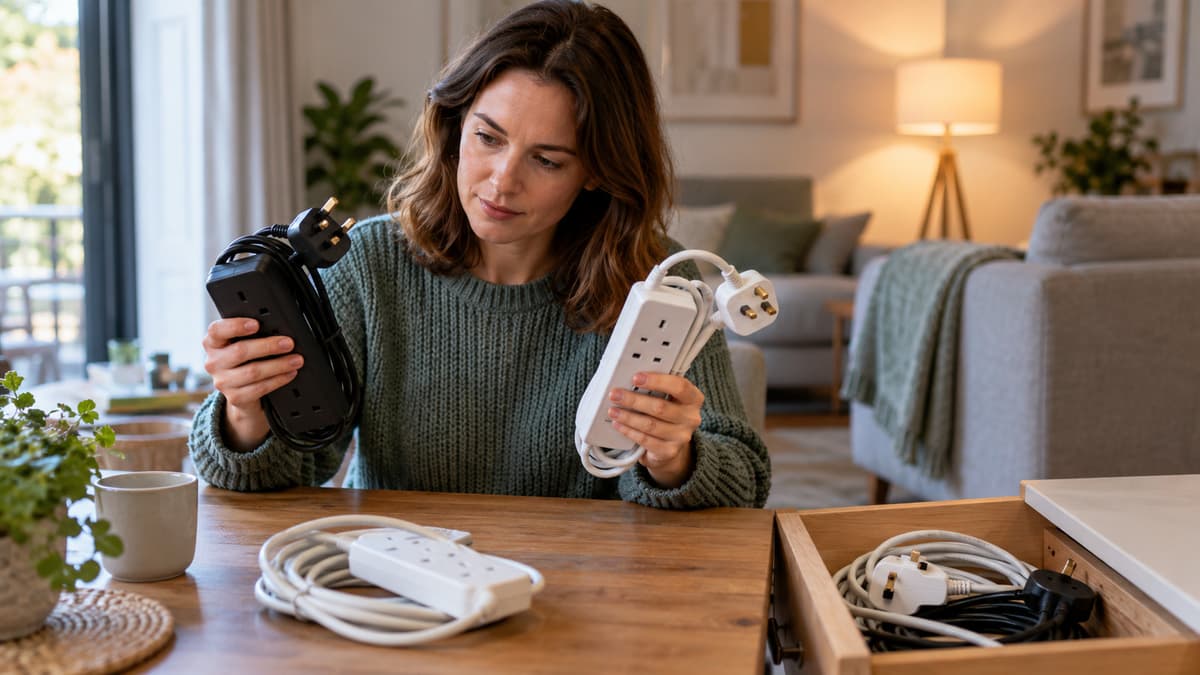
A plain lead needs a BS 1363 plug and a marked rating. Surge text on the carton does not change that check.

Part P new socket: when to call an electrician
A plug-in UPS is not a new circuit. Fixed wiring still follows the England notification split, which a battery brick does not.