Independent comparisons. We may earn from shop links. More info

How to fit a ground anchor: sheet first, not the carton

Updated: 22 October 2026

The coloured drawing on the FD-Moto box is not a life-size template, a Task Force sleeve crumbles if you hammer it empty, and GA1 reviews disagree about a 16 mm bit. This is how to fit a ground anchor from the bolt-down set on the [floor anchor comparison](/hub/screws-and-accessories/floor-anchor). It assumes you already chose the anchor and sound masonry. There is no brand ranking here, only the sequence, the tools and the stop points.

The coloured drawing on the FD-Moto box is not a life-size template, a Task Force sleeve crumbles if you hammer it empty, and GA1 reviews disagree about a 16 mm bit.

Our top picks

Oxford Oxford Task Force LK408

Best overall

Oxford Oxford Task Force LK408
7.9/10about £24.16
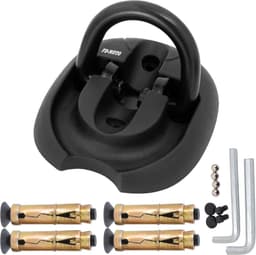
FD-Moto FD-Moto four-bolt anchor

Alternative

FD-Moto FD-Moto four-bolt anchor
8.5/10about £18.95
Burg-Wächter Burg-Wächter GA1

Best value

Burg-Wächter Burg-Wächter GA1
8.4/10about £17.66
On this page

Before you drill

Start with permission. In a rented garage, a shared block or a leasehold flat, drilling the floor or a party wall may breach the agreement even when the concrete is sound. Ask in writing if you are not sure. Once one-way ball bearings are seated, the fix is meant to stay. Use eye protection and a hammer drill, not a small cordless driver on hammer mode, plus the instruction sheet, not the marketing carton. UK buyers of the GA1, Task Force and FD-Moto describe hammer drills in reviews. Read the sheet for hole count, depth, sleeve order and torque. Mark through the steel plate or the paper template. If the listing says the carton art is the wrong scale, as FD-Moto does, believe it. Sold Secure grades are settled on the floor anchor buying guide. They do not change this sequence.

Holes, sleeves and bearings

Drill clearance holes to the depth on the manufacturer sheet, clear the dust, insert the sleeves, pass the bolts through the plate, and tighten in the pattern shown, often diagonally. Hammer the ball bearings into the bolt heads only when the position is final. Sealey’s PDF for a different model, the MCGA01, is not an ASIN here, but it says that once the bearings are fitted that unit cannot be removed. Buyers in this set describe the same one-way result. Task Force reviews warn against driving a sleeve in without the bolt threaded through. An empty sleeve splits or drops through an over-deep hole. After tightening, tug the plate. If it rocks, stop before you load the bearings. A proud loop catches feet. If you must drive over the spot, Task Force is the fold-flat row in this nine. Do not bend a proud shackle afterwards.
Oxford Oxford Task Force LK408

Testsieger

Oxford Oxford Task Force LK408
7.9/10about £24.16

The 16 mm argument

Reviews of the GA1 and other rows often mention a 16 mm masonry bit. That is buyer-reported, not a universal spec on every card. One GA1 review says 16 mm left the fixing loose, which usually means an oversize hole, the wrong plug, or dust left in the hole. Do not copy a blog size, or Sealey’s 12 mm example, onto ABUS, ARTAGO or Oxford hardware. Match the plug to the fixings in your packet. If the sheet lists a millimetre, use it. Guides that cite about 7.5 cm of hole depth and 10 cm of floor thickness are a rule of thumb, not a certificate and not an override of the sheet. A loose anchor in an oversized hole is a patch or a move, not a longer bolt.

When to stop

Do not drill into reinforcement you cannot locate, a paving slab, block paving on sand, or a thin screed over voids. A neat hole in a slab is still a failed security install, because the weak layer lifts. That case is concrete floor or wall. Stop if you lack permission, if the drill is underpowered, or if you cannot clear the holes. Concrete-in anchors need days to cure. This page is bolt-down only. When the sequence is done, return to the comparison for the lock, not for a fresh ranking.

Common questions

What tools do I need before I open the fixings?
Eye protection, a hammer drill, masonry bits matched to your plugs, a way to clear dust, and the instruction sheet. A small cordless driver on hammer mode is the wrong tool for ordinary garage concrete.
Do I drill from the picture on the box?
No, when the listing says the carton is not a template. FD-Moto states that the drawing is not life size. Use the supplied drilling guide, or mark through the plate.
Is 16 mm always the right bit?
No. Reviewers often name 16 mm for GA1-class fixings, and one review reports looseness at that size. Follow the fixings in your packet.
When do I hammer the ball bearings?
Last, when the bolts are tight and you will not move the plate. After the bearings are seated, removal is impractical.
Why do the sleeves fall apart?
Usually the holes are over-deep, or a sleeve was hammered in without the bolt. Task Force buyers report that failure. Thread the bolt through the sleeve first.
Can I undo it later if I move house?
Assume no, once the bearings are seated. Plan the hole as permanent before you drive them in.
When should I stop and not drill?
Stop for slabs, timber, no permission, the wrong tool, or a loose trial fit. Fix the surface or the hardware first.
Does a successful hole in a slab count as fitted?
No, for security. The slab is the weak link even when the anchor feels tight today.

Related pages

Sources

Public UK sources used for this page in October 2026. Prices, stars and review counts are from the nine amazon.co.uk listings captured on 19 October 2026. Sold Secure grades are the published rows, not an attack test run for this page. There is no laboratory test.

  1. Sold Secure powered-cycle ratings (retrieved 19 October 2026)
  2. Sold Secure pedal-cycle ratings (retrieved 19 October 2026)
  3. Sold Secure, Burg-Wächter GA1 (retrieved 19 October 2026)
  4. Sold Secure, ABUS WBA 75 (retrieved 19 October 2026)
  5. Sold Secure, ARTAGO ground anchor 61 (retrieved 19 October 2026)
  6. Sold Secure, bicycle ground anchors (retrieved 19 October 2026)
  7. Insight Security, ground and wall anchor buyer’s guide (retrieved 19 October 2026)
  8. Consumer Rights Act 2015 (retrieved 19 October 2026)