Independent comparisons. We may earn from shop links. More info

Scroll saw blade TPI: teeth per inch, not a size 18

Updated: 22 October 2026

The packet in your hand says 18 teeth, and it is easy to read that as a number 18 scroll saw blade. It is not. Scroll saw blade TPI on these pinned packs means teeth per inch. A plain-end universal number is a different system, and a higher count does not make the blade narrower. You already have the right end and the right length. The [scroll saw blade comparison](/hub/saw-accessories/scroll-saw-blade) is the ASIN list. This page is the pitch, and the point where “soft metals” stops.

The packet in your hand says 18 teeth, and it is easy to read that as a number 18 scroll saw blade. It is not. Scroll saw blade TPI on these pinned packs means teeth per inch.

Our top picks

On this page

Teeth per inch, not blade number

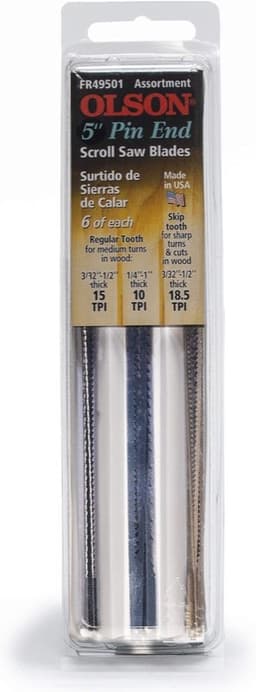
TPI is the number of teeth in one inch. On a pinned pack printed “10 / 15 / 18 / 24 teeth”, read those figures as teeth per inch. Olson’s universal numbers belong to plain-end blades, and they run finer as the number falls. A 2/0 skip is about 28 TPI and about 0.022 inch wide. A number 5 skip is about 12.5 TPI. An “18 teeth” pin blade is not size 18. Shesto’s note on the Olson SA4950 is six at 15 TPI, six at 10 TPI and six at 18.5 TPI skip, about 0.070 inch wide on the pin chart, still far wider than a 2/0. A pinned “18 teeth” pack will not substitute for size 5 or 2/0. That reading comes after mount and length on the scroll saw blades buying guide.

What those counts are for

About 10 TPI is the faster, coarser cut in wood. About 15–18 TPI is general woodwork. Finer counts, such as 24 teeth or the 21 TPI Xcalibur ten-pack, suit thinner sheet. Olson’s chart puts more TPI with a finer cut. That is Olson’s wording, not a lab result for every amazon.co.uk pack. Width limits a tight curve. VooGenzek and TXErfolg print about 3 mm, so a 24 TPI blade at that width still will not turn lace. Xcalibur’s 21 TPI pack is £8.99. A UK review describes pins, and an MDF job blunted a blade over the day. That is one job, not an MDF pitch. The mount, if you still need it, is on pin or plain end scroll saw blades.

Skip, reverse and the spiral title

Skip tooth leaves a gap so chips clear, and the face is a little rougher. Reverse tooth reduces splinter on the underside and can run hotter. A 2/0 regular has more TPI than a 2/0 skip, so the word skip matters as well as the number. Only the Olson bullet says skip tooth. The VooGenzek and TXErfolg mixes do not. The Xcalibur 18-piece title says 10, 18 and 21 teeth while the tooth attribute says 24. Brrnoo’s title says spiral and a bullet says every third tooth is reversed, so that style is unsettled until you see the blade. The Olson box against the cheaper mix is on best scroll saw blades.

Soft metals, as the listing puts it

“Soft metals” on a pinned pack is the listing’s phrase, not a claim that the blade will cut steel plate. Olson’s chart allows universal numbers 3/0 to 5 on soft metal sheet up to 1/8 inch. That is a plain-end note, not a test of these pinned packs. One UK review describes Brrnoo blades on aluminium sheet, on a packet that does not state pin or plain. If the saw is work equipment, HSE notes that blunt tools make more dust. Changing TPI does not replace extraction. If the curve is tighter than a 3 mm blade can turn, change width and mount, not the number printed as “18 teeth”.

Common questions

What does TPI mean on a scroll saw blade?
It means teeth per inch. On the pinned packs in this set, a label of 10, 15, 18 or 24 teeth is that count, not a universal blade number. More teeth per inch generally leave a finer face and cut more slowly. Fewer teeth take a bigger bite in thicker wood. TPI does not tell you the width.
Is 18 teeth the same as a number 18 blade?
No. Eighteen teeth on a pinned pack is about 18 teeth per inch. Pin-end blades sit outside Olson’s numbering. On the plain-end chart a number 5 skip is about 12.5 TPI, and a 2/0 is about 28 TPI. Shesto’s 18.5 TPI skip in the Olson SA4950 mix is still a pin-end pitch.
When do I want about 10 teeth, and when 24?
Use about 10 TPI for a faster, coarser cut in wood. Use about 15–18 TPI for general wood. Use 24, or the Xcalibur 21 TPI ten-pack, when the sheet is thin and a coarse tooth would chip the edge. Olson’s chart ties fewer teeth to harder wood.
What does a reverse tooth change on the underside?
The bottom few teeth point the other way and cut on the upstroke, which reduces splinter on the underside of the wood. The same blades can run hotter because they clear less dust. Olson’s guide, for its own reverse-tooth blades, wants about one to two reverse teeth showing above the table on the upstroke. Most packs here never use the words reverse tooth. Brrnoo’s bullet does, while the title says spiral, so do not treat that packet as a settled reverse-tooth blade.
Can these blades cut metal?
Only in the narrow sense the sources allow. Listings that say soft metals mean that phrase, not steel plate. Olson’s chart allows universal numbers 3/0 to 5 on soft metal sheet up to 1/8 inch, which is a plain-end note, not a test of these pinned packs. One UK review describes Brrnoo blades cutting aluminium sheet. That is a single report, on a packet that does not state pin or plain. Thick steel is outside what this set supports.

Related pages

Sources

Public UK sources used for this comparison. Shelf prices are amazon.co.uk listings from 19 October 2026.

  1. HSE: PUWER overview (retrieved 20.10.2026)
  2. HSE: Safe use of woodworking machinery (L114) (retrieved 20.10.2026)
  3. HSE: Wood dust (retrieved 20.10.2026)
  4. HSE WD0: Wood dust – controlling the risks (retrieved 20.10.2026)
  5. Einhell TC-SS 405 E manual (retrieved 20.10.2026)
  6. Lumberjack SS558V manual (retrieved 20.10.2026)
  7. Olson scroll saw blade chart (retrieved 20.10.2026)
  8. Consumer Rights Act 2015 (retrieved 20.10.2026)