Independent comparisons. We may earn from shop links. More info

How to change a scroll saw blade without snapping it

Updated: 22 October 2026

The new pack is on the bench, the old blade is still in the arms, and you want to know how to change a scroll saw blade without snapping the replacement on the first stroke. Unplug the saw, point the teeth toward the table, seat the end your machine actually uses, then tension until the blade no longer flops. The [scroll saw blade comparison](/hub/saw-accessories/scroll-saw-blade) is where the packs are listed. This page is the fitting sequence. If the guard or the tension parts are damaged, stop. A new pack does not repair the saw.

The new pack is on the bench, the old blade is still in the arms, and you want to know how to change a scroll saw blade without snapping the replacement on the first stroke.

Our top picks

On this page

Unplug, then point the teeth at the table

Take the plug out before you touch the holders. Einhell’s TC-SS 405 E instructions put the teeth toward the table, unless your own manual says otherwise. Teeth that point down hold the work against the table. An upside-down blade lifts the work and leaves dust on the top face. Unplug again and turn the blade over if the piece chatters upwards. A UK review of the Xcalibur 21 TPI pack describes the teeth set facing downwards. That matches Einhell. It is one buyer’s fit, not a survey. The Einhell sound figure of LpA 90.1 dB(A) belongs to the saw, not the blade. Keep the hearing protection you already use for that machine.

Pin in the notch, plain end in the clamp

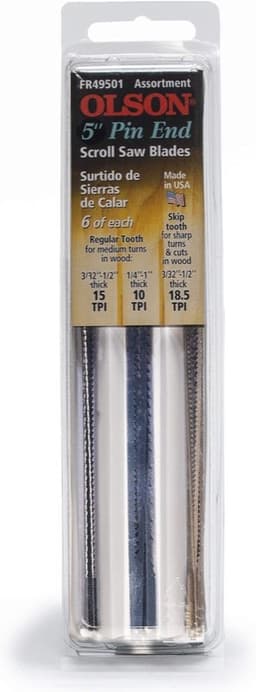
The Lumberjack SS558V seats a pin in the V-notch and a plain end with the locking handle. Do not mix those actions. Release the tension first so you are not bending the blade into the arms. Seat the lower end, then the upper end, with the teeth still pointing down. A pin should sit fully in the notch. With the saw still unplugged, pull the blade lightly and see whether the pin stays put. Olson reviews include pins that came off on the first fit, and VooGenzek reviews include pins that snap. Those are buyer reports, not a failure rate. Which end to buy is on pin or plain end scroll saw blades.

Tension until it stops flopping

There is no single UK tension number. Woodworkers Institute describes about 1–2 mm of flex, then a square check in scrap. Too much tension on a fine plain-end number 2 or 3 snaps it. Too little on a number 5 to 7 lets it wander. Those are plain-end sizes, not “10 / 18 teeth” on a pinned pack. Olson’s guide limits an Olson blade to 1/8 inch of movement at the centre. That figure is not for VooGenzek or TXErfolg. Then cut scrap of the same thickness. If the length was wrong, use the scroll saw blades buying guide.

When a new blade still misbehaves

If it still wanders, change one cause and cut scrap again. Too little tension lets the blade leave the line. A 3 mm pinned blade, where VooGenzek and TXErfolg print that width, cannot turn like a narrow plain end. Teeth the wrong way lift the work. HSE notes that blunt tools make more dust when the saw is work equipment. A pin that has left the steel is a finished blade. A finer TPI will not put it back. Pitch and width are on scroll saw blade TPI. If the guard is missing, or you are not the appointed user of work equipment, stop.

Common questions

Which way do the teeth face?
Toward the table, on Einhell’s TC-SS 405 E instructions, so the blade cuts on the downstroke and holds the work down. An upside-down blade lifts the wood and leaves dust on the top face. Unplug before you turn it. A UK review of an Xcalibur pack describes the teeth set downwards. Your own manual wins if it disagrees, and the Einhell sentence is the named UK instruction in this set.
How do I seat a pin-end blade?
Release the tension, set the teeth toward the table, and drop each pin fully into the V-notch, as the Lumberjack SS558V manual describes for a pin. The pin should not perch on the rim. With the saw still unplugged, give the blade a light pull and check that the pin stays in. Reviews in this set include pins that come off on first fit, so watch that first seating before you start the motor.
How do I clamp a plain end?
Use the locking handle or clamp, not the pin notch. On the Lumberjack SS558V the plain end is held by the locking handle while a pin uses the V-notch. A pin-only saw will not hold a plain shank. Seat the shank square in the jaw so it cannot walk out, then tension. If the title said plain and the blade in your hand has pins, you have the wrong end for this step.
How tight is tight enough?
Tight enough that the blade does not flop, and no tighter than the rule for that blade. Woodworkers Institute describes about 1–2 mm of flex. Olson’s guide says the centre of an Olson blade should not move more than 1/8 inch front to back under reasonable force. Those are two published rules, not one official UK figure. Check with a short cut in scrap of the same thickness. A fine plain-end blade snaps if you over-tighten it.
What if the pins pull out of the blade?
That blade is done. Reseating a pin that has left the steel does not restore it, and some Olson and VooGenzek reviews describe exactly that. Fit another blade from the pack and watch the notch as you tension. If several pins fail in the same session, check that you are using the pin holder rather than clamping the pin, and that the saw’s holders are not worn. A new brand does not repair a damaged clamp.

Related pages

Sources

Public UK sources used for this comparison. Shelf prices are amazon.co.uk listings from 19 October 2026.

  1. HSE: PUWER overview (retrieved 20.10.2026)
  2. HSE: Safe use of woodworking machinery (L114) (retrieved 20.10.2026)
  3. HSE: Wood dust (retrieved 20.10.2026)
  4. HSE WD0: Wood dust – controlling the risks (retrieved 20.10.2026)
  5. Einhell TC-SS 405 E manual (retrieved 20.10.2026)
  6. Lumberjack SS558V manual (retrieved 20.10.2026)
  7. Olson scroll saw blade chart (retrieved 20.10.2026)
  8. Consumer Rights Act 2015 (retrieved 20.10.2026)